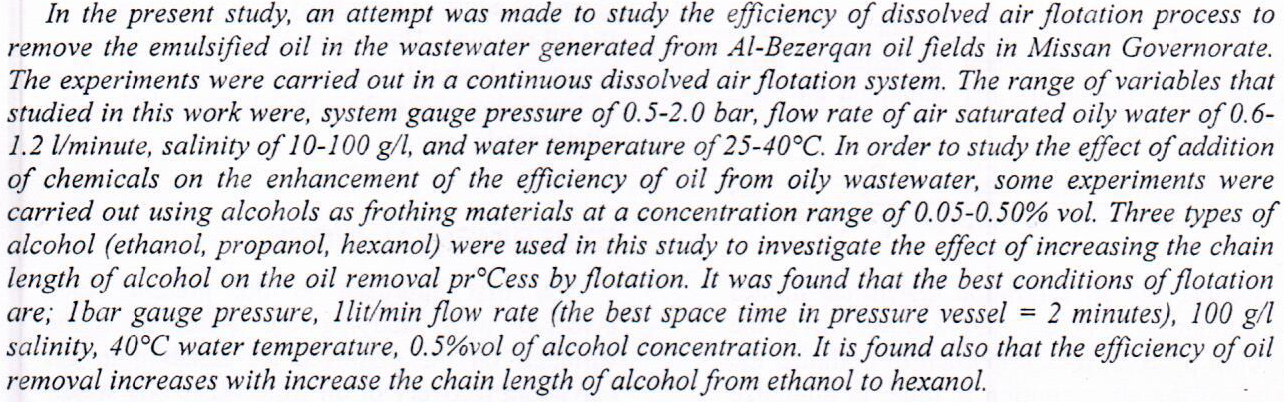
Oil Removal from Wastewater of Al-Bezerqan Crude Oil Fields by Air Flotation

 (32)
(32)
 (30)
(30)



This study seeks to address the impact of marketing knowledge dimensions (product, price, promotion, distribution) on the organizational performance in relation to a number of variables which are (efficiency, effectiveness, market share, customer satisfaction), and seeks to reveal the role of marketing knowledge in organizational performance.
In order to achieve the objective of the study the researcher has adopted a hypothetical model that reflects the logical relationships between the variables of the study. In order to reveal the nature of these relationships, several hypotheses have been presented as tentative solutions and this study seeks to verify the validity of these hypotheses.
... Show More
In this paper we generalize Jacobsons results by proving that any integer in is a square-free integer), belong to . All units of are generated by the fundamental unit having the forms
Our generalization build on using the conditions
This leads us to classify the real quadratic fields into the sets Jacobsons results shows that and Sliwa confirm that and are the only real quadratic fields in .
The current work discusses the removal of brilliant dyes. These dyes were Brilliant Cresyl Blue (BCB) and Brilliant Green (BG) by the use of poly acrylic acid hydrogel beads (PAA). We examined the adsorption isotherms and found that the factors preferring it are temperature and salt, shaking effects, wet PAA, (BCB) and (BG) follows Freundlich equation more than other equations. Based on the results, there is a positive correlation between adsorption of dyes (BCB and BG) and temperature (Endothermic process). We calculated the thermodynamic functions (ΔG, ΔS, and ΔH). The ion strength effects on the adsorptions at (20 °C) increased adsorption if the salt concentrations is high. We treated the kinetics outcomes based on Lagergren Equation
... Show More
(1)
Introduction: The current study investigated the use of acid-treated rice husks to remove heavy metals and organic pollutants from water containing heavy metals (R2C and Cd2) and organic pollutants (phenol and atrazine). Methods: The adsorption effect of acid-treated rice husks was compared with other adsorbents such as activated carbon, chitosan, and bentonite clay. Result: both acid-treated rice husks and activated carbon were highly efficient materials, and thus, rice husks were established as a cost-effective alternative. It was revealed that acid treatment of rice husks enhanced adsorption capacity by half, and lead removal was nearly doubled. The most effective pH value for optimizing organic pollutants and heavy metals while
... Show More
(2)
(2)
The research seeks to identify the image of foreign oil companies operating in Iraq among the public of Basra, and the research aims to clarify the mental image of foreign oil companies among the Iraqi public, and to identify the extent to which the Iraqi public benefit from the social responsibility programs offered by foreign oil companies and their contribution to improving the standard of living and services for the population. Nearby areas and society as a whole, the research is classified within descriptive research, and the researcher used the survey method for the Iraqi public in Basra governorate, which includes the areas in which these companies are located, and he used the scale tool to find out, so he distributed 600 que
... Show MoreThe research mainly seeks to predict the amounts of non- oil Iraqi exports which concludes ) Food & Animals , Raw materials and non- tanned Leather and fur , Mineral fuels and Lubricating Oil , Chemical substances and amounts , Manufactured goods , Electrical and non - electrical machines , Supplies and Total non- Oil exports ) by using Markov Chain as one of Statistical approach to forecasting in future . In this search We estimate the transliteration probabilities matrix according to Maximum Likelihood on a data collected from central organization for Statistics and information technology represents an index numbers of non- Oil exports amount in Iraq from 2004 to 2015 depending on 2007 as a basic year . Results shown that trend of index
... Show MoreA Laboratory study was conducted in quality control department ,state company for food stuff trading ministry of trade (2005-2006) on sunflower oil imported to Iraq from different origins included 12 trade marks, Complete random design was used with four replication .The purpose of the study is to know the origins effect on fatty acid percent and study the simple correlation between them, the result showed Turkish origin for trademark (Narin) was superior in Palmitic and Stearic fatty acid (10.41,3.29%).While Omanian origin for trademark Alsafwa was superior in Oleic(35.09%) and Syrian origin for trade mark Alnahraen was superior in Linoleic fatty acid percent 66.53% whereas Egyptian origin for trademark Alasel was superior in the percent
... Show More
In oil and gas well cementing, a strong cement sheath is wanted to insure long-term safety of the wells. Successful completion of cementing job has become more complex, as drilling is being done in highly deviated and high pressure-high temperature wells. Use of nano materials in enhanced oil recovery, drilling fluid, oil well cementing and other applications is being investigated. This study is an attempt to investigate the effect of nano materials on oil well cement properties. Two types of nano materials were investigated, which are Nano silica (>40 nm) and Nano Alumina (80 nm) and high sulfate-resistant glass G cement is used. The investigated properties of oil well cement included compressive strength, thickening
... Show More