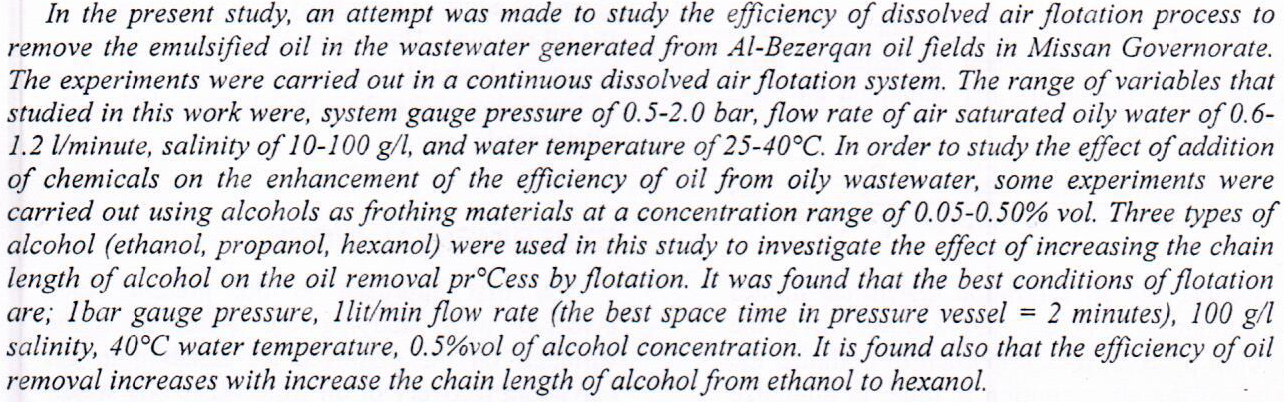
Oil Removal from Wastewater of Al-Bezerqan Crude Oil Fields by Air Flotation

Visualization of subsurface geology is mainly considered as the framework of the required structure to provide distribution of petrophysical properties. The geological model helps to understand the behavior of the fluid flow in the porous media that is affected by heterogeneity of the reservoir and helps in calculating the initial oil in place as well as selecting accurate new well location. In this study, a geological model is built for Qaiyarah field, tertiary reservoir, relying on well data from 48 wells, including the location of wells, formation tops and contour map. The structural model is constructed for the tertiary reservoir, which is an asymmetrical anticline consisting of two domes separated by a saddle. It is found that
... Show More
The aim of this study is interpretation well logs to determine Petrophysical properties of tertiary reservoir in Khabaz oil field using IP software (V.3.5). The study consisted of seven wells which distributed in Khabaz oilfield. Tertiary reservoir composed from mainly several reservoir units. These units are : Jeribe, Unit (A), Unit (A'), Unit (B), Unit (BE), Unit (E),the Unit (B) considers best reservoir unit because it has good Petrophysical properties (low water saturation and high porous media ) with high existence of hydrocarbon in this unit. Several well logging tools such as Neutron, Density, and Sonic log were used to identify total porosity, secondary porosity, and effective porosity in tertiary reservoir. For
... Show More (4)
(4)
This research is a continued efforts for a project on the fire tube boiler control for Al Rasheed edible oil factory. The aim is to enhance the control system with new integral control one. A functional blocks diagram (FBD) was built and simulated. With Schneider smart relays, FBD differs than ladder logic programming in which the PID option is active. An extensive work was done to understand the operation sequence, emergency shutdown, and faults causing the trips. A control program was designed to control logical sequence of operation. Furthermore temperature is controlled via cascade control with fuel and air controllers. The temperature controller output is send as remote set point to the fuel controller in a serial cascade manner. The f
... Show More
The Sadi reservoir is one of the largest and most important unconventional tight oil reservoirs in southern Iraq. However, it suffers from low production rates, necessitating many development strategies that require a correct and reliable characterization of reservoir fluid properties. Whilst these properties are originally obtained from laboratory experiments, measurement errors often occur despite rigorous workflows, which negatively affect the calculation of reservoir fluid properties. This study utilizes the fluid thermodynamics characterization program (PVTp) to generate a reliable model for determining the oil properties of Sadi reservoir. A methodology was developed to simulate fluid thermodynamic tests, including Differ
... Show More
The growing demand for sustainable and high-performance asphalt binders has prompted the exploration of waste-derived modifiers. This study investigates the performance enhancement of Natural Asphalt (NA) using Sugarcane Molasses (SM) and Waste Engine Oil (WEO). The modified blends were prepared by partially replacing 50 % NA with varying proportions of SM and WEO ranging from 10 % to 40 % of the total weight of NA. Comprehensive testing was conducted, including penetration, softening point, ductility, viscosity, Bending Beam Rheometer (BBR), Multiple Stress Creep Recovery (MSCR), Energy Dispersive X-ray Spectroscopy (EDX), Fourier Transform Infrared (FTIR) spectroscopy, and Scanning Electron Microscopy (SEM). The results demonstrated that
... Show More (5)
(3)
(5)
(3)

The possibility of using zero-valent iron as permeable reactive barrier in removing lead from a contaminated groundwater was investigated. In the batch tests, the effects of many parameters such as contact time between adsorbate and adsorbent (0-240 min), initial pH of the solution (4-8), sorbent dosage (1-12 g/100 mL), initial metal concentration (50-250 mg/L), and agitation speed
(0-250 rpm) were studied. The results proved that the best values of these parameters achieve the maximum removal efficiency of Pb+2 (=97%) were 2 hr, 5, 5 g/100 mL, 50 mg/L and 200 rpm respectively. The sorption data of Pb+2 ions on the zero-valent iron have been performed well by Langmuir isotherm model in compared with Freundlich model under the studied
(5)
In the present study, a low cost adsorbent is developed from the naturally available sawdust
which is biodegradable. The removal capacity of chromium(VI) from the synthetically prepared
industrial effluent of electroplating and tannery industrial is obtained.
Two modes of operation are used, batch mode and fixed bed mode. In batch experiment the
effect of Sawdust dose (4- 24g/L) with constant initial chromium(VI) concentration of 50 mg/L and
constant particle size less than1.8 mm were studied.
Batch kinetics experiments showed that the adsorption rate of chromium(VI) ion by Sawdust
was rapid and reached equilibrium within 120 min. The three models (Freundlich, Langmuir and
Freundlich-Langmuir) were fitted to exper
(1)
An investigation was conducted for dewaxing of lubricating oil fraction by urea to reduce the pour point.In this study mixture of 45 % methyl ethyl ketone (MEK) and 55 % toluene was used as a solvent. The studied variables are mixing time (10-70 min), solvent to oil volume ratio (0.5:1- 2:1), urea to wax weight ratio (2- 6) and constant mixing speed 1500 rpm. By analysis of the experimental results, the best operating conditions achieved are mixing time 40 min, solvent/oil 2:1 volume ratio, and urea/wax 4:1 weight ratio. At these conditions the pour point of the lubricating oil decreases from 24 ° C to -13 °C.
Background. Bone healing is a complex and dynamic process that represents a well-orchestrated series of biological events of cellular recruitment, proliferation, and differentiation. The use of medicinal plants in bone healing has attracted increasing interest because of their lower side effects. Punica granatum seed oil (PSO) contains high levels of phenolic compounds, promotes osteoblast function, and plays an important role in bone remodeling. A gelatin sponge (Spongostan) is a hemostatic agent that is extensively applied as scaffolds in engineering and as drug carriers in the medical field. This study aimed to evaluate the effectiveness of PSO for bone healing enhancement. Twenty adult male New Zealand rabbits, weighing an avera
... Show More
(10)