Oil Removal from Wastewater of Al-Bezerqan Crude Oil Fields by Air Flotation
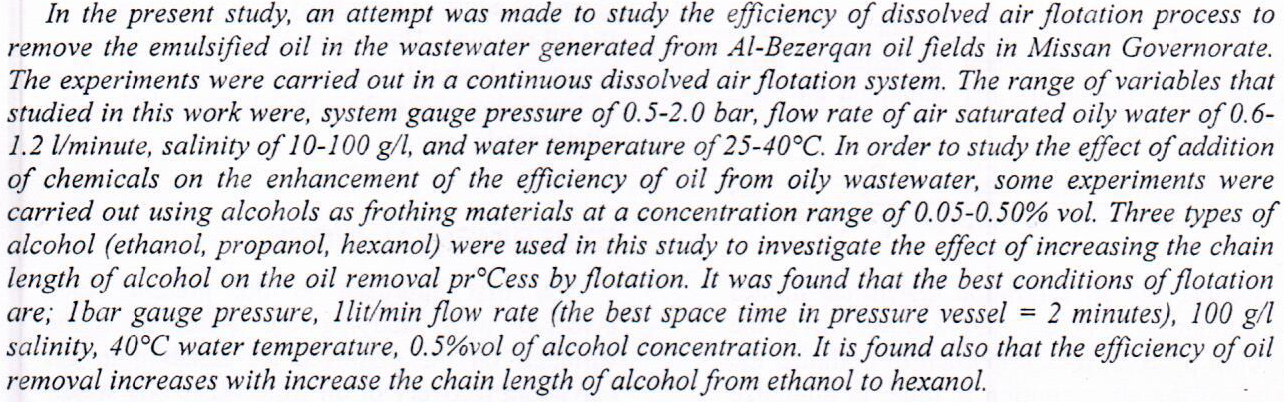

Two different oxidative desulfurization strategies based on oxidation/adsorption or oxidation/extraction were evaluated for the desulfurization of AL-Ahdab (AHD) sour crude oil (3.9wt% sulfur content). In the oxidation process, a homogenous oxidizing agent comprising of hydrogen peroxide and formic acid was used. Activated carbons were used as sorbent/catalyst in the oxidation/adsorption process while acetonitrile was used as an extraction solvent in the oxidation/extraction process. For the oxidation/adsorption scheme, the experimental results indicated that the oxidation desulfurization efficiency was enhanced on using activated carbon as catalyst/sorbent. The effects of the operating conditions (contact time, temperat
... Show More (5)
(5)
 (4)
(4)



The viscosity of crude oil has a crucial role in drag reduction during pipeline transportation; hence additives are required to enhancing the flow properties of AL-Ahdab crude oil. In this work, the potato starch biopolymer and CTAB surfactant are utilized to achieve the target. The drag reduction experiments were carried out at different crude oil flow rates (20-35-50 liters/min), pipe diameters (0.5-0.75 -1 inch), and different concentrations of potato starch (500-2000 ppm) and CTAB (100-500 ppm). The results showed that these additives had minimized flow resistance in various operating conditions, the drag reduction percent increased with increasing of additives concentration increase. The maximum drag reduction achieved using CT
... Show More
In this paper, split-plate airlift electrochemical reactor as an apparatus with new configuration for wastewater treatment was provided. Two aluminum plates were fixed inside the reactor and present two functions; first it works as split plates for internal loop generation of the airlift system (the zone between the two plates acts as riser while the other two zones act as downcomer) and second it works as two electrodes for electrocoagulation process. Simulated wastewater contaminated with zinc ions was used to test the performance of this apparatus for zinc removal by studying the effect of different experimental variables such as initial concentration of zinc (50-800 ppm), electrical current density (2.67-21.4 mA/cm2), init
... Show MoreThe high viscosity of heavy oil is a crucial factor that strongly affects its up-stream recovering, down-stream surface transporting and refining processes. Economical methods for recovering the heavy oil and reducing is very important and related to capital and/or operating cost. This research studies the treatment of Iraqi heavy crude oil, which characterize with high viscosity and low API which makes transportation of heavy crude oil a difficult mission, needs for treatment to reduce viscosity for facilitating transportation and processing. Iraqi heavy crude oil was used Sharqi Baghdad, which obtained from Baghdad east oil fields with API 22.2º.Many kinds of additives were used to reduce the viscosity, experiments were performed o
... Show More
(4)
Naturally occurring radioactive materials (NORM) contaminated sites at Al-Rumaila Iraqi oil fields have been characterized as a part of soil remediation project. Activity of radium isotopes in contaminated soil have been determined using gamma spectrometer High Purity Germanium detector (HPGe) and found to be very high for Al-Markezia, Al-Qurainat degassing stations and storage area at Khadhir Almay region. The activity concentration of samples ranges from 6474.11±563.8 Bq/kg to 1232.5±60.9 Bq/kg with mean value of 3853.3 Bq/kg for 226Ra, 843.59±8.39 Bq/kg to 302.2±9.2 Bq/kg with mean value of 572.9 Bq/kg for 232Th and 294.31±18.56 Bq/kg to 156.64±18.1 Bq/kg with mean value of 225.5 for 40K. S
... Show MoreIn the present study, advanced oxidation process / heterogeneous photocatalytic process (UV/TiO2/Fenton) system was investigated to the treatment of oily wastewater. The present study was conducted to evaluate the effect of hydrogen peroxide concentration H2O2, initial amount of the iron catalyst Fe+2, pH, temperature, amount of TiO2 and the concentration of oil in the wastewater. The removal efficiency for the system UV/TiO2/Fenton at optimal conditions and dosage (H2O2 = 400mg/L, Fe+2 = 40mg/L, pH=5, temperature =30oC, TiO2=75mg/L) for 1000mg/L load was found to be 77%.
Aluminum foil cover around the re
... Show More
(13)
(12)

