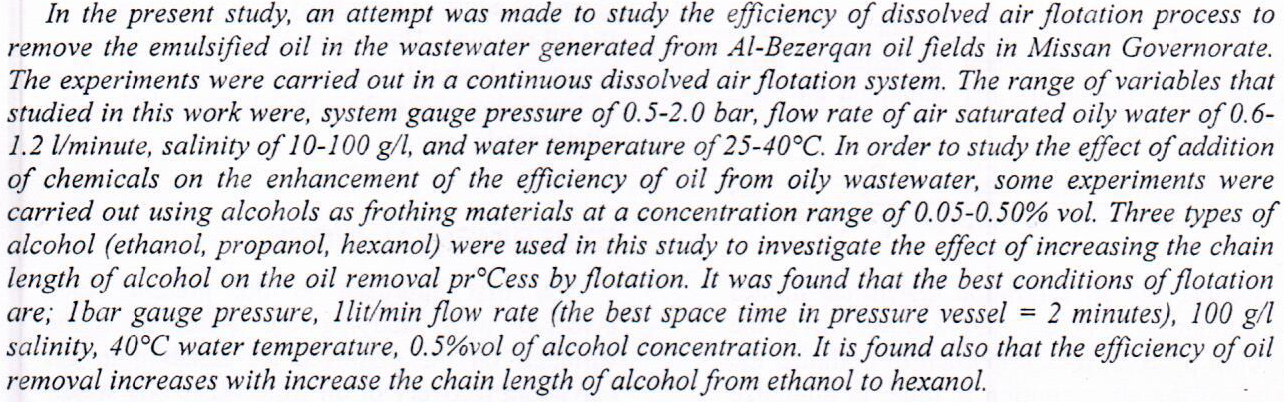
Oil Removal from Wastewater of Al-Bezerqan Crude Oil Fields by Air Flotation

In this research, we discussed and analyzed the relationship between oil prices and the U.S. dollar exchange rate in Iraq. The study adopted the descriptive analysis and econometrics analysis. The descriptive analysis refers to the rise (fall) in crude oil price lead to appreciate (depreciate) in the Iraqi dinar exchange rate, though the channel of the international reserves. The econometrics analysis is based on monthly data covered the period (December/2002 – December/2011), the unit root test, co-integration test, vector error correction model, and Granger causality test have been adopted in this research to check the existence and direction of this relationship. The results refer to the lon
... Show More
The Fauqi field is located about 50Km North-East Amara town in Missan providence in Iraq. Fauqi field has 1,640 MMbbl STOIIP, which lies partly in Iran. Oil is produced from both Mishrif and Asmari zones. Geologically, the Fauqi anticline straddles the Iraqi/Iranian border and is most probably segmented by several faults. There are several reasons leading to drilling horizontal wells rather than vertical wells. The most important parameter is increasing oil recovery, particularly from thin or tight reservoir permeability. The Fauqi oil field is regarded as a giant field with approximately more than 1 billion barrels of proven reserves, but it has recently experienced low production rate problems in many of its existing wells. This study
... Show More
The petroleum industry, which is one of the pillars of the national economy, has the potential to generate vast wealth and employment possibilities. The transportation of petroleum products is complicated and changeable because of the hazards caused by the corrosion consequences. Hazardous chemical leaks caused by natural disasters may harm the environment, resulting in significant economic losses. It significantly threatens the aim for sustainable development. When a result, determining the likelihood of leakage and the potential for environmental harm, it becomes a top priority for decision-makers as they develop maintenance plans. This study aims to provide an in-depth understanding of the risks associated with oil and gas pipeli
... Show More (4)
(4)
Natural gas and oil are one of the mainstays of the global economy. However, many issues surround the pipelines that transport these resources, including aging infrastructure, environmental impacts, and vulnerability to sabotage operations. Such issues can result in leakages in these pipelines, requiring significant effort to detect and pinpoint their locations. The objective of this project is to develop and implement a method for detecting oil spills caused by leaking oil pipelines using aerial images captured by a drone equipped with a Raspberry Pi 4. Using the message queuing telemetry transport Internet of Things (MQTT IoT) protocol, the acquired images and the global positioning system (GPS) coordinates of the images' acquisition are
... Show More (15)
(7)
(15)
(7)
 (33)
(38)
(33)
(38)

Drilling operations in the Halfaya oilfield frequently encounter severe wellbore instability challenges. When navigating shale deposits, wellbore instability remains the primary operational concern. Based on the analysis of the wellbore instability intervals, low-strength shale and marlstone formations are identified as the principal unstable zones that lead to non-productive time and higher drilling costs. By planning a safe operating mud window, these non-productive times and drilling costs can be mitigated. Several wellbore instability concerns have been found in a southern Iraqi oil field. A problem-diagnostic technique was done by evaluating well log data, drilling reports, mud logging reports, and pore pressure readings.
... Show More
The present study aims to establish an empirical correlation between biochemical oxygen demand (BOD5) and chemical oxygen demand (COD) of the sewage flowing in Al-Diwaniyah wastewater treatment plant. The strength of the wastewater entering the plant varied from medium to high. High concentrations of BOD5 and COD in the effluent were obtained due to the poor performance of the plant. This was observed from the BOD5 /COD ratios that did not confirm with the typical ratios for the treated sewage. Regression equations for BOD5 and COD removal percentages were suggested which can be used to evaluate rapid effluent assessment after the treatment processes or optimal process control to improve the performance of wastewater treatment plants.
... Show MoreThe present work is to investigate the feasibility of removal vanadium (V) and nickel (Ni) from Iraqi heavy gas oil using activated bentonite. Different operating parameters such as the degree of bentonite activation, activated bentonite loading, and operating time was investigated on the effect of heavy metal removal efficiency. Experimental results of adsorption test show that Langmuir isotherm predicts well the experimental data and the maximum bentonite uptake of vanadium was 30 mg/g. The bentonite activated with 50 wt% H2SO4 shows a (75%) removal for both Ni and V. Results indicated that within approximately 5 hrs, the vanadium removal efficiencies were 33, 45, and 60% at vanadium loadings of 1
... Show More
(1)
The Electro-Fenton oxidation process is one of the essential advanced electrochemical oxidation processes used to treat Phenol and its derivatives in wastewater. The Electro-Fenton oxidation process was carried out at an ambient temperature at different current density (2, 4, 6, 8 mA/cm2) for up to 6 h. Sodium Sulfate at a concentration of 0.05M was used as a supporting electrolyte, and 0.4 mM of Ferrous ion concentration (Fe2+) was used as a catalyst. The electrolyte cell consists of graphite modified by an electrodepositing layer of PbO2 on its surface as anode and carbon fiber modified with Graphene as a cathode. The results indicated that Phenol concentration decreases with an increase in current dens
... Show More
(15)
This paper presents an efficient methodology to design modified evaporative air-cooler for winter air-conditioning in Baghdad city as well as using it for summer air-conditioning by adding a heating process after the humidification process. laboratory tests were performed on a direct evaporative cooler (DEC) followed by passing the air on hot water through heat exchanger placed in the coolers air duct exit. The tests were conducted on the 2nd of December /2011 when the ambient temperature was 8.1°C and the relative humidity was (68%). The air flow rate is assumed to vary between 0.069 to 0.209 kg/s with constant water flow rate of 0.03 kg/s in the heat exchanger. The performance is reported in terms of effectiveness of DEC, satura
... Show More