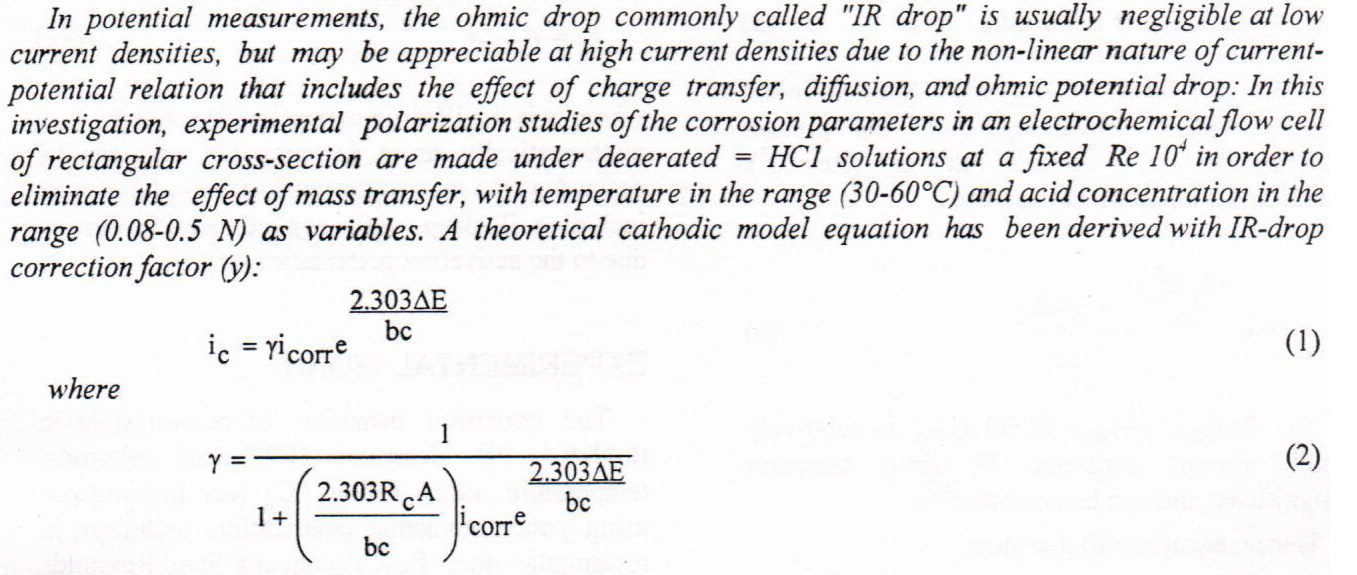
Determination of Corrosion Parameters for a Cathodic Reaction Complicated by IR Drop Effect in a Flow System

For modeling a photovoltaic module, it is necessary to calculate the basic parameters which control the current-voltage characteristic curves, that is not provided by the manufacturer. Generally, for mono crystalline silicon module, the shunt resistance is generally high, and it is neglected in this model. In this study, three methods are presented for four parameters model. Explicit simplified method based on an analytical solution, slope method based on manufacturer data, and iterative method based on a numerical resolution. The results obtained for these methods were compared with experimental measured data. The iterative method was more accurate than the other two methods but more complexity. The average deviation of
... Show More (58)
(58)
 (24)
(24)



A comparison between the resistance capacity of a single pile excited by two opposite rotary machines embedded in dry and saturated sandy soil was considered experimentally. A small-scale physical model was manufactured to accomplish the experimental work in the laboratory. The physical model consists of: two small motors supplied with eccentric mass 0·012 kg and eccentric distance 20 mm representing the two opposite rotary machines, an aluminum shaft with 20 mm in diameter as the pile, and a steel plate with dimensions of (160 × 160 × 20 mm) as a pile cap. The experimental work was achieved taking the following parameters into consideration, pile embedment depth ratio (L/d; length to diameter) and operating freq
... Show More
(15)
(16)
This paper presents the implementation of a complex fractional order proportional integral derivative (CPID) and a real fractional order PID (RPID) controllers. The analysis and design of both controllers were carried out in a previous work done by the author, where the design specifications were classified into easy (case 1) and hard (case 2) design specifications. The main contribution of this paper is combining CRONE approximation and linear phase CRONE approximation to implement the CPID controller. The designed controllers-RPID and CPID-are implemented to control flowing water with low pressure circuit, which is a first order plus dead time system. Simulation results demonstrate that while the implemented RPID controller fails to stabi
... Show More
(25)
(17)
The economical and highly performed anode material is the critical factor affecting the efficiency of electro-oxidation toward organics. The present study aimed to detect the best conditions to prepare Mn-Co oxide composite anode for the electro-oxidation of phenol. Deposition of Mn-Co oxide onto graphite substrate was investigated at 25, 30, and 35 mA/cm2 to detect the best conditions for deposition. The structure and the crystal size of the Mn-Co oxide composite electrode were examined by using an X-Ray diffractometer (XRD), the morphological properties of the prepared electrode were studied by scanning electron microscopy (SEM) and Atomic force microscopy (AFM) techniques, and the chemical composition of the various
... Show More
Atenolol was used with ammonium molybdate to prove the efficiency, reliability and repeatability of the long distance chasing photometer (NAG-ADF-300-2) using continuous flow injection analysis. The method is based on reaction between atenolol and ammonium molybdate in an aqueous medium to obtain a dark brown precipitate. Optimum parameters was studied to increase the sensitivity for developed method. A linear range for calibration graph was 0.1-3.5 mmol/L for cell A and 0.3-3.5 mmol/L for cell B, and LOD 133.1680 ng/100 µL and 532.6720 ng/100 µL for cell A and cell B respectively with correlation coefficient (r) 0.9910 for cell A and 0.9901 for cell B, RSD% was lower than 1%, (n=8) for the determination of ate
... Show More
(9)
(4)
The objective of an Optimal Power Flow (OPF) algorithm is to find steady state operation point which minimizes generation cost, loss etc. while maintaining an acceptable system performance in terms of limits on generators real and reactive powers, line flow limits etc. The OPF solution includes an objective function. A common objective function concerns the active power generation cost. A Linear programming method is proposed to solve the OPF problem. The Linear Programming (LP) approach transforms the nonlinear optimization problem into an iterative algorithm that in each iteration solves a linear optimization problem resulting from linearization both the objective function and constrains. A computer program, written in MATLAB environme
... Show More
(2)
This research aims to present a proposed model for disclosure and documentation when performing the audit according to the joint audit method by using the questions and principles of the collective intelligence system, which leads to improving and enhancing the efficiency of the joint audit, and thus enhancing the confidence of the parties concerned in the outputs of the audit process. As the research problem can be formulated through the following question: “Does the proposed model for disclosure of the role of the collective intelligence system contribute to improving joint auditing?”
The proposed model is designed for the disclosure of joint auditing and the role
... Show More