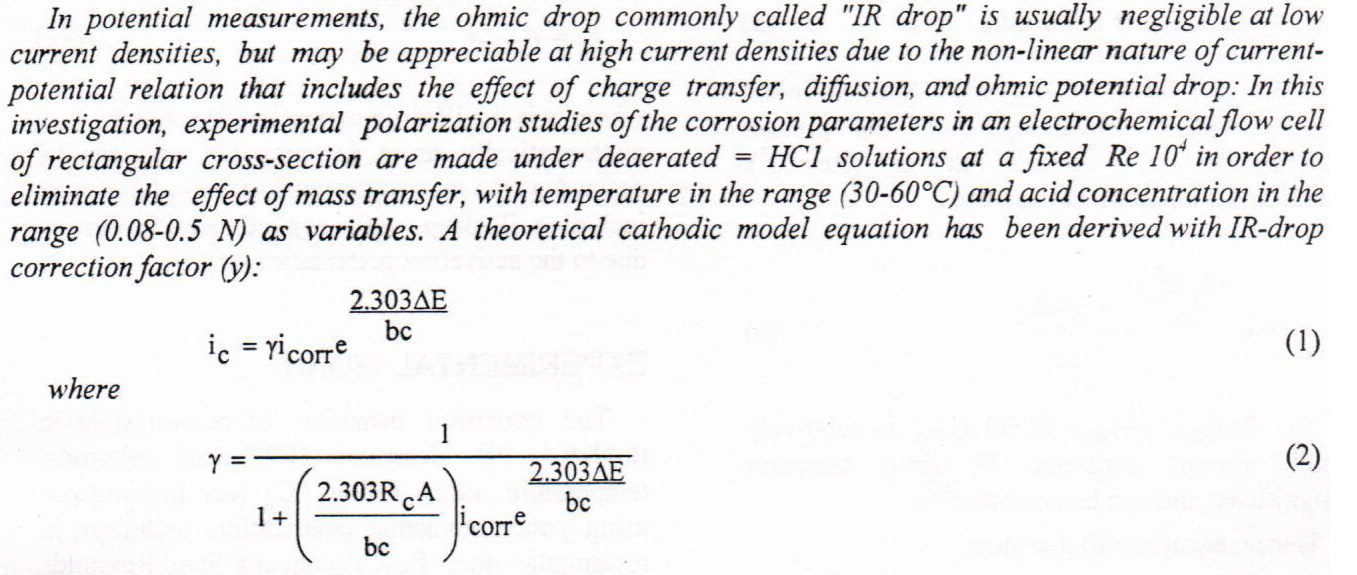
Determination of Corrosion Parameters for a Cathodic Reaction Complicated by IR Drop Effect in a Flow System

The inhibitive action of Reactive Red (RR31) dye against corrosion of carbon steel in 1M acetic acid solution has been studied using gravimetric method at temperature ranged (288-318)K. The antibacterial activity for the different concentrations of RR31 dye against different bacterial species was studied. The experimental data indicates that this dye acts as a potential inhibitor for carbon-steel in acetic acid medium and the protection efficiency increase with increasing (RR31) dye. The adsorption of (RR31) dye on the carbon steel surface was found to follow Langmuir adsorption isotherm. Thermodynamic data for the adsorption process such as Gibbs free energy change ∆Gads, enthalpy change ∆Hads, and entropy change ∆Sads were estima
... Show MoreThis study investigated a novel application of forward osmosis (FO) for oilfield produced water treatment from the East Baghdad oilfield affiliated to the Midland Oil Company (Iraq). FO is a part of a zero liquid discharge system that consists of oil skimming, coagulation/flocculation, forward osmosis, and crystallization. Treatment of oilfield produced water requires systems that use a sustainable driving force to treat high-ionic-strength wastewater and have the ability to separate a wide range of contaminants. The laboratory-scale system was used to evaluate the performance of a cellulose triacetate hollow fiber CTA-HF membrane for the FO process. In this work, sodium chloride solution was used as a feed solution (FS) with a concentratio
... Show MoreA Multiple System Biometric System Based on ECG Data
 (1)
(1)

A simple, accurate and rapid method for separation and determination of most commonly usedinsecticides in Iraq [thiamethoxam (Thi), imidacloprid (Imi), indoxacarb (Ind), and abamectin (Aba)] ispresented. The separation was performed by gradient reversed-phase high performance liquidchromatography on a C18 stationary phase column. The method was developed and validated. The-1mobile phase was a mixture of acetonitrile and water using gradient flow. The flow rate was 1.0 mL min .The optimum temperature of separation was 25 ºC. The detection was performed at multiple wavelengths.The analysis time was up to 10.5 minutes with retention times of 3.221, 3.854, 6.385, and 9.452 min for-1the studied insecticides. The linearity was in the range of 0.
... Show MorePlanning of cities show great attention on streets planning as one of the most structural component foundations for cities, that providing many functional needs and connect parts of the city each other, and work as a commercial and services activities centers. Instead of this highly focused on distributing streets with different streets types such as economical and trading and housing streets. This concerned was only on the dimensions and scales of different types of vehicles and their movement. When scale and dimension and movement of mans were as a second priority in designing and planning streets. Which came's first for traditional streets. The research try to submit some designs guides for planners that contribute in re conce
... Show MoreA simple, low cost and rapid flow injection turbidimetric method was developed and validated for mebeverine hydrochloride (MBH) determination in pharmaceutical preparations. The developed method is based on forming of a white, turbid ion-pair product as a result of a reaction between the MBH and sodium persulfate in a closed flow injection system where the sodium persulfate is used as precipitation reagent. The turbidity of the formed complex was measured at the detection angle of 180° (attenuated detection) using NAG dual&Solo (0-180°) detector which contained dual detections zones (i.e., measuring cells 1 & 2). The increase in the turbidity of the complex was directly proportional to the increase of the MBH concentration
... Show More
(19)
 (13)
(13)


A simple, low cost and rapid flow injection turbidimetric method was developed and validated for mebeverine hydrochloride (MBH) determination in pharmaceutical preparations. The developed method is based on forming of a white, turbid ion-pair product as a result of a reaction between the MBH and sodium persulfate in a closed flow injection system where the sodium persulfate is used as precipitation reagent. The turbidity of the formed complex was measured at the detection angle of 180° (attenuated detection) using NAG dual&Solo (0-180°) detector which contained dual detections zones (i.e., measuring cells 1 & 2). The increase in the turbidity of the complex was directly proportional to the increase of the MBH concentration
... Show More
(19)
(13)
In this work, a numerical study is performed to predict the solution of two – dimensional, steady and laminar mixed convection flow over a square cylinder placed symmetrically in a vertical parallel plate. A finite difference method is employed to solve the governing differential equations, continuity, momentum, and energy equation balances. The solution is obtained for stream function, vorticity and temperature as dependent variables by iterative technique known as successive over relaxation. The flow and temperature patterns are obtained for Reynolds number and Grashof number at (Re= -50,50,100,-100) (positive or negative value refers to aidding or opposing buoyancy , +1 assisting flow, -1 opposing flow) and (102 to 105) , respective
... Show MoreWater flow into unsaturated porous media is governed by the Richards’ partial differential equation expressing the mass conservation and Darcy’s laws. The Richards’ equation may be written in three forms,where the dependent variable is pressure head or moisture content, and the constitutive relationships between water content and pressure head allow for conversion of one form into the other. In the present paper, the “moisture-based" form of Richards’ equation is linearized by applying Kirchhoff’s transformation, which
combines the soil water diffusivity and soil water content. Then the similarity method is used to obtain the analytical solution of wetting front position. This exact solution is obtained by means of Lie’s
(2)
In this research, a study is introduced on the effect of several environmental factors on the performance of an already constructed quality inspection system, which was designed using a transfer learning approach based on convolutional neural networks. The system comprised two sets of layers, transferred layers set from an already trained model (DenseNet121) and a custom classification layers set. It was designed to discriminate between damaged and undamaged helical gears according to the configuration of the gear regardless to its dimensions, and the model showed good performance discriminating between the two products at ideal conditions of high-resolution images. So, this study aimed at testing the system performance at poo
... Show More
(1)
(1)