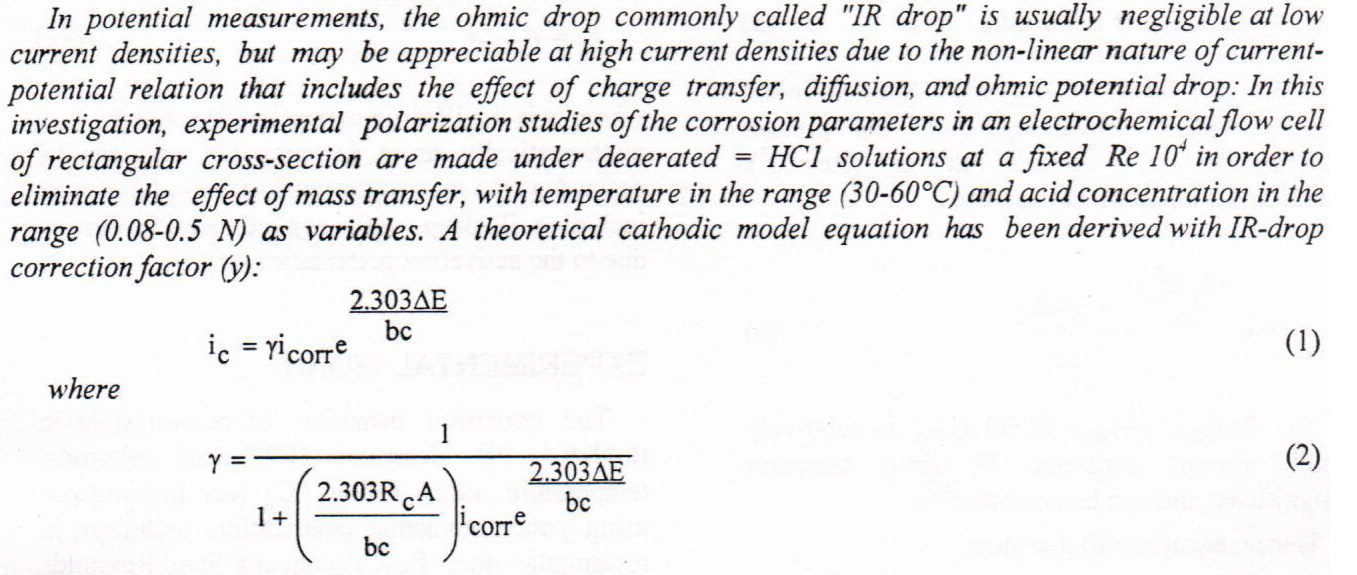
Determination of Corrosion Parameters for a Cathodic Reaction Complicated by IR Drop Effect in a Flow System

In this research, a study is introduced on the effect of several environmental factors on the performance of an already constructed quality inspection system, which was designed using a transfer learning approach based on convolutional neural networks. The system comprised two sets of layers, transferred layers set from an already trained model (DenseNet121) and a custom classification layers set. It was designed to discriminate between damaged and undamaged helical gears according to the configuration of the gear regardless to its dimensions, and the model showed good performance discriminating between the two products at ideal conditions of high-resolution images.
So, this study aimed at testing the system performance at poor s
... Show More (1)
(1)
 (1)
(1)


In current article an easy and selective method is proposed for spectrophotometric estimation of metoclopramide (MCP) in pharmaceutical preparations using cloud point extraction (CPE) procedure. The method involved reaction between MCP with 1-Naphthol in alkali conditions using Triton X-114 to form a stable dark purple dye. The Beer’s law limit in the range 0.34-9 μg mL-1 of MCP with r =0.9959 (n=3) after optimization. The relative standard deviation (RSD) and percentage recoveries were 0.89 %, and (96.99–104.11%) respectively. As well, using surfactant cloud point extraction as a method to extract MCP was reinforced the extinction coefficient(ε) to 1.7333×10⁵L/mol.cm in surfactant-rich phase. The small volume of organi
... Show More
(14)
(4)

This work provides a historical overview of water storage tanks used for solar energy collection, with a focus on the impact of different geometric configurations on thermal performance and energy storage efficiency. The designs of cylindrical, spherical, rectangular and triangular tanks were reviewed to analyse their effects on thermal gradients, heat retention and energy storage capacity. Within the scope of nominal processes, the study primarily aimed to identify the factors influencing the choice of tank shape in terms of size, capacity and aspect ratio. Another key objective was to assess what enhances heat storage in the tank to improve thermal efficiency. Comparing cylindrical shapes to other shapes, such as spherical, rectan
... Show More
Lowering the emission, fuel economy and torque management are the essential
requirements in the recent development in the automobile industry. The main engine control
input that satisfies the above requirements is the throttling angle which adjusts the air mass
flow rate to the engine port. Due to the uncertainty and the presence of the nonlinear
components in its dynamical model, the sliding mode control theory is utilized in this work
for the throttle valve angle control system to design a robust controller for this system in the
presence of a nonlinear spring and Coulomb friction. A continuous sliding mode control law
which consists of a saturation function, instead of a signum function, and the integral of
ano
(2)
This investigation proposed an identification system of offline signature by utilizing rotation compensation depending on the features that were saved in the database. The proposed system contains five principle stages, they are: (1) data acquisition, (2) signature data file loading, (3) signature preprocessing, (4) feature extraction, and (5) feature matching. The feature extraction includes determination of the center point coordinates, and the angle for rotation compensation (θ), implementation of rotation compensation, determination of discriminating features and statistical condition. During this work seven essential collections of features are utilized to acquire the characteristics: (i) density (D), (ii) average (A), (iii) s
... Show More
(1)
This paper proposes a new structure for a Fractional Order Sliding Mode Controller (FOSMC) to control a Twin Rotor Aerodynamic System (TRAS). The new structure is composed by defining two 3-dimensional sliding mode surfaces for the TRAS model and introducing fractional order derivative integral in the state variables as well as in the control action. The parameters of the controller are determined so as to minimize the Integral of Time multiplied by Absolute Error (ITAE) performance index. Through comparison, this controller outperforms its integer counterpart in many specifications, such as reducing the delay time, rise time, percentage overshoot, settling time, time to reach the sliding surface, and amplitude of chattering in control inpu
... Show MoreThe performance of a solar assisted desiccant cooling system for a meeting-hall located in the College of Engineering/University of Baghdad was evaluated theoretically. The system was composed of four components; a solar air heater, a desiccant dehumidifier, a heat exchanger and an evaporative cooler. A computer simulation was developed by using MATLAB to assess the effect of various design and operating conditions on the performance of the system and its components. The actual weather data on recommended days were used to assess the load variation and the system performance during those days. The radiant time series method (RTS) was used to evaluate the hourly variation of the cooling load. Four operation modes were employed for perform
... Show More
(10)
(10)
Background: Because of the disturbance in the pituitary gland, growth hormone (GH) secretion will be increased and, as a result, insulin-like growth factor 1 (IGF-1) secretion will be increase as well, leading to a chronic and rare disease called acromegaly disease. One of the most serious complications of acromycaly is diabetes. Insulin resistance, which causes diabetes, occurs in the body because of increased growth hormone secretion Objective: The aim of this work is to estimate some biochemical parameters. These parameters were not studied extensively in the literature such as BALP and LOX and the possibility of using LOX as a new biomarker for acromyalgic patients with diabetic. Patients and Methods: The study was performed on (25) mal
... Show MoreA mathematical eco-epidemiological model consisting of harvested prey–predator system involving fear and disease in the prey population is formulated and studied. The prey population is supposed to be separated into two groups: susceptible and infected. The susceptible prey grows logistically, whereas the infected prey cannot reproduce and instead competes for the environment’s carrying capacity. Furthermore, the disease is transferred through contact from infected to susceptible individuals, and there is no inherited transmission. The existence, positivity, and boundedness of the model’s solution are discussed. The local stability analysis is carried out. The persistence requirements are established. The global behavior of th
... Show More
(12)
(5)