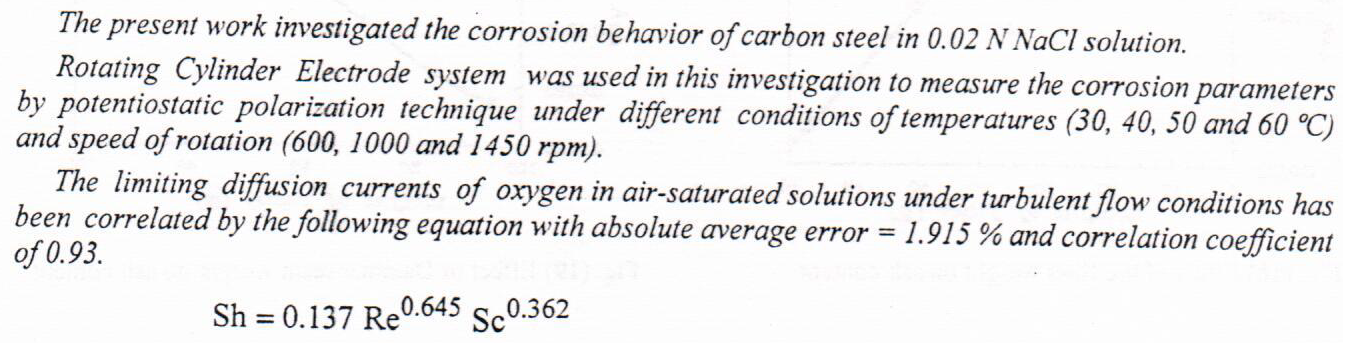
Effect of Velocity and Temperature on Mass Transfer of Oxygen in Corrosion Processes

Photorefractive keratectomy (PRK) is the refractive technique that began with a physical scraping of the epithelial layer of cornea subsequent by laser treatment. Post this procedure to about 48 hours the removed epithelial layer regenerated to protect the eye again. The regeneration process (called re-epithelization) started from the limbus of the cornea toward the central part of it. The re-epithelization mechanism consists of a change in cell density (mitosis) and cell concentration (migration) with a velocity in two directions: radial and tangential. In the present study, an estimation for both radial (responsible for the overlapped layers toward the outward direction of the cornea) and tangential comp
... Show More
Lasers, with their unique characteristics in terms of excellent beam quality, especially directionality and coherency, make them the solution that is key for many processes that require high precision. Lasers have good susceptibility to integrate with automated systems, which provides high flexibility to reach difficult zones. In addition, as a processing tool, a laser can be considered as a contact-free tool of precise tip that became attractive for high precision machining at the micro and nanoscales for different materials. All of the above advantages may be not enough unless the laser technician/engineer has enough knowledge about the mechanism of interaction between the laser light with the processed material. Several sequential phenom
... Show More (1)
(1)
The degradation and mineralization of 4-chlorophenol (4-CP) by advanced oxidation processes (AOPs) was investigated in this work, using both of UV/H2O2 and photo-Fenton UV/H2O2/Fe+3 systems.The reaction was influenced by the input concentration of H2O2, the amount of the iron catalyst, the type of iron salt, the pH and the concentration of 4-CP. A colored solution of benzoquinon can be observed through the first 5 minutes of irradiation time for UV/H2O2 system when low concentration (0.01mol/L) of H2O2 was used. The colored solution of benzoquinon could also be observed through the first 5 minutes for the UV/H2O2/Fe+3 system at high
concentration (100ppm) of 4-CP. The results have shown that adding Fe+3 to the UV/H2O2 system enhanced
(1)
The research aims to measure the relationship and impact of the operations of the knowledge of management of the six dimensions (diagnosis knowledge, define knowledge objectives, knowledge generation, knowledge storage, distribution of knowledge, application of knowledge) in the fiscal performance of the General Authority for taxes of the four dimensions (financial, customers (taxpayers), Operations Interior, learn and grow), the research aims also to the use of computerized programs for training and career development of the Authority that helps to add knowledge workers in the Authority, and to reach an appropriate arrangement for knowledge management processes in the Authority, as well as analysis of the reality of the Authority to get
... Show More
 (20)
(17)
(20)
(17)


The corcosion behoviour of Aluminum bronze in sodium chloride solution has been studied ^tentiostatically at five temperatures in the range 293-313K.The corrosion potential shifted to more negative values with increasing temperature. The corrosion current density increased with increasing temperature. Values of Tal'el slopes and the transfer coefficients indicated hydrogen evolution reaction to occur at the cathode and mainly the dissolution at the anode.Benzotriazole (BTA) had an inhibiting effect ??? the corrosion of the Al-bronze in deaerated NaCl solution at a concentration (1*10'?- IxlO‘1) mol dm'^ over the temperature range 293-313K. Values of the protection efficiency and kinetics parameters were obtained from the corrosion current
... Show MoreWater injection equipments such as pipelines, which are used in the second recovery of oil in the Al-Ahdeb wells, suffer from the corrosion in water during maintaining vacuum deoxygenated tower that used to decrease concentration of the dissolved oxygen gas in the water from 6.2-9.1 ppm to o.5 ppm. This study involved calculation the corrosion rates of the internal surfaces of the
pipelines either during operation of the vacuum unit or when the tower out of operation. Finally, find the solution by one of the following suggestions. In the first suggestion removal of the dissolved O2 from water is achieved by increasing the dosage of the oxygen scavenger (sodium sulphite). The second suggestion involves removing the dissolved O2 from w
(1)
Water injection equipments such as pipelines, which are used in the second recovery of oil in the Al-Ahdeb wells, suffer from the corrosion in water during maintaining vacuum deoxygenated tower that used to decrease concentration of the dissolved oxygen gas in the water from 6.2-9.1 ppm to o.5 ppm. This study involved calculation the corrosion rates of the internal surfaces of the pipelines either during operation of the vacuum unit or when the tower out of operation. Finally, find the solution by one of the following suggestions. In the first suggestion removal of the dissolved O2 from water is achieved by increasing the dosage of the oxygen scavenger (sodium sulphite). The second suggestion involves re
... Show MoreCorrosion experiments were carried out to investigate the effect of several operating parameters on the corrosion rate and corrosion potential of carbon steel in turbulent flow conditions in the absence and presence of sodium benzoate inhibitor using electrochemical polarization technique. These parameters were rotational velocity (0 - 1.57 m/s), temperature (30oC – 50oC), and time. The effect of these parameters on the corrosion rate and inhibition efficiency were investigated and discussed. It was found that the corrosion rate represented by limiting current increases considerably with increasing velocity and temperature and that it decreased with time due to the formation of corrosion product layer. The corrosion potential shifted t
... Show More
(1)