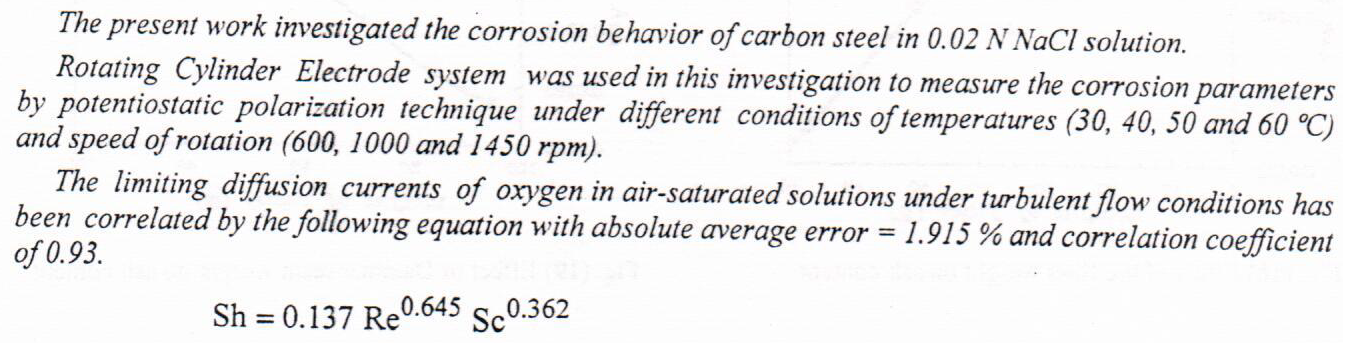
Effect of Velocity and Temperature on Mass Transfer of Oxygen in Corrosion Processes

Objective: To establish growth curve for a sample of infertile women and to assess Body Mass Index.
Methodology: Non-probability (purposive sample) of (100) infertile women, who visit Kamal Al-Samaraee
Hospital/ fertility and IVF center . The data are collected through the use of constructed questionnaire, which
consists of two parts. Part 1: consists of (5) items about demographic characteristics, part 2: consists of (4) items
about reproductive status, descriptive statistical analysis procedures (frequency, percentage, Contingency
coefficients, polynomial cube order).
Results: Revealed that the infertile women in the study group had decrease in their Body Mass Index with aging
(with increase of infertility duration
Abstract
This work involves studying the effect of adding some selective organic component mixture on corrosion behavior of pure Al and its alloys in condensed synthetic automotive solution (CSAS) at room temperature. This mixture indicates the increasing of octane number in previous study and in this study show the increasing in corrosion resistance through the decreasing in corrosion rate values.
Electrochemical measurements were carried out by potentiostat at 3 mV/sec to estimate the corrosion parameters using Tafel extrapolation method, in addition to cyclic polarization test to know the pitting susceptibility of materials in tested medium.
The cathodic Tafel slope
... Show MoreBackground: Hair loss is a common distressing disease and challenging problem for many dermatologist. Telogen effluvium is the most common hair loss disease in which nutritional deficiencies may precipitate the disease through their effect on hair structure and growth.
Study Aim : Validating role of serum ferritin level and body mass index in Chronic Telogen Effluvium and analyzing association between these factors with socioeconomic, demographic, gynecological factors and weight loss effect. Establishing a nutritional preventive advice to improve treatment successfulness and decrease the disease occurrence.
... Show More

The photoconductivity and its dependence on light intensity have been investigated in a-Ge20Se80 thin films as a function of temperature between (293–323)K. The result showed that the photoconductivity and photosensitivity increase with increase of annealing temperature. This behavior is interpreted in terms of the dispersive diffusion –controlled recombination of localized electrons and holes.
 (9)
(9)
 (9)
(9)


This research aims at calculating the optimum cutting condition for various types of machining methods, assisted by computers, (the computer program in this research is designed to solve linear programs; the program is written in v. basic language). The program obtains the results automatically, this occur through entering the preliminary information about the work piece and the operating condition, the program makes the calculation actually by solving a group of experimental relations, depending on the type of machining method (turning, milling, drilling). The program was transferred to package and group of windows to facilitate the use; it will automatically print the initial input and optimal solution, and thus reduce the effort and t
... Show MoreThis research investigates the adsorption isotherm and adsorption kinetics of nitrogen from air using packed bed of Li-LSX zeolite to get medical oxygen. Experiments were carried out to estimate the produced oxygen purity under different operating conditions: input pressure of 0.5 – 2.5 bar, feed flow rate of air of 2 – 10 L.min-1 and packing height of 9-16 cm. The adsorption isotherm was studied at the best conditions of input pressure of 2.5 bar, the height of packing 16 cm, and flow rate 6 Lmin-1 at ambient temperature, at these conditions the highest purity of oxygen by this system 73.15 vol % of outlet gas was produced. Langmuir isotherm was the best models representing the experimental data., and the m
... Show More
(1)
The present study develops the sorption model for simulating the effects of pH and temperature on the uptake of cadmium from contaminated water using waste foundry sand (WFS) by allowing the variation of the maximum adsorption capacity and affinity constant. The presence of two acidic functional groups with the same or different affinity is the basis in the derivation of the two models; Model 1 and Model 2 respectively. The developed Bi-Langmuir model with different affinity (Model 2) has a remarkable ability in the description of process under consideration with coefficient of determination > 0.9838 and sum of squared error < 0.08514. This result is proved by FTIR test where the weak acids responsible of cadmium ions removal
... Show More
(35)
(30)
Background: Non-alcoholic fatty liver disease (NAFLD) is the most common liver disorder globally. The prevalence is 25% worldwide, distributed widely in different populations and regions. The highest rates are reported for the Middle East (32%). Due to modern lifestyles and diet, there has been a persistent increase in the number of NAFLD patients. This increase occurred at the same time where there were also increases in the number of people considered being obese all over the world. By analyzing fatty liver risk factors, studies found that body mass index, one of the most classical epidemiological indexes assessing obesity, was associated with the risk of fatty liver. Objectives: To assess age, sex, and body mass index (BMI) as
... Show More
Background: Non-alcoholic fatty liver disease (NAFLD) is the most common liver disorder globally. The prevalence is 25% worldwide, distributed widely in different populations and regions. The highest rates are reported for the Middle East (32%). Due to modern lifestyles and diet, there has been a persistent increase in the number of NAFLD patients. This increase occurred at the same time where there were also increases in the number of people considered being obese all over the world. By analyzing fatty liver risk factors, studies found that body mass index, one of the most classical epidemiological indexes assessing obesity, was associated with the risk of fatty liver.
Objectives: To assess age, sex, and body
... Show More