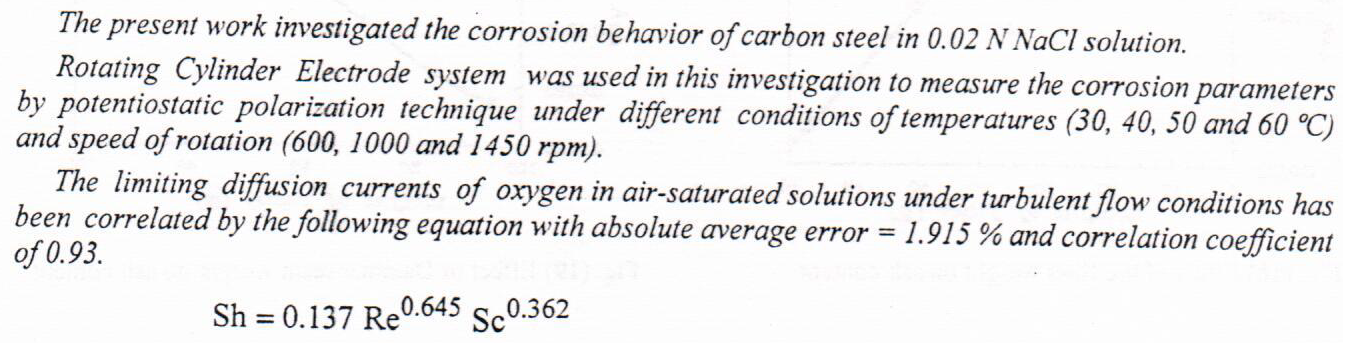
Effect of Velocity and Temperature on Mass Transfer of Oxygen in Corrosion Processes



Computational study of three-dimensional laminar and turbulent flows around electronic chip (heat source) located on a printed circuit board are presented. Computational field involves the solution of elliptic partial differential equations for conservation of mass, momentum, energy, turbulent energy, and its dissipation rate in finite volume form. The k-ε turbulent model was used with the wall function concept near the walls to treat of turbulence effects. The SIMPLE algorithm was selected in this work. The chip is cooled by an external flow of air. The goals of this investigation are to investigate the heat transfer phenomena of electronic chip located in enclosure and how we arrive to optimum level for cooling of this chip. These par
... Show MoreThis research aims to investigate the thermal performance of different thermal composite insulators, wrapped around a closed-loop copper pipe (CLP). To achieve this aim a system was designed and manufactured. It is consisted of closed water tank insulated by Rock Wool, and supplied with two electric heaters, two thermostat, a flow meter, a water pump, digital temperature scales, and four series of (CLP).
Six insulators were prepared namely; composites of Impregnated Fiberglass with Elastoclad and foaming Rubber (FER), Impregnated Fiberglass with Elastoclad resin and Polymeric Membrane (FEM), Impregnated Fiberglass with Polyurethane thermoset resin and Foaming Rubber (FUR), Impregnated Fiberglass with Polyurethane thermoset resin and P
Finite element modeling of transient temperature distribution is used to understand physical phenomena occurring during the dwell (penetration) phase and moving of welding tool in friction stir welding (FSW) of 5mm plate made of 7020-T53 aluminum alloy at 1400rpm and 40mm/min.
Thermocouples are used in locations near to the pin and under shoulder surface to study the welding tool penetration in the workpiece in advance and retreate sides along welding line in three positions (penetrate (start welding) , mid, pullout (end welding)).
Numerical results of ANSYS 12.0 package are compared to experimental data including axial load measurements at different tool rotational speeds (710rpm.900rpm.1120rpm and 1400rpm) Based on the experiment
 (6)
(6)
Cooling towers is one of the most important unit in industry, they are used to dispose heat from cooling media used in the integrated units. The choice of the cooling media plays recently an important rule due to fresh-water scarcity. The use of saline as a cooling media become of growing interest, but the corrosion problem has to be taken in consideration. In this study the simultaneous effect of cooling tower operation parameters on the corrosion rate of mild-steel is considered. The role of NaCl content is found to be pronounced more than the working solution temperature and flowrate. The corrosion of mild-steel in these studied factors had shown an interesting result especially with the NaCl% content. Firstly, there was an increase in t
... Show More (7)
(2)
(7)
(2)
The inhibitive power of Polyvinyl Alcohol (PVA) was investigated toward the corrosion of carbon steel in 0.2N H2SO4 solution in the temperature range of 30-60˚C and PVA concentration range of 150-2000 ppm.
The corrosion rate was measured using both the weight loss and the electrochemical techniques. The weight loss results showed that PVA could serve as a corrosion inhibitor but its inhibition power was found to be low for the corrosion of carbon steel in the acidic media. Electrochemical analysis of the corrosion process of carbon steel in an electrochemical corrosion cell was investigated using 3-Electrode corrosion cell. Polarization technique was used for carbon steel corrosion in 0.2N H
The inhibitor property of curcuma longa L. extract in different concentrations of simulated refinery wastewater (0.05% - 2% wt) and at various temperatures (30, 35 and 40 ˚C) was investigated using weight loss method. The results showed that the presence of about 1.2 % (v/v) of curcuma extract gave about 84% inhibition indicating its effectiveness on mild steel corrosion in simulated refinery wastewater, besides the adsorption process on the mild steal surface obeyed the Langmuir adsorption isotherm.
Phenylthiourea (PHTU),was tested as inhibitor for the corrosion of low carbon steel in different HCI acid concentration by mass loss ,and polarization measurements .it was found that (PHTU) is a good inhibitor for the corrosion of low carbon steel in 1,3,and 5N HCI solution ,and its inhibition efficiency (0) increases with its concentration and attains approximately 97% at l g/I .polarization curves indicate that (PHTU) acts as an anodic type inhibitor .the inhibitor was adsorbed on the low carbon steel surface according to the Langmuir adsorption isotherm model. Results show that the rate of corrosion of low carbon steel increased with increasing temperature o
... Show MoreThe characteristics of sulfur nanoparticles were studied by using atomic force microscope (AFM) analysis. The atomic force microscope (AFM) measurements showed that the average size of sulfur nanoparticles synthesized using thiosulfate sodium solution through the extract of cucurbita pepo extra was 93.62 nm. Protecting galvanized steel from corrosion in salt media was achieved by using sulfur nanoparticles in different temperatures. The obtained data of thermodynamic in the presence of sulfur nanoparticles referred to high value as compares to counterpart in the absence of sulfur nanoparticles, the high inhibition efficiency (%IE) and corrosion resistance were at high temperature, the corrosion rate or weig
... Show More
(17)
(5)

a porentioncsisteve has been carried out of the corrosion behavior of inconel(600) in chloride ions (Cl) over the tempreatures 293 over the temperatures 308K in both the dcacrated and the alloy