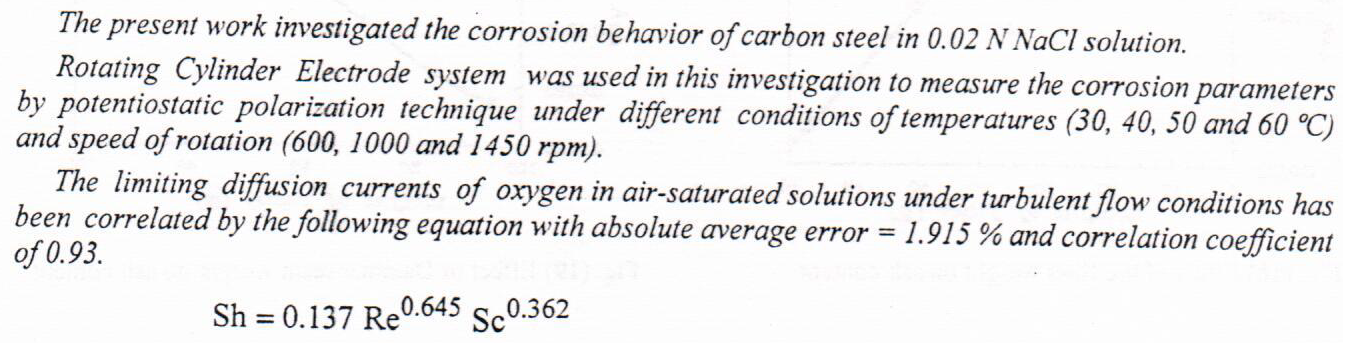
Effect of Velocity and Temperature on Mass Transfer of Oxygen in Corrosion Processes

Conjugate heat transfer has significant implications on heat transfer characteristics, particularly in thick wall applications and small diameter pipes. In this study, a three-dimensional numerical investigation was carried out using commercial CFD software “ANSYS FLUENT” to study the influence of conjugate heat transfer of laminar flow in mini channels at constant heat flux wall conditions. Two parameters were studied and analyzed: the wall thickness and thermal conductivity and their effect on heat transfer characteristics such as temperature profile and Nusselt number. Thermal conductivity of (0.25, 10, 202, and 387) W/m2C and wall thickness of (1, 5, and 50) mm were used for a channel of (1*2) mm cross
... Show More

In this paper, an experimental analysis of conventional air-cooled and microchannel condensers in automotive vapor compression refrigeration cycle concerning heat transfer coefficient and energy using R134a as a refrigerant was presented. The performance of two condensers and cycles tested regarding ambient temperature which it was varied from 40oC to 65oC, while the indoor temperature and load have been set to be 23oC and 2200 W respectively. Results showed that the microchannel condenser has 224 % and 77 % higher refrigerant side and air side heat transfer coefficient respectively than the coefficients of the conventional condenser. Thus, the COP, in case of using the microchannel
... Show More (4)
(4)
The aim of this project was to study the in vitro effect of antineoplastic drugs (vincristine and vinblastine) on mice spermatozoa. Eighteen adult (age 8-9 weeks) male mice were divided into three groups equally. The animals in each group were slain by cervical dislocation, the testes were removed and two tails of epididymides isolated. Spermatozoa were obtained from the two tails of epididymides by mincing in 500 µl TCM-199.The first group non-treated (unadded) as a control group, second group added 10 µg/ml of vincristine to TCM-199 and the third group added 10 µg/ml of vinblastine to TCM-199. After 10 minutes from added of vincristine and vinblastin measured the following test: spermatozoa activity, percentage dead spermatozoa and mor
... Show More
(1)
Anticyclone of synoptic studies that influence weather and climate of Iraq, The aim of
the study is to clarify the effect variation of repetition of Anticyclone and effect on thermal
characteristic in Iraq were pressure level has been analyzed (1000) millibars and that because
of pressure level is the closet to the earth surface and the clarity of climatic phenomenon
based on a systematic analysis of synoptic seeking maps and observation and (12:00)
according to timing GMT for five climatic stations which is (Mosul, Kirkuk, Baghdad, Rutba,
and Basra) and so far three consecutive climatic cycles which is first climatic cycle for period
(1986-1976). and second climatic cycle for period (1997-1987) and third climatic cy
In this study, the feasibility of Forward–Reverse osmosis processes was investigated for treating the oily wastewater. The first stage was applied forward osmosis process to recover pure water from oily wastewater. Sodium chloride (NaCl) and magnesium chloride (MgCl2) salts were used as draw solutions and the membrane that was used in forward osmosis (FO) process was cellulose triacetate (CTA) membrane. The operating parameters studied were: draw solution concentrations (0.25 – 0.75 M), oil concentration in feed solution (FS) (100-1000 ppm), the temperature of FS and draw solution (DS) (30 - 45 °C), pH of FS (4-10) and the flow rate of both DS and FS (20 - 60 l/h). It was found that the water flux and oil concentration in FS increas
... Show More
(4)
In this work we present a detailed study on anisotype nGe-pSi heterojunction (HJ) used as photodetector in the wavelength range (500-1100 nm). I-V characteristics in the dark and under illumination, C-V characteristics, minority carriers lifetime (MCLT), spectral responsivity, field of view, and linearity were investigated at 300K. The results showed that the detector has maximum spectral responsivity at λ=950 nm. The photo-induced open circuit voltage decay results revealed that the MCLT of HJ was around 14.4 μs
Zinc oxide (ZnO) nanostructures were synthesized through the hydrothermal method at various conditions growth times (6,7 and 8 hrs.) and a growth temperature (70, 90, and 100 ºC). The prepared ZnO nanostructure samples were described using scanning electron microscopy (SEM) and X-ray diffractometer to distinguish their surface morphologies and crystal structures. The ZnO samples were confirmed to have the same crystal type, with different densities and dimensions (diameter and length). The obtained ZnO nanostructures were used to manufacture gas sensors for NO2 gas detection. Sensing characteristics for the fabricated sensor to NO2 gas were examined at different operating temperatures (180, 200, 220, and 240) ºC with a low gas concentrati
... Show More (3)
(1)
(3)
(1)
This research was conducted in order to monitor and measure the dimensions of media policy in satellite channels directed from the point of view of the communicator, and this research is classified among the descriptive studies, as the researcher used the survey method to answer the questions that were formulated in light of the research problem represented by the main question: What are the dimensions of media policy in Directed satellite channels? .
To achieve the objectives of the study, the researcher used the following tools:
The questionnaire, in order to survey the attitudes of communicators about the extent to which the media policy during crises reflects on their professional standards. The research community is represente
(1)
Recently the use of nanofluids represents very important materials. They are used in different branches like medicine, engineering, power, heat transfer, etc. The stability of nanofluids is an important factor to improve the performance of nanofluids with good results. In this research two types of nanoparticles, TiO2 (titanium oxide) and γ-Al2O3 (gamma aluminum oxide) were used with base fluid water. Two-step method were used to prepare the nanofluids. One concentration 0.003 vol. %, the nanoparticles were examined. Scanning Electron Microscopy (SEM), Atomic Force Microscopy (AFM) and X-ray diffraction (XRD) were used to accomplish these tests. The stability of the two types of nanofluids is measured by
... Show More
(9)