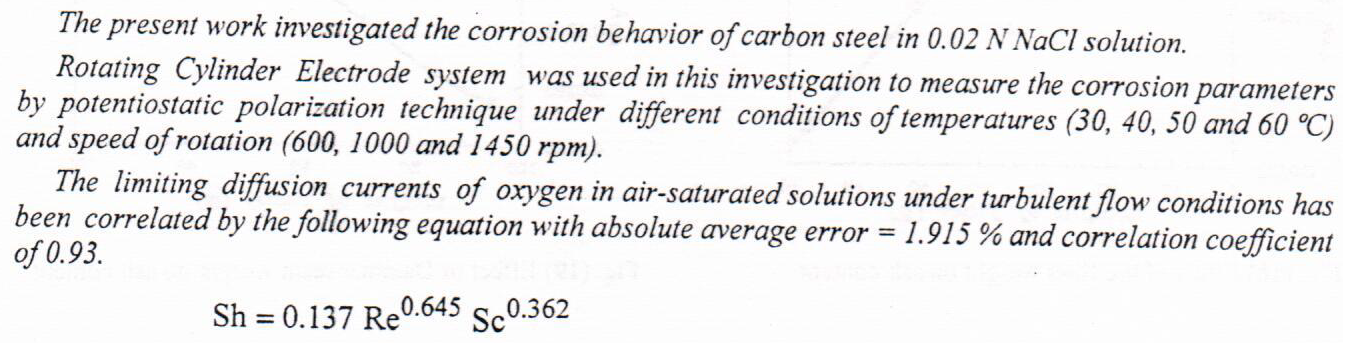
Effect of Velocity and Temperature on Mass Transfer of Oxygen in Corrosion Processes

Internal curing is a method that has been advised to decrease the primary age cracking, mainly of concrete mixes using low (water to cementitious materials - w/cm) ratios corresponding to the self-compacting concrete-(SCC). This research aims to study the effect of the internal curing using saturated lightweight aggregate- (LWA) on the steel reinforcing corrosion in SCC. In this research, crushed bricks or thermostone were partially replaced by (20%) by the weight of sand and volumetrically measured. The results showed that the steel reinforcement of internally cured concrete showed a slight increase in corrosion up to 300 days of exposure to the saline solution (containing 3.5% NaCl). The ability of using the crushed bricks or thermostone
... Show More (4)
(4)
 (1)
(1)
 (1)
(1)

Premature degradation is the problem of maxillofacial silicones, significantly affected by ultraviolet exposure, contributing to silicones photodegradation. Degradation necessitates frequent replacement of prostheses that increase the total cost of rehabilitation.
This study evaluated the effect of bisoctrizole on the ultraviolet absorption properties of silicone material and the stability of this absorption over time. Also, the bisoctrizole effect on the surface roughness of silicone was evaluated.
(1)
(1)
(17)
(2)
Abstract
Stainless steel (AISI 304) has good electrical and thermal conductivities, good corrosion resistance at ambient temperature, apart from these it is cheap and abundantly available; but has good mechanical properties such as hardness. To improve the hardness and corrosion resistance of stainless steel its surface can be modified by developing nanocomposite coatings applied on its surface. The main objective of this paper is to study effect of electroco-deposition method on microhardness and corrosion resistance of stainless steel, and to analyze effect of nanoparticles (Al2O3, ZrO2 , and SiC) on properties of composite coatings. I
... Show More
(1)
Corrosion inhibiting admixtures are unique among other methods to protect reinforced concrete from corrosion damage. In this study, the effect of furfural on the fresh and hardened properties of concrete mixes of 35 and 45 MPa compressive strengths as well as the corrosion inhibition of furfural was evaluated. Furfural was added at different dosages (1, 2 and 3% by weight of cement) with and without superplasticizer (HRWR). Different electrochemical measurements were performed (Half-cell potential, Tafel plot and linear polarization resistance). Electrochemical measurements confirmed that furfural dramatically reduces the rate of corrosion; the inhibition efficiencies were 62.7 and 63.8 % due to 3% furfural addition to 35 and 45MPa-concr
... Show More
(1)
The V2O5 films were deposited on glass substrates which produce using "radio frequency (RF)"power supply and Argon gas technique. The optical properties were investigated by, UV spectroscopy at "radio frequency" (RF) power ranging from 75 - 150 Watt and gas pressure, (0.03, 0.05 and 0.007 Torr), and substrate temperature (359, 373,473 and 573) K. The UV-Visible analysis shows that the average transmittance of all films in the range 40-65 %. When the thickness has been increased the transhumance was decreased from (65-40) %. The values of energy band gap were lowered from (3.02-2.9 eV) with the increase of thickness the films in relation to an increase in power, The energy gap decreased (2.8 - 2.7) eV with an increase in the pressure and
... Show More
(3)
Abstract: Objectives: To investigate the effect of temperature elevation on the bonding strength of resin cement to the zirconia ceramic using fractional CO2 laser. Background: Fractional CO2 laser is an effective surface treatment of zirconia ceramic, as it increases the bonding strength of zirconia to resin cement. Methods: Thirty sintered zirconia discs (10 mm diameter, 2 mm thickness) were prepared and divided to three groups (N=10) and five diffident pulse durations were used in each group (0.1, 0.5, 1, 5 and 10 ms). Group A was treated with 10 W power setting, group B with 20 W and group C with 30 W. During laser irradiation, temperature elevation measurement was recorded for each specimen. Luting cement was bonded to the treated z
... Show MoreThe optical energy gap(Eopt) and the width of the tails of localized states in the band gap (?E) for Se:2%Sb thin films prepared by thermal co-evaporation method as a function of annealing temperature are studied in the photon energy range ( 1 to 5.4)eV.Se2%Sb film was found to be indirect transition with energy gap of (1.973,2.077, 2.096, 2.17) eV at annealing temperature (295,370,445,520)K respectively. The Eopt and ?E of Se:2%Sb films as a function of annealing temperature showed an increase in Eopt and a decrease in ?E with increasing the annealing temperature. This behavior may be related to structural defects and dangling bonds.