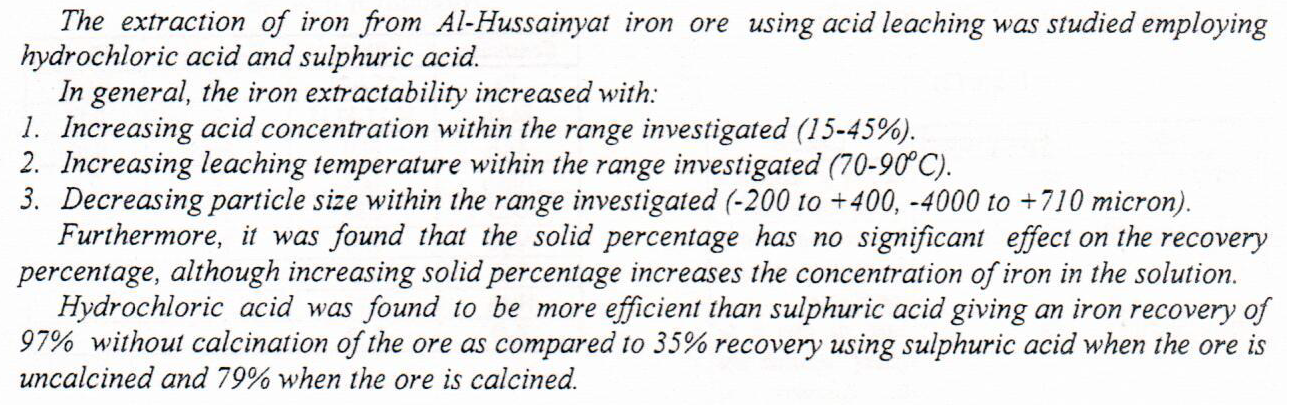
Extraction of Iron from Al-Hussainyat Iron Ore using Acid Leaching

 (55)
(55)
 (48)
(48)



Leaching scheduling techniques are one of the suggested solutions for water scarcity problems .The aim of the study is to show the possibility of using leaching scheduling, when applying the irrigation scheduling program for a certain irrigation project, which was prepare by Water Resources Engineering –University of Baghdad with some modifications to generalized it and it make applicable to various climatic zone and different soil types.
The objectives of this research is to build a system that concerns the prediction of the leaching scheduling (depth and date of leaching water), illustrating the main problems (soil salinity, save the amount of leaching requirement, and to maintain crops growth).The other objective is to compare be
This work was conducted to study the extraction of pelletierine sulphate from Punica granatum L. roots by liquid membrane techniques. Pelletierine sulphate is used widely in medicine. The general behavior of extraction process indicates that pelletierine conversion increased with increasing the number of stages and the discs rotation speed but high rotation speed was not favored because of the increased risk of droplet formation during the operation. The pH of feed and acceptor solution was also important. The results exhibit that the highest pelletierine conversion was obtained when using two stages,(10 rpm) discs speed of stainless steel discs,(pH= 9.5) of feed solution and (pH= 2) of acceptor solution in n-decane. Assuming the existence
... Show MoreIn this work, the extraction of glycyrrhizin from Licorice using bulk liquid membrane technique was developed and optimized. The effect of various parameters such as pH of stripping and donor solutions, temperature, stirring speed and kinetic parameters were investigated. Moreover, to study the impact of the polarity of membrane solvent, two types of extraction solvents were used as a membrane solvent: n-Hexane was used as a non-polar solvent and 1-Hexanol was as a polar solvent. The optimum extraction condition was found (95.53%) using 1-Hexanol, rotating speed was 400 rpm, and pH of the acceptor and donor solutions were 8 and 5.5, respectively. The reaction kinetics constants ( and ) for the transport of glycyrrhizin from the donor pha
... Show More
(18)
(13)
This work was conducted to study the extraction of pelletierine sulphate from Punica granatum L. roots by liquid membrane techniques. Pelletierine sulphate is used widely in medicine. The general behavior of extraction process indicates that pelletierine conversion increased with increasing the number of stages and the discs rotation speed but high rotation speed was not favored because of the increased risk of droplet formation during the operation. The pH of feed and acceptor solution was also important. The results exhibit that the highest pelletierine conversion was obtained when using two stages, (10 rpm) discs speed of stainless steel discs, (pH=9.5) of feed solution and (pH=2) of acceptor solution in n-decane. Assuming the existen
... Show More
(2)
(1)
The orogenic gold deposit of Tamilouw – Haya is hosted by slate and metapelitic rocks within Tehoru metamorphic complex. Gold and polymetallic sulfides mineralization at study area is predominantly formed in the form of veins, stockwork and breccia although minor dissemination is slightly appeared in the rock float samples. They are trapped and controlled by NE-SW and NNE-SSW trending geologic structure occurred during orogeny process from Late Miocene to Pliocene. The common ore minerals assemblage at Tamilouw – Haya deposit are dominated by native gold, chalcopyrite, pyrite, sphalerite, galena, pyrrhotite, tetrahedrite-tennantite (sulphosalt), marcasite,realgar, kalininite and arsenopyrite as hypogene minerals and accompanied by co
... Show More
(3)
The aim of this study was extraction of jojoba oil using different solvents. A mixture of waterhexane and water-ethanol are used as solvents to extract jojoba oil in a batch extraction process and compared with a pure solvent extraction process. The effects of particle size of crushed seeds, solvent-to-water ratio and time on jojoba oil extraction were investigated. The best recovery of oil was obtained at the boiling temperature of the solvent and four hour of extraction time. When seed particle size was 0.45 mm and a pure ethanol was used (45% yield of oil extraction), whereas, it was 40% yield of oil at 25% water-hexane mixture. It was revealed that the water-ethanol and water-hexane mixtures have an effect on the oil extraction yield. T
... Show More
Forty one isolates of genus Proteus were collected from 140 clinical specimens such as urine, stool, wound, burn, and ear swabs from patients of both sex. These isolates were identified to three Proteus spp. P. mirabilis, P. vulgaris and P. penneri .The ability of these bacteria to produce L-asparaginase II by using semi quantitative and quantitative methods was determined. P. vulgaris Pv.U.92 was distinguished for high level of L-asparaginase II production with specific activity 1.97 U/mg. Optimum conditions for enzyme production were determined; D medium with 0.3% of L-asparagine at pH 7.5 with temperature degree 35°C for incubation. Ultrasonication was used to destroy the P. vulgaris Pv.U.92 cells then ASNase II was extracted and pu
... Show More
