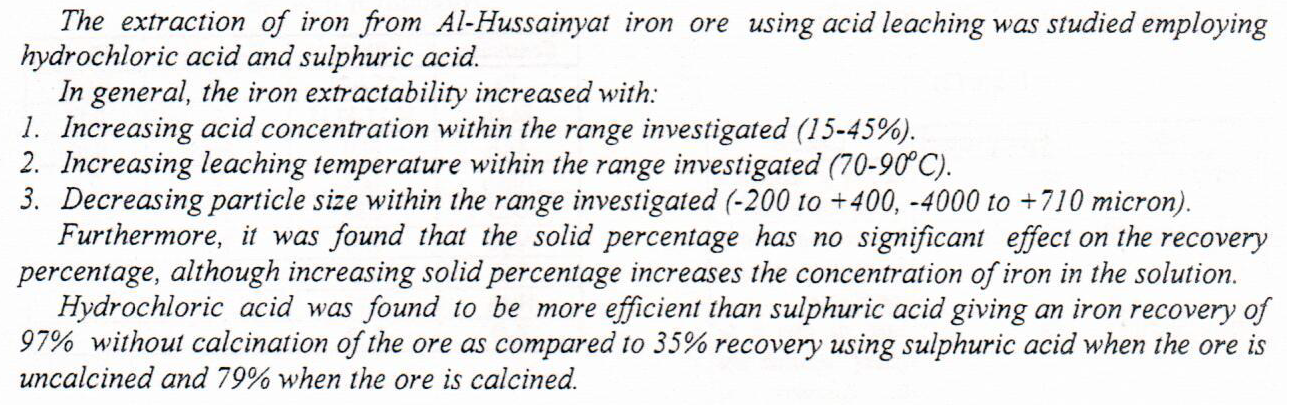
Extraction of Iron from Al-Hussainyat Iron Ore using Acid Leaching

A liquid membrane process of Alkaloids extraction from Datura Innoxia solution was studied applying pertraction process in rotating discs contactor (RDC). Decane as a liquid membrane and dilute sulphuric acid as stripping solution were used. The effect of the fundamental parameters influencing the transport process, eg type of solvent used, effect of disks speed, amount of liquid membrane and effect of pH for feed and strip solution. The transport of alkaloids was analysed on the basis of kinetic laws of two consecutive irreversible first order reactions. Thus, the kinetic parameters (k1, k1,, tmax, and) for the transport of alkaloids were determined. The effect of organic membrane type on percentage of Alkaloids transport was found to be i
... Show MoreThe plants of genus Heliotropium L. (Boraginaceae) are well-known for containing the toxic metabolites called pyrrolizidine alkaloids (PAs) in addition to the other secondary metabolites. Its spread in the Mediterranean area northwards to central and southern Europe, Asia, South Russia, Caucasia, Afghanistan, Iran, Pakistan, and India, Saudi Arabia, Turkey, and over lower Iraq, Western desert. The present study includes the preparation of various extracts from aerial parts of the Iraqi plant. Fractionation, screening the active constituent, and identification by chromatographic techniques were carried out.Heliotropium europaeum
... Show More (4)
(4)
 (2)
(2)


The extraction of Eucalyptus oil from Iraqi Eucalyptus Camadulensis leaves was studded using water distillation methods. The amount of Eucalyptus oil has been determined in a variety of extraction temperature and agitation speed. The effect of water to Eucalyptus leaves (solvent to solid) ratio and particle size of Eucalyptus leaves has been studied in order to evaluate the amount of Eucalyptus oil. The optimum experimental condition for the Eucalyptus oil extraction was established as follows: 100 C extraction temperature, 200 rpm agitation speed; 0.5 cm leave particle size and 6: 1 ml: g amount of water to eucalyptus leaves Ratio.
In this study some generic commercial products of Atorvastatin tablets were evaluated by dissolution test in acid medium by comparing with that of parent drug Lipitor of Pfizer Company. Some of solubilizing agents were studied in formulation of Atorvastatin tablet including; surface active agent and PEG 6000 .The most effective factor was the use of PEG6000 in formulation of Atorvastatin tablet which improved the dissolution and the results of dissolution profile of formulated tablet in this work was bioequivalent to that of Lipitor .The quantitative analysis of this work was performed by using reversed phase liquid chromatography and a proper mixture of  
... Show More
In this study, a proposed process for the utilization of hydrogen sulphide separated with other gases from omani natural gas for the production of sulphuric acid by wet sulphuric acid process (WSA) was studied. The processwas simulated at an acid gas feed flow of 5000 m3/hr using Aspen ONE- V7.1-HYSYS software. A sensitivity analysis was conducted to determine the optimum conditions for the operation of plant. This included primarily the threepacked bed reactors connected in series for the production of sulphur trioxidewhich represented the bottleneck of the process. The optimum feed temperature and catalyst bed volume for each reactor were estimated and then used in the simulation of the whole process for tw
... Show MoreThe process of accurate localization of the basic components of human faces (i.e., eyebrows, eyes, nose, mouth, etc.) from images is an important step in face processing techniques like face tracking, facial expression recognition or face recognition. However, it is a challenging task due to the variations in scale, orientation, pose, facial expressions, partial occlusions and lighting conditions. In the current paper, a scheme includes the method of three-hierarchal stages for facial components extraction is presented; it works regardless of illumination variance. Adaptive linear contrast enhancement methods like gamma correction and contrast stretching are used to simulate the variance in light condition among images. As testing material
... Show More
(1)
<span>One of the main difficulties facing the certified documents documentary archiving system is checking the stamps system, but, that stamps may be contains complex background and surrounded by unwanted data. Therefore, the main objective of this paper is to isolate background and to remove noise that may be surrounded stamp. Our proposed method comprises of four phases, firstly, we apply k-means algorithm for clustering stamp image into a number of clusters and merged them using ISODATA algorithm. Secondly, we compute mean and standard deviation for each remaining cluster to isolate background cluster from stamp cluster. Thirdly, a region growing algorithm is applied to segment the image and then choosing the connected regi
... Show More
(15)
(6)
The main object of the current work was to determine the antifungal efficiency of secondary metabolites product called synephrine that extracted from Citrus sinesis peels and the ability of synephrine to biosynthesis gold nanoparticles from HAucl4 which consider environmentally favourable method, then determine their activity against pathogenic human dermatophyte. The identification of synephrine done by Thin layer chromatography (TLC), High Performance Liquid Chromatography (HPLC) and The Fourier Transform Infrared (FTIR). The characterization of gold nanoparticles by using Ultra Violet-Visible Spectroscopy (UV-Vis), Field – Emission Scanning Electron Microscopy (FESEM) and Fourier Transform Infrared (FTIR), confirmed the biosynt
... Show More
(2)
(1)

A comparative study was carried out to evaluate alkaloid antibacterial activity which was extracted from the root bark Punica granatum L. by liquid membrane techniques (SA) and organic solvent traditional techniques (SB). The screening of the antimicrobial activity was conducted by agar well diffusion method against Staphylococcus aureus, Enterobacter cloacae, Escherichia coli, Klebsiella pneumoniae, and Proteus mirabilis at three concentration levels (5, 10 and 15 mg/ml). Alkaloid extracts were analyzed by a high performance liquid chromatography (HPLC) method. Among the tested extractions, SB showed the highest antibacterial activity against all five bacterial strains, especially at 15 mg/ml concentration. However, all the B type solution
... Show MoreLaser shock peening (LSP) is deemed as a deep-rooted technology for stimulating compressive residual stresses below the surface of metallic elements. As a result, fatigue lifespan is improved, and the substance properties become further resistant to wear and corrosion. The LSP provides more unfailing surface treatment and a potential decrease in microstructural damage. Laser shock peening is a well-organized method measured up to the mechanical shoot peening. This kind of surface handling can be fulfilled via an intense laser pulse focused on a substantial surface in extremely shorter intervals. In this work, Hydrofluoric Acid (HF) and pure water as a coating layer were utilized as a new technique to improve the properti
... Show More