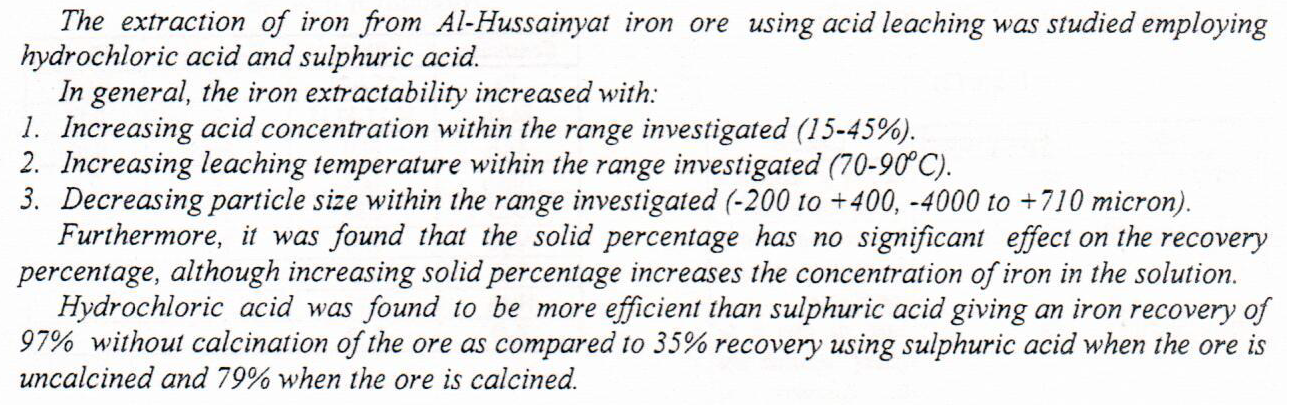
Extraction of Iron from Al-Hussainyat Iron Ore using Acid Leaching

Abstract :In this study, amygdaline in Iraqi plant seeds was extracted and isolated from their seeds matrix using reflux procedure and subsequently identified and determined by high performance liquid chromatography (HPLC) on reversed phase column of LC-18 (150mm x 4.6mm, 5?m )with actonitrile :water ( 50 : 50 ) as mobile phase at flow rate of ( 0.5 mL/min ) and detection at wavelength of 215 nm.The experimental results indicated that the linearity of calibration is in the range of 1.0-30.0 mg L-1amygdaline with the correlation coefficient of 0.9949. The limit of detection (LOD) and limit of quantitation (LOQ) for amygdaline were of 0.88 and 2.93 mg L-1 in standard pure sample. The mean recovery percent is 97.34±0.58 at 95% confidence inte
... Show More (2)
(2)

 (43)
(26)
(43)
(26)

Cloud point extraction is a simple, safe, and environmentally friendly technique for preparing many different kinds of samples. In this review, we discussed the CPE method and how to apply it to our environmental sample data. We also spoke about the benefits, problems, and likely developments in CPE. This process received a great deal of attention during preconcentration and extraction. It was used as a disconnection and follow-up improvement system before the natural mixtures (nutrients, polybrominated biphenyl ethers, pesticides, polycyclic sweet-smelling hydrocarbons, polychlorinated compounds, and fragrant amines) and inorganic mixtures were examined and many metals like (silver, lead, cadmium, mercury, and so on). We also find
... Show More
(5)
(2)
Cloud point extraction is a simple, safe, and environmentally friendly technique for preparing many different kinds of samples. In this review, we discussed the CPE method and how to apply it to our environmental sample data. We also spoke about the benefits, problems, and likely developments in CPE. This process received a great deal of attention during preconcentration and extraction. It was used as a disconnection and follow-up improvement system before the natural mixtures (nutrients, polybrominated biphenyl ethers, pesticides, polycyclic sweet-smelling hydrocarbons, polychlorinated compounds, and fragrant amines) and inorganic mixtures were examined and many metals like (silver, lead, cadmium, mercury, and so on). We also find
... Show More
(5)
(2)
 (3)
(3)
(3)
(3)
A liquid membrane process of Alkaloids extraction from Datura Innoxia solution was studied applying pertraction process in rotating discs contactor (RDC). Decane as a liquid membrane and dilute sulphuric acid as stripping solution were used. The effect of the fundamental parameters influencing the transport process, e.g. type of solvent used, effect of disks speed, amount of liquid membrane and effect of pH for feed and strip solution. The transport of alkaloids was analysed on the basis of kinetic laws of two consecutive irreversible first order reactions. Thus, the kinetic parameters (k1, k1, , tmax, and ) for the transport of alkaloids were determined. The effect of organic membrane type on percentage of Alkaloids transport was found
... Show MoreThe development of economic and environmentally friendly extractants to recover cobalt metal is required due to the increasing demand for this metal. In this study, solvent extraction of Co(II) from aqueous solution using a mixture of N,N0-carbonyl difatty amides (CDFAs) synthesised from palm oil as the extractant was carried out. The effects of various parameters such as acid, contact time, extractant concentration, metal ion concentration and stripping agent and the separation of Co(II) from other metal ions such as Fe(II), Ni(II), Zn(III) and Cd(II) were investigated. It was found that the extraction of Co(II) into the organic phase involved the formation of 1:1 complexes. Co(II) was successfully separated from commonly associated metal
... Show More
(27)
(14)
Liquid-liquid membrane extraction technique, pertraction, using three types of solvents (methyl isobutyl ketone, n-butyl acetate, and n-amyl acetate) was used for recovery of penicillin V from simulated fermentation broth under various operating conditions of pH value (4-6) for feed and (6-8) for receiver phase, time (0-40 min), and agitation speed (300-500 rpm) in a batch laboratory unit system. The optimum conditions for extraction were at pH of 4 for feed, and 8 for receiver phase, rotation speed of 500 rpm, time of 40 min, and solvent of MIBK as membrane, where more than 98% of penicillin was extracted.
Retained soft tissue foreign bodies following injuries are frequently seen in the Emergency and Plastic Surgery practice. The patients with such presentations require a watchful and detailed clinical as- sessment to overcome the anticipant possibility of missing them. However, the diagnosis based on the clinical evaluation is usually challenging and needs to be supported by imaging modalities that are suboptimal and may fail in identifying some types of foreign bodies. Owing to that, serious complications such as chronic pain, infection, and delayed wound healing can be faced that necessitate a prompt intervention to halt those detrimental consequences. The classical method of removal is a surgical exploration which is not free of risks.
... Show More