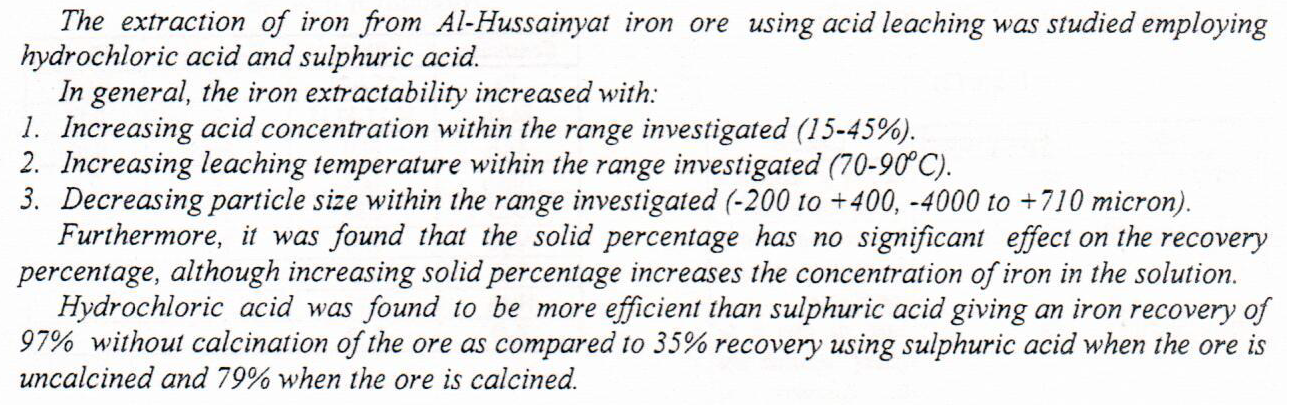
Extraction of Iron from Al-Hussainyat Iron Ore using Acid Leaching

Coffee is the most essential drink today, aside from water, the high consumption of coffee and the byproducts of its soluble industries such as spent coffee grounds can have a negative effect on the environment as a source of toxic organic compounds. Therefore, caffeine removal from the spent coffee ground can be applied as a method to limit the effect of its production on the environment. The aim of this study is to determine the kinetics and thermodynamics parameters and develop models for both processes based on the process parameters by using traditional solid-liquid extraction and Ultrasound-assisted extraction methods. The processes were performed at a temperature range of 25 to 55 °C for traditional and ultrasound baths, and
... Show More (3)
(3)

Abstract
The present study investigates the effect of acetic acid on corrosion behavior and its potential of hydrothermally sealed anodized AA2319-Al-alloys. Anodizing treatment was performed in stagnant phosphoric acid electrolyte with or without addition of acetic acid. Hydrothermal sealing was carried out in boiling water for each anodized specimen. The open circuit potential of the unsealed and sealed anodized samples was examined using open circuit potential measurement for the purpose of starting in scanning polarization diagrams. The potentiostatic polarization technique measurements were performed to assess corrosion behavior and sealing quality (i.e., degree of sealing) of
... Show MoreZinc Oxide is an indispensable substance in the field of dental treatment. It is used daily and intensively in all governmental and private dental clinics, leading to the disposal of very high concentrations of zinc with waste and eventually in landfill sites as a final destination for solid waste removal. This indicates the urgent need to investigate its behavior upon disposal due to the surrounding conditions. Approximately 4195 g of mixed dental waste samples were collected from (17) healthcare centers in Baghdad Al-Karkh. The leaching behavior of ZnO powder was investigated through batch reactors using makeup dental solid waste samples. The ZnO leaching was tested with 3 conditions; acidic, alkaline, and Ionic Streng
... Show More (1)
(1)
(1)
(1)

Adsorption techniques are widely used to remove organics pollutants from waste water particularly, when using low cost adsorbent available in Iraq. Al-Khriet powder which was found in legs of Typha Domingensis is used as bio sorbent for removing phenolic compounds from aqueous solution. The influence of adsorbent dosage and contact time on removal percentage and adsorb ate amount of phenol and 4- nitro phenol onto Al-Khriet were studied. The highest adsorption capacity was for 4-nitrophenol 91.5% than for phenol 82% with 50 mg/L concentration, 0.5 gm. dosage of adsorbent and pH 6 under a batch condition. The experimental data were tested using different isotherm models. The results show that Freundlich model resulted in the best fit also
... Show MoreThis work was conducted to study the extraction of eucalyptus oil from natural plants (Eucalyptus camadulensis leaves) by organic solvents. the effects of the main operating parameters were studied; type of solvent (n-hexane and ethanol), time to reach equilibrium, the temperature (45°C to 65°C) for n-hexane and (45°C to 75°C) for ethanol, solvent to solid ratio (5:1 to 8:1 (v/w)), agitation speed (0 to 900 rpm) and the particle size (0.5 to 2.5 cm) of fresh leaves to find the best processing conditions for the achieving maximum oil yield. The concentration of eucalyptus oil in solvent was measured by using UV-spectrophotometer. The results (for n-hexane) showed that the agitation speed of 900 rpm, temperature 65°C with solvent to soli
... Show More
(3)
(1)

The aim of the present study is to highlight the role of total cholesterol (TC), triacylglycerol (TG), Glycated hemoglobin A1c and iron in Iraqi women with multiple sclerosis and also to examine the biochemical action of copaxone (which is the most widely used in the 21st century to treat multiple sclerosis) on these biochemical parameters. This is the first study in Iraq which deals copaxone action on TC , TG , HbA1c and iron. Ninety women in their fourth decade suffering from multiple sclerosis were enrolled in this study. They were divided into: the first (group B) composed of (30) women without any treatment related to multiple sclerosis or any treatment linked with chronic or inflammatory diseases. The second (group A1) included (30)
... Show More
(2)
Lipase enzyme has attracted a lot of attention in recent years because of its diverse biotechnological applications. The present study was conducted to screen germinated seeds of four crops, namely sunflower (Helianthus annuus), flaxor linseed (Linum usitatissimum ), peanut (Arachis hypogaea ) and castor bean (Ricinus communis), for the activity of their lipases. to the study also included the extraction and purification of lipase from the seeds of the most promising crop using different solvents. The results indicated that the maximum enzymatic activity (0.669 U/ml) was obtained when 0.1 M Tris-HCl buffer extract was used after 3 days of seed germination of all the tested species, as compared to the other test solvents
... Show More
(12)
(6)
An investigation was conducted for the study of extraction of metal ions using aqueous biphasic systems. The extraction of iron, zinc and copper from aqueous sulphate media at different kinds of extractants SCN− , Cl- and I- , different values of pH of the feed solution, phase ratio, concentration of metals, concentration of extractant, concentration of polymer, and concentration of salt was investigated. Atomic absorption spectrophotometer was used to measure the concentration of iron, zinc and copper in the aqueous phase throughout the experiments. The results of the extraction experiments showed the use of SCN− as extractant, pH=2.5, phase ratio=1.5, concentration of metals 1g/l, concentration of extractant 0.06 %, concentration o
... Show More
(4)
