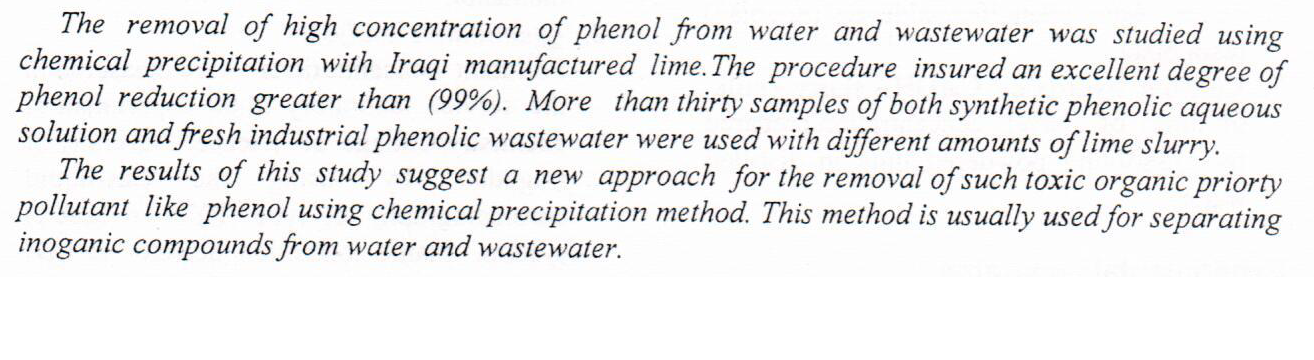
Removal of Phenol from Water and Wastewater by Chemical Precipitation with Lime

In this study, phytoplankton density, chlorophyll-a, and selected physico- chemical parameters were investigated in Erbil wastewater channel. The surveys were carried out monthly from May 2003 to April 2004. Samplings were established on three sites from headwaters to the mouth. The results showed that pH was in alkaline side of neutrality, with significant differences (P<0.05) between sites 1 and 3. TSS concentration decreased from site 1 toward site 2 (mean value, 80.15 to 25.79 mg.l-1). A clear gradual increase in mineral content (TDS) observed from site one of the channel towards the mouthpart. Soluble reactive phosphate has a concentration maximum mean value reached 48.4 µg.l-1 which is recorded in site 2. A high positive relat
... Show More (2)
(2)

 (107)
(98)
(107)
(98)


Water has been acknowledged as one of the key issues of humanity in modern society and worldwide economic advancements, especially with the continuing reductions in fresh-water supply. Solar energy, which is abundant as well as widely available in various fields, has the potential to solve the global challenges of long-term freshwater and energy reduction. Researchers are attempting to address the problem in a variety of methods. Due to the fact that solar energy is the foundation for freshwater, several researches have applied it for improving the effectiveness of solar desalination, evaporation, and wastewater treatment. One of the novel methods used for achieving this is known as “hydrogel,” which comes in a variety of forms. As a un
... Show More
(14)
(9)
The presence of heavy metals in the environment is major concern due to their toxicity. In the present study a strong acid cation exchange resin, Amberlite IR 120 was used for the removal of lead, zinc and copper from simulated wastewater. The optimum conditions were determined in a batch system of concentration 100 mg/L, pH range between 1 and 8, contact time between 5 and 120 minutes, and amount of adsorbent was from 0.05 to 0.45 g/100 ml. A constant stirring speed, 180 rpm, was chosen during all of the experiments. The optimum conditions were found to be pH of 4 for copper and lead and pH 6 for zinc, contact time of 60 min and 0.35 g of adsorbent. Three different temperatures (25, 40 and 60°C) were selected to investigate the effect
... Show More
(7)
The research aims to use a new technology for industrial water concentrating that contains poisonous metals and recovery quantities from pure water. Therefore, the technology investigated is the forward osmosis process (FO). It is a new process that use membranes available commercial and this process distinguishes by its low cost compared to other process. Sodium chloride (NaCl) was used as draw solution to extract water from poisonous metals solution. The driving force in the FO process is provided by a different in osmotic pressure (concentration) across the membrane between the draw and poisonous metals solution sides. Experimental work was divided into three parts. The first part includes operating the forward osmosis process using T
... Show More
(4)
(1)
(1)
Oily carwash wastewater is a high organic and chemical wastewater. This paper targeted to investigate a treatment to decrease the water consumption and contaminants in car-washing stations. Electrocoagulation combined with ultrasonic energy (Sono-Electrocoagulation) was suggested so that the carwash wastewater is treated to be reused. The effect of both the voltage and time of treatment on the removal of COD, turbidity, conductivity, and total dissolved solids (TDS) were studied at constant initial pH 7 and electrode distance 2 cm. The results showed the best results of removal COD, turbidity, TDS, and reduce electrical conductivity is when the voltage was 30 V and a treatment time of 90 minutes.
<
... Show More
(3)
(18)
(16)
Background: Large amounts of oily wastewater and its derivatives are discharged annually from several industries to the environment. Objective: The present study aims to investigate the ability to remove oil content and turbidity from real oily wastewater discharged from the wet oil's unit (West Qurna 1-Crude Oil Location/ Basra-Iraq) by using an innovated electrocoagulation reactor containing concentric aluminum tubes in a monopolar mode. Methods: The influences of the operational variables (current density (1.77-7.07 mA/cm2) and electrolysis time (10-40 min)) were studied using response surface methodology (RSM) and Minitab-17 statistical program. The agitation speed was taken as 200 rpm. Energy and electrodes consumption had been studi
... Show More
(21)
