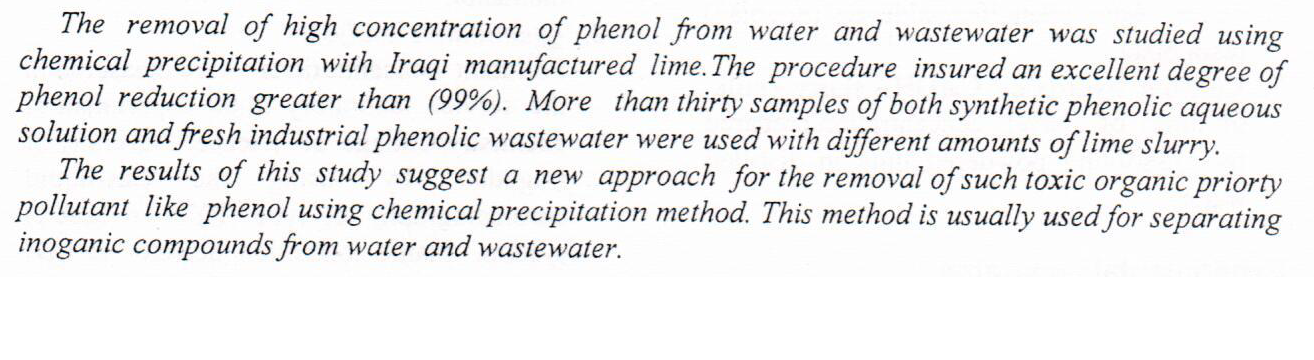
Removal of Phenol from Water and Wastewater by Chemical Precipitation with Lime

Fresh water resources in terms of water quality is a crucial issue worldwide. In Egypt, the Nile River is the main source of fresh water in the country and monitoring its water quality is a major task on governments and research levels. In the present case study, the physical, chemical and algal distribution in Nile River was monitored over two seasons (winter and summer) in 2019. The aims of the study were to check the seasonal variation among the different water parameters and also to check the correlations between those parameters. Water samples were collected from the Nile in Cairo governorate in EGYPT. The different physiochemical and microbiological properties in water samples were assessed. The studied parameters were included: te
... Show More (18)
(18)
 (6)
(6)


 (3)
(3)
(3)
(3)
The aim of this investigation was to study the impact of various reaction parameters on wastewater taken from Al-Wathba water treatment plant on Tigris River in south of Baghdad, Iraq with sodium hypochlorite solution. The parameters studied were sodium hypochlorite dose, contact time, initial fecal coliform bacteria concentration, temperature, and pH. In a batch reactor, different concentrations of sodium hypochlorite solution were used to disinfect 1L of water. The amount of hypochlorite ions in disinfected water was measured using an Iodimetry test for different reaction times, whereas the Most Probable Number (MPN) test was used to determine the concentration of coliform bacteria. Total Plate Count (TPC) was utilized in this study to
... Show More
Background: The quality of drinking water is directly related to community health. Therefore, improving the quality of drinking reflects positively on the health situation in general. The studies that deal with the quality of drinking water in the city of Baghdad in terms of chemical or microbial content are very scanty. Objective: The current review highlights the most important studies and research articles that concern the quality of drinking water, both bottled water and tap water, in terms of chemical and biological contamination and chemophysical specifications for drinking water. Abstract: Studies have shown that drinking water in the city of Baghdad, especially tap water, contains certain levels of heavy metals,
... Show More
(4)
(2)
(60)
(59)
The Moisture damage is considered as one of the main challenge for the experts in the field of asphalt pavement design. The aims of the present study is to modify moisture resistance of the asphalt concrete by utilizing ceramic fibers as a type of reinforcement incorporated with hydrated lime. For this purpose, a penetration grade of the asphalt cement (40-50) was utilized as a binder with an aggregate of the maximum nominal size of 12.5mm and mineral filler limestone dust. A series of specimens has been fabricated by utilizing 0.50, 1.0, 1.5, and 2.0 percentages of ceramic fibers. For each of these contents, another subsequent group of specimens with hydrated lime with 0.0, 1.0, 1.5, and 2.0 percentages were moulded. For the additi
... Show More
(1)
Two series of 1,3,4-oxadiazole derivatives at the sixth position of the 2,4-di-
(16)
(14)
Iraqi crude Atmospheric residual fraction supplied from al-Dura refinery was treated to remove metals contaminants by solvent extraction method, with various hydrocarbon solvents and concentrations. The extraction method using three different type solvent (n-hexane, n-heptane, and light naphtha) were found to be effective for removal of oil-soluble metals from heavy atmospheric residual fraction. Different solvents with using three different hydrocarbon solvents (n-hexane, n-heptane, and light naphtha) .different variables were studied solvent/oil ratios (4/1, 8/1, 10/1, 12/1, and 15/1), different intervals of perceptual (15, 30-60, 90 and 120 min) and different temperature (30, 45, 60 and 90 °C) were used. The metals removal percent we
... Show More
(1)
Iraqi crude Atmospheric residual fraction supplied from al-Dura refinery was treated to remove metals contaminants by solvent extraction method, with various hydrocarbon solvents and concentrations. The extraction method using three different type solvent (n-hexane, n-heptane, and light naphtha) were found to be effective for removal of oil-soluble metals from heavy atmospheric residual fraction. Different solvents with using three different hydrocarbon solvents (n-hexane, n-heptane, and light naphtha) .different variables were studied solvent/oil ratios (4/1, 8/1, 10/1, 12/1, and 15/1), different intervals of perceptual (15, 30-60, 90 and 120 min) and different temperature (30, 45, 60 and 90 °C) were used. The metals removal perce
... Show More
(1)