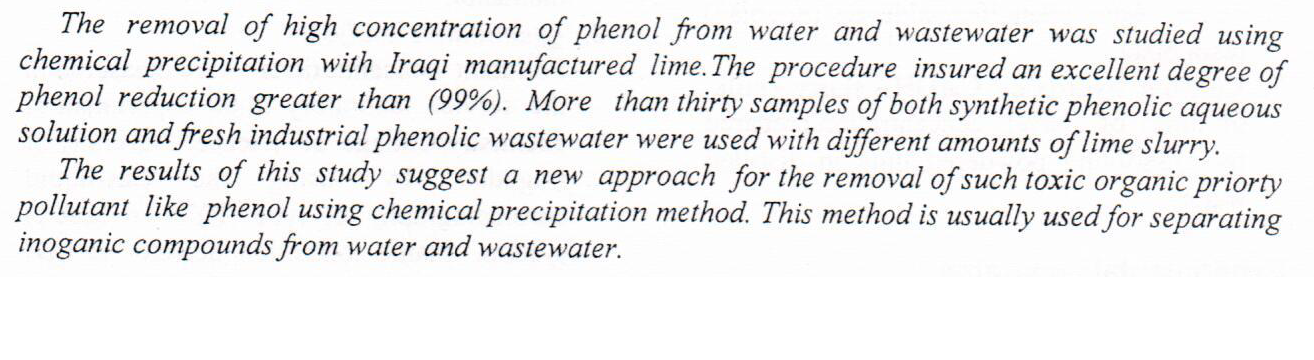
Removal of Phenol from Water and Wastewater by Chemical Precipitation with Lime

Due to the deliberate disposal of industrial waste, a great amount of petroleum hydrocarbons pollute the soil and aquatic environments. Bioremediation that depends on the microorganisms in the removal of pollutants is more efficient and cost-effective technology. In this study, five rhizobacteria were isolated from Phragmites australis roots and exposed to real wastewater from Al-Daura refinery with 70 mg/L total petroleum hydrocarbons (TPH) concentration. The five selected rhizobacteria were examined in a biodegradation test for seven days to remove TPH. The results showed that 80% TPH degradation as the maximum value by Sphingomonas Paucimobilis as identified with Vitek® 2 Compact (France).
 (7)
(7)

The presence of dyes in wastewater has become a major issue all over the world. The discharge of dyes in the environment is concerned for both toxicological and esthetical reasons. In this study, the removal of dyes from aqueous solution by electrocoagulation using aluminum electrodes as cathode and anode were investigated with the electrocoagulation cell of 1litter. The study included: the impact of various operating parameters on the dyes removal efficiency like pH, NaCl concentration, distance between electrodes, voltage, initial dyes concentration and type of electrodes. The dye (congo red) concentrations were (50, 100, 150, and 200 ppm), stirring speed was 120 rpm at room temperature. pH used was maintained constant
... Show More
(9)
In this study, a packed bed was used to remove pathogenic bacteria from synthetic contaminated water. Two types of packing material substrates, sand and zeolite, were used. These substrates were coated with silver nanoparticles (AgNPs), which were prepared by decomposition of Ag ions from AgNO3 solution. The prepared coated packings were characterized using scanning electron microscopy, energy-dispersive X-ray spectroscopy and transmission electron microscopy. The packed column consisted of a PVC cylinder of 2 cm diameter and 20 cm in length. The column was packed with silver nanoparticlecoated substrates (sand or zeolite) at a depth of 10 cm. Four types of bacteria were studied: Escherichia coli, Shigella dysenteriae, Pseudomonas aerugi
... Show More
(5)
 (54)
(48)
(54)
(48)


The removal of cadmium ions from simulated groundwater by zeolite permeable reactive barrier was investigated. Batch tests have been performed to characterize the equilibrium sorption properties of the zeolite in cadmium-containing aqueous solutions. Many operating parameters such as contact time, initial pH of solution, initial concentration, resin dosage and agitation speed were investigated. The best values of these parameters that will achieved removal efficiency of cadmium (=99.5%) were 60 min, 6.5, 50 mg/L, 0.25 g/100 ml and 270 rpm respectively. A 1D explicit finite difference model has been developed to describe pollutant transport within a groundwater taking the pollutant sorption on the permeable reactive barrier (PRB), which i
... Show More
(1)
(3)
(2)
This research presents a study for precipitating phosphorus (as phosphate ion) from simulated wastewater (5ppm initial concentration of phosphorus) using calcium hydroxide Ca(OH)2 solution. The removal of phosphorus by Ca (OH)2 solution is expected to be very effective since the chemical reaction is of acid-base type but Ca(OH)2 forms complex compound with phosphate ions called. Hydroxyapatite Ca5 (PO4)3OH. hydroxyapatite is slightly soluble in water. This research was directed towards sustainable elements as phosphorus. Kinetics of the dissolution reaction of hydroxyapatite was investigated to find the best factors to recover phosphorus. The effect of con
... Show More
The pretreatment process can be considered one of the important processes in wastewater treatment, especially coagulation process to decrease the strength of many pollutants. This paper focused on using powdered date seeds as natural coagulant in addition to chemical coagulants (alum and ferric chloride) to find the optimum dosage of each coagulant that makes efficient removal of turbidity and chemical oxygen demand (COD) from domestic wastewater as a pretreatment process, then finding the optimum combined dosages of date seeds with alum, date seeds with ferric chloride that make efficient removal for both pollutants. Concerning turbidity, the optimum dosage for date seeds, alum and ferric chloride were 40 mg/l (79%), 70
... Show MoreMagnetic nanoparticles (MNPs) of iron oxide (Fe3O4) represent the most promising materials in many applications. MNPs have been synthesized by co-precipitation of ferric and ferrous ions in alkaline solution. Two methods of synthesis were conducted with different parameters, such as temperature (25 and 80 ̊C), adding a base to the reactants and the opposite process, and using nitrogen as an inert gas. The product of the first method (MNPs-1) and the second method (MNPs-2) were characterized by x-ray diffractometer (XRD), Zeta Potential, atomic force microscope (AFM) and scanning electron microscope (SEM). AFM results showed convergent particle size of (MNPs-1) and (MNPs-2) with (86.01) and (74.14)
... Show More
(47)
The exploitation of obsolete recyclable resources including paper waste has the advantages of saving resources and environment protection. This study has been conducted to study utilizing paper waste to adsorb phenol which is one of the harmful organic compound byproducts deposited in the environment. The influence of different agitation methods, pH of the solution (3-11), initial phenol concentration (30-120ppm), adsorbent dose (0.5-2.5 g) and contact time (30-150 min) were studied. The highest phenol removal efficiency obtained was 86% with an adsorption capacity of 5.1 mg /g at optimization conditions (pH of 9, initial phenol concentration of 30 mg/L, an adsorbent dose of 2 g and contact time of 120min and at room temperature).
... Show More
(6)