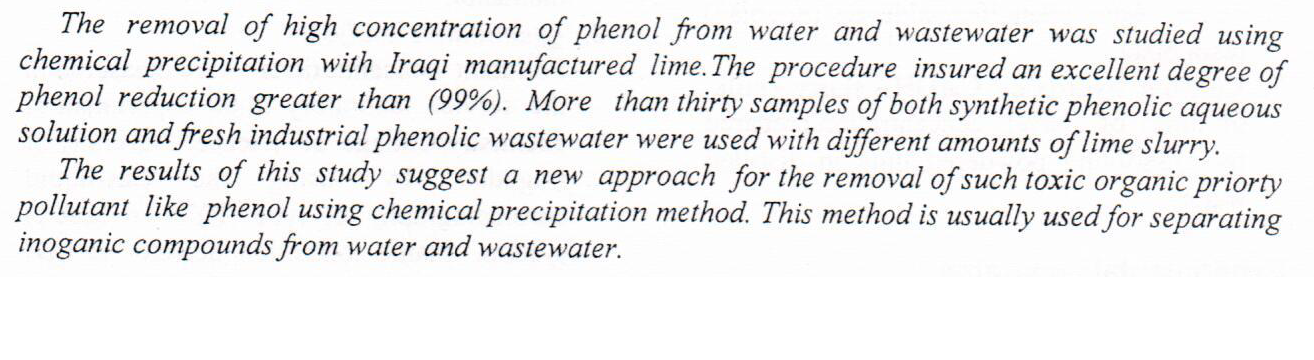
Removal of Phenol from Water and Wastewater by Chemical Precipitation with Lime

 (5)
(5)
 (5)
(5)



The research discussed the possibility of adsorption of Brilliant Blue Dye (BBD) from wastewater using 13X zeolite adsorbent, which is considered a byproduct of the production process of potassium carbonate from Iraqi potash raw materials. The 13X zeolite adsorbent was prepared and characterized by X-ray diffraction that showed a clear match with the standard 13X zeolite. The crystallinity rate was 82.15% and the crystal zeolite size was 5.29 nm. The surface area and pore volume of the obtained 13X zeolite were estimated. The prepared 13X zeolite showed the ability to remove BBD contaminant from wastewater at concentrations 5 to 50 ppm and the removal reached 96.60% at the lower pollutant concentration. Adsorption measurements versus tim
... Show More
(9)
This study concerns the removal of a trihydrate antibiotic (Amoxicillin) from synthetically contaminated water by adsorption on modified bentonite. The bentonite was modified using hexadecyl trimethyl ammonium bromide (HTAB), which turned it from a hydrophilic to a hydrophobic material. The effects of different parameters were studied in batch experiments. These parameters were contact time, solution pH, agitation speed, initial concentration (C0) of the contaminant, and adsorbent dosage. Maximum removal of amoxicillin (93 %) was achieved at contact time = 240 min, pH = 10, agitation speed = 200 rpm, initial concentration = 30 ppm, and adsorbent dosage = 3 g bentonite per 1L of pollutant solution. The characterization of the adsorbent, modi
... Show More
(28)
(28)
Dairy wastewater generally contains fats, lactose, whey proteins, and nutrients. Casein precipitation causes the effluent to decompose into a dark, strong-smelling sludge. Fluid waste contains soluble organic matter, suspended solids, and gaseous organic matter, which cause undesirable taste and smell, grant tone and turbidity, and advance eutrophication, which plays an essential role in increasing biological oxygen demand (BOD) in water. It also contains detergents and disinfecting agents from the rinses and washing processes, which increase the need for chemical oxygen (COD). One of the characteristics of dairy effluents is their relatively high temperature, high organic contents, and wide pH range, so the discharge of wastewater into
... Show More
(7)
This investigation deals with the use of orange peel (OP) waste as adsorbent for removal of nitrate (NO3) from simulated wastewater. Orange peel prepared in two conditions dried at 60C° (OPD) and burning at 500 °C (OPB). The effect of pH: 2-10, contact time: 30- 180 min, sorbent weight: 0.5- 3.0 g were considered. The optimal pH value for NO3 adsorption was found to be 2.0 for both adsorbents. The equilibrium data were analyzed using Langmuir and Freundlich isotherm models. Freundlich model was found to fit the equilibrium data very well with high-correlation coefficient (R2). The adsorption kinetics was found to follow pseudo-second-order rate kinetic model, with a good correlation (R2
... Show MoreIn the present work, the pollutants of the municipal wastewater are reduced using Chlorella vulgaris microalgae. The pollutants that were treated are: Total organic carbon (TOC), Chemical oxygen demand (COD), Nitrate (NO3), and Phosphate (PO4). Firstly, the treatment was achieved at atmospheric conditions (Temperature = 25oC), pH 7 with time (1 – 48 h). To study the effect of other microorganisms on the reduction of pollutants, sterilized wastewater and unsterilized wastewater were used for two types of packing (cylindrical plastic and cubic polystyrene) as well as algae's broth (without packing), where the microalgae are grown on the packing then transported to the wastewater for treatment. Th
... Show More
(5)
(6)
(6)
This paper studied kinetics of flotation of emulsified paraffine in water in bubble column with sodium .dodecylsulphate as a collector agent. The effects of oil drops and air bubble diameters on the flotation rate constant were studied. The removal rate for each oil drop size was first order with respect to oil drop concentration. An experimental procedure permitting determination of the first order rate constants for removal due to bubble/drop interaction was developed, decreasing bubble diameter by adding NaCl and increasing oil drop diameter increased the rate constants. A comparison between the experimental and theoretical rate constants showed
... Show MoreThe present study is to investigate the possibility of using wastes in the form of scrap iron (ZVI) and/ or aluminum ZVAI for the detention and immobilization of the chromium ions in simulated wastewater. Different batch equilibrium parameters such as contact time (0-250) min, sorbent dose (2-8 g ZVI/100 mL and 0.2-1 g ZVAI/100 mL), initial pH (3-6), initial pollutant concentration of 50 mg/L, and speed of agitation (0-250) rpm were investigated. Maximum contaminant removal efficiency corresponding to (96 %) at 250 min contact time, 1g ZVAI/ 6g ZVI sorbent mass ratio, pH 5.5, pollutant concentration of 50 mg/L initially, and 250 rpm agitation speed were obtained.
The best isotherm model for the batch single Cr(III) uptake by ZVI
... Show More
(12)