Removal of Phenol from Water and Wastewater by Chemical Precipitation with Lime
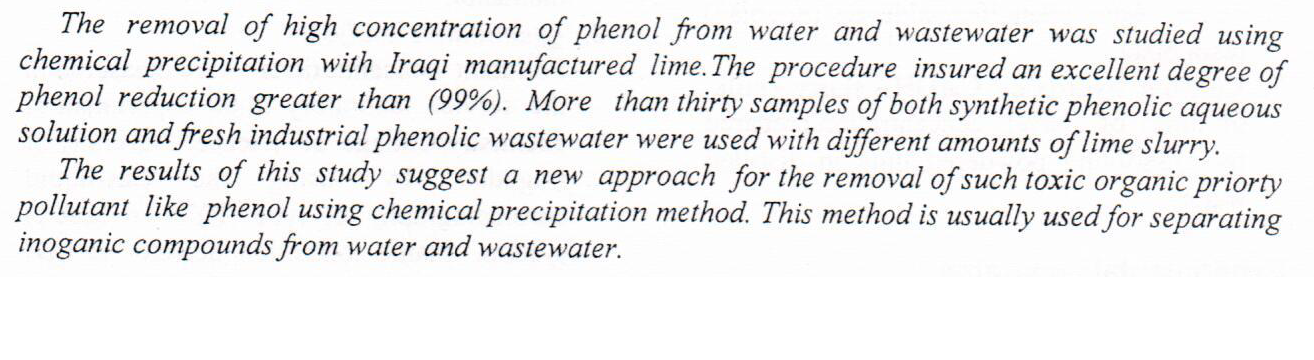

 (5)
(5)
 (5)
(5)



In this study, the sonochemical degradation of phenol in water was investigated using two types of ultrasonic wave generators; 20 kHz ultrasonic processor and 40 kHz ultrasonic cleaner bath. Mineralization rates were determined as a function of phenol concentration, contact time, pH, power density, and type of ultrasonic generator. Results revealed that sonochemical degradation of the phenol conversion was enhanced at increased applied power densities and acidic conditions. At 10 mg/L initial concentration of phenol, pH 7, and applied power density of 3000 W/L, the maximum removal efficiency of phenol was 93% using ultrasonic processor at 2h contact time. Whereby, it was 87% using and ultrasonic cleaner bath at 16h contact time and 150 W
... Show More
Four samples were collected from the wastewater of State Battery Manufacturing Company (SBMC); Babylon 2 factory in AL-Waziriya district, as triplicates. Physical and chemical measurements were carried out such as temperature, pH, Lead concentrations and their ranges were: (19.5-34.5) °C, (6.1-6.4) and (4.5-6.5) mg/L, respectively. Six dominant Bacillus spp. isolates were isolated from these samples; namely, Bacillus subtilis N1, Bacillus subtilis N2, Bacillus subtilis N3, Bacillus cereus N4, Bacillus cereus N5 , Bacillus cereus N6. These isolates were capable of removing Lead from aqueous solutions in a capacity reached 27.6 ± 1.4, 10.1 ± 1.7, 74.5 ± 0.7, 8.93 ± 2.8, 8.1 ± 3.5, 1.6± 0.7 mg/L, respectively. Whereas cell walls,
... Show More
A phytoremediation experiment was carried out with kerosene as a model for total petroleum hydrocarbons. A constructed wetland of barley was exposed to kerosene pollutants at varying concentrations (1, 2, and 3% v/v) in a subsurface flow (SSF) system. After a period of 42 days of exposure, it was found that the average ability to eliminate kerosene ranged from 56.5% to 61.2%, with the highest removal obtained at a kerosene concentration of 1% v/v. The analysis of kerosene at varying initial concentrations allowed the kinetics of kerosene to be fitted with the Grau model, which was closer than that with the zero order, first order, or second order kinetic models. The experimental study showed that the barley plant designed in a subsu
... Show More
(13)
(10)
A phytoremediation experiment was carried out with kerosene as a model for total petroleum hydrocarbons. A constructed wetland of barley was exposed to kerosene pollutants at varying concentrations (1, 2, and 3% v/v) in a subsurface flow (SSF) system. After a period of 42 days of exposure, it was found that the average ability to eliminate kerosene ranged from 56.5% to 61.2%, with the highest removal obtained at a kerosene concentration of 1% v/v. The analysis of kerosene at varying initial concentrations allowed the kinetics of kerosene to be fitted with the Grau model, which was closer than that with the zero order, first order, or second order kinetic models. The experimental study showed that the barley plant designed in a subsu
... Show More
(10)
An environmentally friendly technique was used to prepare titanium dioxide@ silver (core shell) (TiO₂@Ag NPs) using chard leaf extract, a natural stabilizer and reductant. A nanocomposite (NCs) of TiO₂@Ag supported by halloysite nanotubes (HNTs), TiO2@Ag/HNT NCs, was prepared under microwave irradiation. The microwave technique is used to accelerate the reaction and enhance the homogeneity of nanoparticle distribution. Spectroscopic and structural analyses were performed on the resulting nanocomposite. X-ray diffraction (XRD) revealed a clear crystalline structure with grain sizes ranging from 7 to 15 nm, with an average of ~11 nm, the transmission electron microscope (TEM) revealed that the size of nanoparticles in the TiO₂@Ag/HNT N
... Show More
A solid Phase Extraction (SPE) followed by HPLC-UV method is described for the simultaneous quantitative determination of nine priority pollutant phenols : Phenol, 2- and 4-Nitrophenol, 2,4-Dimethylphenol, 2-, 2,4-Di-, 2,4,6-Tri-, and Penta- chlorophenol, 4 Chloro-3-methylphenol. The phenols were separated using a C-18 column with UV detector at wave length of 280nm. The Flow of mobile phase was isocratic consisted of 50:50 Acetonitrile: phosphate buffer pH=7.1, column temperature 45 C°, Flow Rate 0.7 ml/min. Calibration curves were linear (R2 = 0.9961-0.9995). The RSDs (1.301-5.805)%, LOD(39.1- 412.4) µg/L, LOQ(118.5-1250.8) µg/L, the Robustness (1.55-4.89), Ruggedness (2.82-4.00), Repeatability (2.1-4.95), Recoveries%
... Show MoreManganese dioxide rotating cylinder electrode prepared by anodic deposition on a graphite substrate using MnSO4 solution in the presence of 0.918 M of H2SO4. The influence of different operational parameters (MnSO4 concentration, current density, time, and rotation speed) on the structure, and morphology of MnO2 deposit film was examined widely. The structure and crystal size determined by X-ray diffraction (XRD), the morphology examined by scanning electron microscopy (SEM) and atomic force microscopy (AFM) techniques. The γ-MnO2 obtained as the main product of the deposition process. It found that the four parameters have a significant influence on the structure, morphology, and roughness of the prepared MnO2 deposit. The crystal size in
... Show More
(21)
(17)
Nanosilica was extracted from rice husk, which was locally collected from the Iraqi mill at Al-Mishikhab district in Najaf Governorate, Iraq. The precipitation method was used to prepared Nanosilica powder from rice husk ash, after treating it thermally at 700°C, followed by dissolving the silica in the alkaline solution and getting a sodium silicate solution. Two samples of the final solution were collected to study the effect of filtration on the purity of the sample by X-ray fluorescence spectrometry (XRF). The result shows that the filtered samples have purity above while the non-filtered sample purity was around The structure analysis investigated by the X-ray diffraction (XRD), found that the Nanosilica powder has an amorphous
... Show More
(24)
(17)