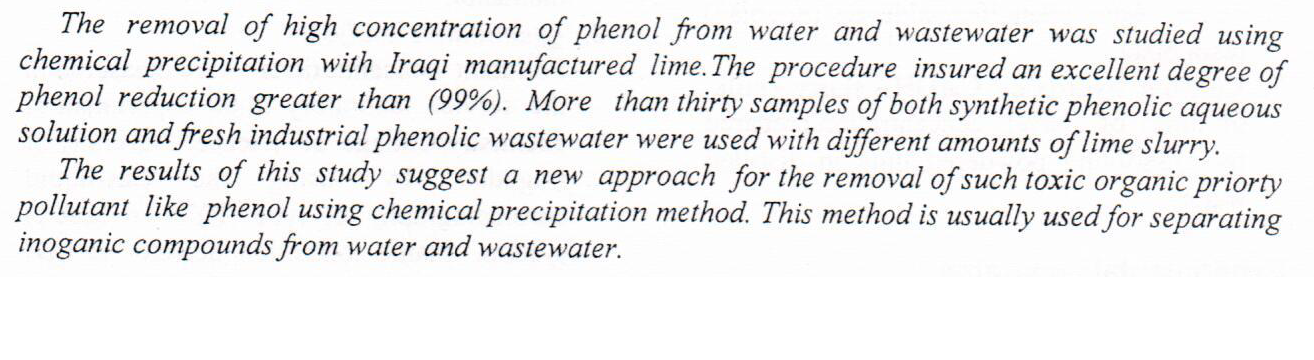
Removal of Phenol from Water and Wastewater by Chemical Precipitation with Lime

The present work aimed to study the efficiency of nanofiltration (NF) and reverse osmosis (RO) process for water recovery from electroplating wastewater and study the factors affecting the performance of two membrane processes. Nanofiltration and reverse osmosis membranes are made from polyamide as spiral wound module. The inorganic materials ZnCl2, CuCl2.2H2O, NiCl2.6H2O and CrCl3.6H2O were used as feed solutions. The operating parameters studied were: operating time, feed concentrations for heavy metal ions, operating pressure, feed flow rate, feed temperature and feed pH. The experimental results showed, the permeate concentration increased and water flux decreased with increase in time from 0 to 70 min. The permeate concentrations incre
... Show MoreA study was performed to evaluate heavy metals removal from sewage sludge using lime. The processes of stabilization using alkaline chemicals operating on a simple principle of raising pH to 12 or higher, with sufficient mixing and suitable contact time to ensure that immobilization can reduce heavy metals. A 0.157 m3 tank was designed to treat Al-Rustemeyia wastewater treatment plant sludge. Characteristics of raw sludge were examined through two parameters: pH and heavy metal analysis. Different lime doses of (0- 25) g CaO/100 g sludge were mixed manually with raw sludge in a rotating drum. The samples were analyzed two hours after mixing. pH and heavy metals results were compared with EPA and National Iraqi Stand
... Show More (4)
(4)

This study investigated the impact of lime stabilization on the fate and transformation of AgNPs. It also evaluated the changes in the population and diversity of the five most relevant bacterial phyla in soil after applying lime-stabilized sludge containing AgNPs. The study was performed by spiking an environmentally relevant concentration of AgNPs (2 mg AgNPs/g TS) in sludge, applying lime stabilization to increase pH to above 12 for two hours, and applying lime-treated sludge to soil samples. Transmission electron microscopy (TEM) and energy-dispersive X-ray spectroscopy (EDS) were used to investigate the morphological and compositional changes of AgNPs during lime stabilization. After the application of lime stabilized sludge to
... Show More (4)
(1)
(4)
(1)


In the present work, Response Surface Methodology (RSM) was utilized to optimize process variables and find the best circumstances for indirect electrochemical oxidation of mimicked wastewater to remove phenol contaminants using prepared ternary composite electrode. The electrodeposition process is used for the synthesis of a ternary composite electrode of Mn, Co, and Ni oxides. The selected concentrations of metal salts of these elements were 0.05, 0.1, and 1.5 M, with constant molar ratio, current density, and electrolysis time of 1:1:1, 25 mA/cm2, and 2 h. Interestedly, the gathered Mn-Co-Ni oxides were deposited at both the anode and cathode. X-ray diffraction (XRD) and scanning electron microscopy (SEM) facilitated the qualitative char
... Show More
(4)
(3)
(8)
(5)
(3)
(4)
This study was conducted to determine the ability of water treatment system (Vortisand) to reduce some chemical and physical properties for tigris river raw water, It consisted of turbidity, electrical conductivity, pH, total hardness, calcium Hardness as well as temperature in order to determine the unit`s efficiency for reducing their concentration as compared to those in the water produced by some classical potable water projects (Dora and Wathba) in Baghdad. Samples were collected during the cold months (December 2016 and January 2017) and during the hot months (May and June 2017). The results showed that this system has the ability to reduce some properties such as turbidity, the values were 215NTU in raw water and decreased to NTU
... Show MoreThe ability of using aluminum filings which is locally solid waste was tested as a mono media in gravity rapid filter. The present study was conducted to evaluate the effect of variation of influent water turbidity (10, 20and 30 NTU); flow rate(30, 40, and 60 l/hr) and bed height (30and60)cm on the performance of aluminum filings filter media for 5 hours run time and compare it with the conventional sand filter. The results indicated that aluminum filings filter showed better performance than sand filter in the removal of turbidity and in the reduction of head loss. Results showed that the statistical model developed by the multiple linear regression was proved to be
valid, and it could be used to predict head loss in aluminum filings
The removal of fluoride ions from aqueous solution onto algal biomass as biosorbent in batch and continuous fluidized bed systems was studied. Batch system was used to study the effects of process parameters such as, pH (2-3.5), influent fluoride ions concentration (10- 50 mg/l), algal biomass dose (0–1.5 g/ 200 ml solution), to determine the best operating conditions. These conditions were pH=2.5, influent fluoride ions concentration= 10 mg/l, and algal biomass dose=3.5 mg/l. While, in continuous fluidized bed system, different operating conditions were used; flow rate (0.667- 0.800 l/min), bed depth (8-15 cm) corresponded to bed weight of (80- 150 g). The results show that the breakthrough time increases with the inc
... Show MoreThe present work aims to study the removal of dyes from wastewater by reverse osmosis process. Two dyes were used direct blue 6, and direct yellow. Experiments were performed with feed concentration (75 – 450 ppm), operation temperature (30 – 50 oC) and time (0.2 – 2.0 hr). The membrane used is thin film composite membrane (TFC). It was found that modal permeate concentration decreases with increasing feed concentration and time operating, while permeate concentration increases with increasing feed temperature. Also it was found that product rate increase with increasing temperature, but it decrease with increasing feed concentration and time. The concentration of reject solution showed an increase with increasing feed concentratio
... Show More