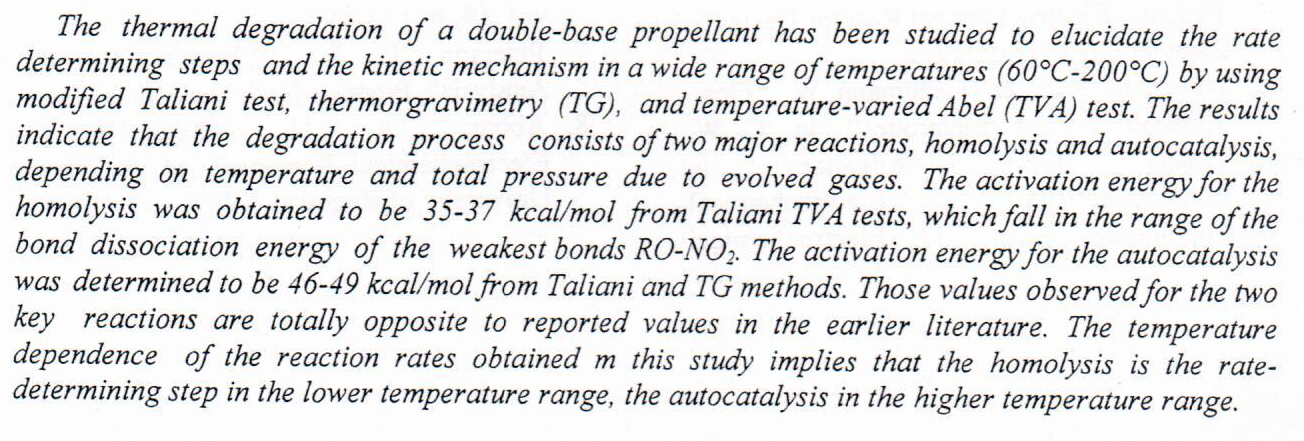
Kinetic Mechanism on Thermal Degradation of a Nitrate Ester Propellant

In this study, the thermal buckling behavior of composite laminate plates cross-ply and angle-ply all edged simply supported subjected to a uniform temperature field is investigated, using a simple trigonometric shear deformation theory. Four unknown variables are involved in the theory, and satisfied the zero traction boundary condition on the surface without using shear correction factors, Hamilton's principle is used to derive equations of motion depending on a Simple Four Variable Plate Theory for cross-ply and angle-ply, and then solved through Navier's double trigonometric sequence, to obtain critical buckling temperature for laminated composite plates. Effect of changing some design parameters such as, ortho
... Show More (1)
(1)
 (171)
(171)
This work provides a historical overview of water storage tanks used for solar energy collection, with a focus on the impact of different geometric configurations on thermal performance and energy storage efficiency. The designs of cylindrical, spherical, rectangular and triangular tanks were reviewed to analyse their effects on thermal gradients, heat retention and energy storage capacity. Within the scope of nominal processes, the study primarily aimed to identify the factors influencing the choice of tank shape in terms of size, capacity and aspect ratio. Another key objective was to assess what enhances heat storage in the tank to improve thermal efficiency. Comparing cylindrical shapes to other shapes, such as spherical, rectan
... Show More
 (18)
(11)
(18)
(11)
 (30)
(171)
(171)
(30)
(171)
(171)
This paper numerically and theoretically investigates the optical and thermal performance of a parabolic trough collector PTC system. Many numerical simulations and theoretical analyses are conducted to demonstrate the influence of the receiver geometry and shifting from the focal position on the optical performance. The examined receiver geometries are circular, square, triangular, elliptical, and the new circular–square combined geometry is named as channel receiver. The thermal performance of PTC is examined for different volume flow rates theoretically in the range of (0.36 to 2.4 lpm). The results show that the best optical design is the channel receiver with an intercept factor of 84%, while the worst is the elliptical receiver with
... Show More
(19)
(11)
In this study, silver nanoparticles (AgNPs) were synthesized using a cold plasma technique and a plasma jet. They were then used to explore how photothermal treatment may be used to treat lung cancer (A549) and normal cells (REF) <i>in vitro</i>. The anti-proliferative activity of these nanoparticles was studied after A549 cells were treated with (AgNPs) at various concentrations (100%, 50%, or 25%) and exposure times (6 or 8 min) of laser after 1 h or 24 h from exposed AgNPs. The highest growth inhibition for cancer cells is (75%) at (AgNPs) concentration (100%) and the period of exposure to the laser is (8 min). Particle size for the prepared samples varied according to the diameter o
... Show More
(4)
(2)
In this study, pebble bed as an absorber and storage material was placed in a south facing, flat plate air-type solar collector at fixed tilt angle of (45°). The effect of this material and differ- ent parameters on collector efficiency has been investigated experimentally and
theoretically. Two operation modes were employed to study the performance of the solar air heater. An inte- grated mode of continuous operation of the system during the period of (11:00 am – 3:00 pm) and non-integrated mode in which the system stored the solar energy through the day then used the stored energy during the period of (3:00 pm – 8:00 pm). The results of parametric study in case of continuous operating showed that the maximum average temperatur
(2)
The present project involves photodegrading the dye solochrom violet under advanced oxidation techniques at (25 oC) temperature and UV light. Zinc Oxide (ZnO) and UV radiation at a wavelength of 580 nm were used to conduct the photocatalytic reaction of the solochrom violet dye. One of the factors looked into was the impact of the starting conditions. pH, the amount of original hydrogen peroxide, and the dye concentration time radiation were used. For hours, the kinetics and percentages of degradation were examined at various intervals. In general, it has been discovered that the photodegradation rates of the dye were greater when H2O2 and ZnO were combined with UV light. The best wavelength to use was determined. Modern oxidation techni
... Show More