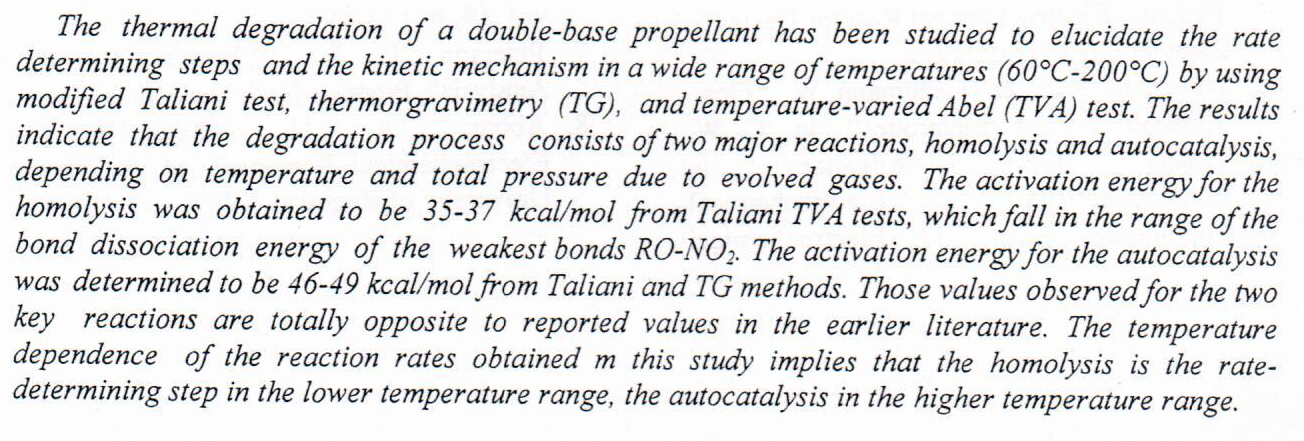
Kinetic Mechanism on Thermal Degradation of a Nitrate Ester Propellant

In order to take measures in controlling soil erosion it is required to estimate soil loss over area of interest. Soil loss due to soil erosion can be estimated using predictive models such as Universal Soil Loss Equation (USLE). The accuracy of these models depends on parameters that are used in equations. One of the most important parameters in equations used in both of models is (C) factor that represents effects of vegetation and other land covers. Estimating land cover by interpretation of remote sensing imagery involves Normalized Difference Vegetation Index (NDVI), an indicator that shows vegetation cover. The aim of this study is estimate (C) factor values for Part of Baghdad city using NDVI derived from satellite Image of Landsat-7
... Show More


In this work, the photocatalytic degradation of indigo carmine (IC) using zinc oxide suspension was studied. The effect of influential parameters such as initial indigo carmine concentration and catalyst loading were studied with the effect of Vis irradiation in the presence of reused ZnO was also investigated. The increased in initial dye concentration decreased the photodegradation and the increased catalyst loading increased the degradation percentage and the reused-ZnO exhibits lower photocatalytic activity than the ZnO catalyst. It has been found that the photocatalytic degradation of indigo carmine obeyed the pseudo-first-order kinetic reaction in presence of zinc oxide. This was found from plotting the relationship between ln
... Show More (12)
(12)
 (10)
(10)
Target tracking is a significant application of wireless sensor networks (WSNs) in which deployment of self-organizing and energy efficient algorithms is required. The tracking accuracy increases as more sensor nodes are activated around the target but more energy is consumed. Thus, in this study, we focus on limiting the number of sensors by forming an ad-hoc network that operates autonomously. This will reduce the energy consumption and prolong the sensor network lifetime. In this paper, we propose a fully distributed algorithm, an Endocrine inspired Sensor Activation Mechanism for multi target-tracking (ESAM) which reflecting the properties of real life sensor activation system based on the information circulating principle in the endocr
... Show More
(8)
(2)
(43)
(39)
Biomedical alloy 316L stainless steel enhancing to replace biological tissue or to help stabilize a biological structure, such as bone tissue, enhancing were coated with deposition a thin layer of silver nanoparticles as anti-bacterial materials by using DC- magnetron sputtering device. The morphology surface of The growth nanostructure under the influence of different working pressure were studied by atomic force microscope. The average grain size decrease but roughness of the silver thin layer was increased with‖ ―increasing the working pressure. The thickness of silver thin layer was increased from 107 nm at 0.08 mbar to 126 nm at 1.1 mbar. Antimicrobial activity of silver thin layers at different working pressure were studied. Th
... Show More
(2)
Adaptive responses in larval behavior may be of two kinds: Taxis: This involves a change in direction relative to source of a stimulus. Kinesis: Kinesis has no directional component, but involves change in the rate of performance in response to a stimulus. Drosophila larvae exhibited flexible behavioral responses associated with food acquisition and selection for different environmental conditions. In this investigation, we are concerned explosively with kinetic responses to food viability. Third instar larvae were subjected to test for thirty minutes in each of the following conditions i) in distilled water, ii) in Ringer's solution, iii) in glucose solution and on live yeast suspension. In each case the larva was in a thin layer of solu
... Show More
Simple and sensitive spectrophotometric method is described based on the coupling reaction of tetracycline hydrochloride (TC. HCl) with diazotized 4-aminopyridine in bulk and pharmaceutical forms. Colored azo dye formed during this reaction is measured at 433 nm as a function of time. Factors affecting the reaction yield were studied and the conditions were optimized. The kinetic study involves initial rate and fixed time (10 minutes) procedures for constructing the calibration graphs to determine the concentration of (TC. HCl). The graphs were linear for both methods in concentration range of 10.0 to 100.0 μg.mL-1. The recommended procedure was applied successfully in the determination of (TC. HCl) in its commercial formulations.
(3)
Simple and sensitive spectrophotometric method is described based on the coupling reaction of tetracycline hydrochloride(TC. HCl) with diazotized 4-aminopyridine in bulk and pharmaceutical forms. Colored azo dye formed during this reaction is measured at 433 nm as a function of time. Factors affecting the reaction yield were studied and the conditions were optimized. The kinetic study involves initial rate and fixed time (10 minutes) procedures for constructing the calibration graphs to determine the concentration of (TC. HCl). The graphs were linear for both methods in concentration range of 10.0 to 100.0 µg.mL-1. The recommended procedure was applied successfully in the determination of (TC. HCl) in itscommercial formulations.
... Show More
(3)
(3)
Background :Alkaline phosphatase (ALP) was a widely used marker for skeletal and hepatobiliary disorders, but its activity was also increased in atherosclerosis and peripheral vascular disease. Several study has showed that ALP activity was increased in the sera of diabetic patients. The current study was conducted to evaluate ALP activity in type 2 diabetic patients and optimum conditions for enzyme activity in their sera.Methods: This study was carried out at in AL-Yarmok hospital(diabetic center) between February /2009 and April /2009. Fifty two patients with type 2 diabetes have been enrolled. Besides BMI, WHR, serum fasting blood glucose, ALP, HbA1C,uric acid and lipid profile levels have been performed .The relationship bet
... Show More
(1)