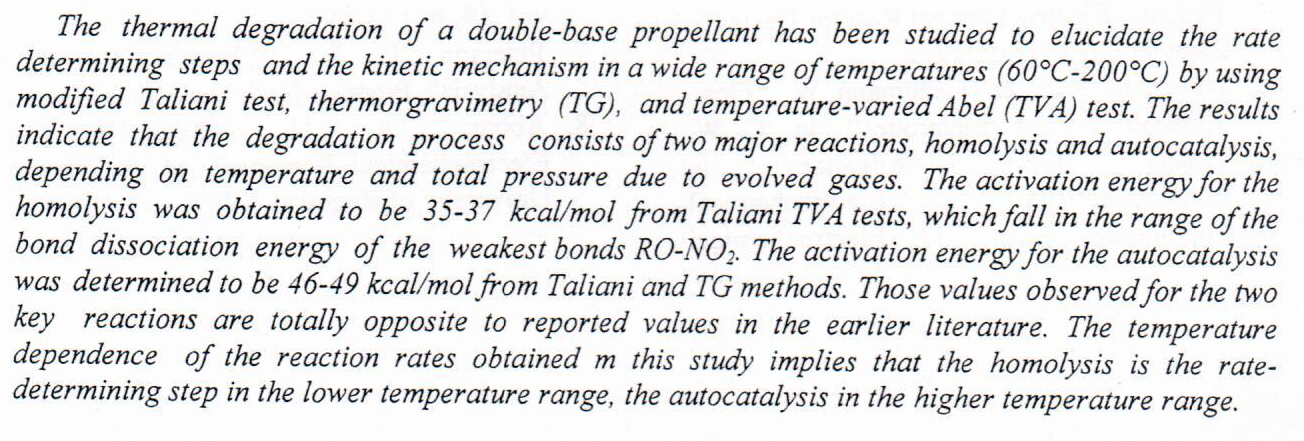
Kinetic Mechanism on Thermal Degradation of a Nitrate Ester Propellant

Thermal performance of closed wet cooling tower has been investigated experimentally and theoretically
in this work. The theoretical model based on heat and mass transfer equations and heat and mass transfer balance equations which are established for steady state case. A new small indirect cooling tower was used for conducting experiments. The cooling capacity of cooling tower is 1 kW for an inlet water temperature of 38oC, a water mass velocity 2.3 kg/m2.s and an air wet bulb temperature of 26oC. This study investigates the relationship between saturation efficiency, cooling capacity and coefficient of performance of closed wet cooling tower versus different operating parameters such wet-bulb temperature, variable air-spray water fl

 (28)
(28)
 (19)
(19)


Pathological blood clot in blood vessels, which often leads to cardiovascular diseases, are one of the most common causes of death in humans. Therefore, enzymatic therapy to degrade blood clots is vital. To achieve this goal, bromelain was immobilized and used for the biodegradation of blood clots. Bromelain was extracted from the pineapple fruit pulp (Ananas comosus) and purified by ion exchange chromatography after precipitation with ammonium sulphate (0-80 %), resulting in a yield of 70%, purification fold of 1.42, and a specific activity of 1175 U/mg. Bromelain was covalently immobilized on functionalized multi-walled carbon nanotubes (MWCNT), with an enzyme loading of 71.35%. The results of the characterization of free and immobilized
... Show More
Sawdust has the ability to adsorb the dyestuff from aqueous solution. It may be useful low cost adsorbent for the treatment of effluents, discharged from textile industries. The effectiveness of sawdust has been tested for the removal of color from the wastewater samples containing two dyes namely Direct Blue (DB) and Vat Yellow (VY). Effect of various parameters such as agitation time, adsorbent dose and initial concentration of each dye has been investigated in the present study. The adsorption of dyes has been tested with various adsorption isotherm models. The Langmuir isotherms model is found to be the most suitable one for the dye adsorption using sawdust and the maximum adsorption capacity is 8.706 mg/g and 6.975 mg/g for DB and V
... Show MoreCold plasma is a relatively low temperature gas, so this feature enables us to use cold plasma to treat thermally sensitive materials including polymers and biologic tissues. In this research, the non-thermal plasma system is designed with diameter (3 mm, 10 mm) Argon at atmospheric pressure as well as to be suitable for use in medical and biotechnological applications.
The thermal description of this system was studied and we observed the effect of the diameter of the plasma needle on the plasma, when the plasma needle slot is increased the plasma temperature decrease, as well as the effect of the voltages applied to the temperature of the plasma, where the temperature increasing with increasing the applied voltage . Results showed t
(2)
The objective of this research was to study the effect of physical exertion training on bio-kinetic abilities in weightlifting among students of Physical Education and Sports Sciences. The present study had a pre-posttest experimental design in which participants were recruited in two groups: experimental group and control group. A total of 30 students of Physical Education and Sports Sciences constituted the sample of the study. The sample selection was done by a comprehensive inventory method. Participants were equally allocated into two groups with n=15 in each group. Participants of experimental group were made to perform special physical exercises with three training units per week during eight weeks. The statisti
... Show More
In the current study, CuAl0.7In0.3Te2 thin films with 400 nm thickness were deposited on glass substrates using thermal evaporation technique. The films were annealed at various annealing temperatures of (473,573,673 and 773) K. Furthermore, the films were characterized by X-ray Diffraction spectroscopy (XRD), field emission scanning electron microscopy (FESEM), atomic force microscopy (AFM), and Ultra violet-visible (UV–vis). XRD patterns confirm that the films exhibit chalcopyrite structure and the predominant diffraction peak is oriented at (112). The grain size and surface roughness of the annealed films have been reported. Optical properties for the synthesized films including, absorbance, transmittance, dielectric constant, and refr
... Show More
(10)
(8)
In this research, hand lay- up technique is used to prepare samples from epoxy resin reinforced with multi- walled carbon nanotubes in different weight fractions (0, 2, 3, 4, 5) wt%. The immersion effect by sodium hydroxide solution (NaOH) at normality (0.3N) for a period of (15 days) on the thermal conductivity of nanocomposites was studied, and compared to natural condition (before immersion). The thermal conductivity of epoxy nanocomposites specimens were carried out using Lee’s disk method. The experimental results showed that thermal conductivity increased with increase weight fraction before and after immersion for all specimens, while the immersion effect leads to decrease thermal conductive values compared to thermal conductivi
... Show More
(10)
(8)