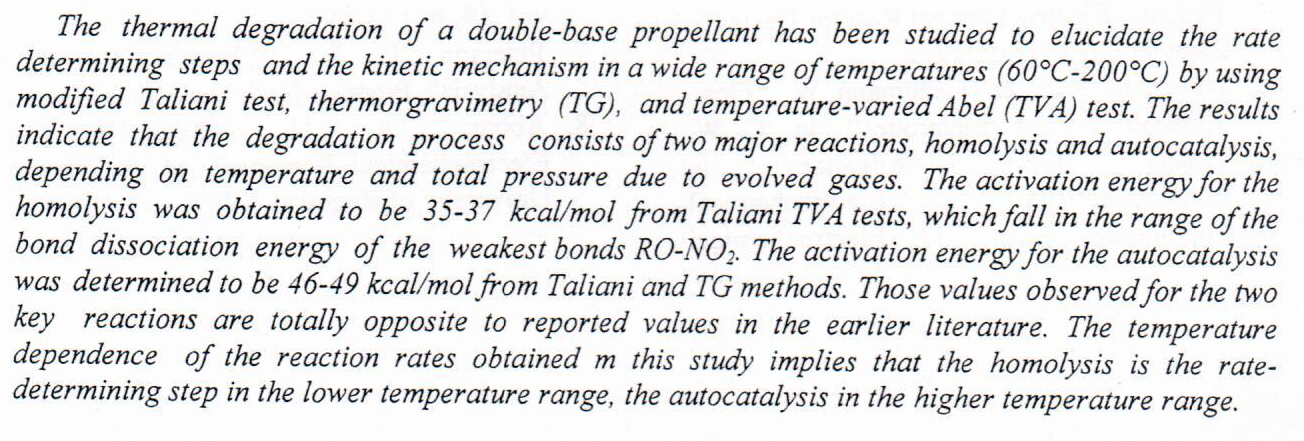
Kinetic Mechanism on Thermal Degradation of a Nitrate Ester Propellant

A new copolymer (MFA) was prepared from condensation of melamine (M) with p- methyl – anisole (A) in the presence of condensation agent like 37% (w/v) of formaldehyde. The new copolymer was characterized by elemental, IR and HNMR spectra. The chelating ion-exchange property of this polymer was studied for methylene blue dye in aqueous solution in 100-200ppm concentrations. The adsorption study was carried out over a wide range of pH, shaking time and in media of various kinetic parameters models. Thermal parameters like enthalpy, entropy and Gibbs free energy of adsorption process of methylene blue on surface of MFA resin were determined on the basis of kinetic parameters at different temperatures. To describe the equilibrium of adsorp
... Show More
Phase change materials (PCMs) such as paraffin wax can be used to store or release large amount of energy at certain temperature at which their solid-liquid phase changes occurs. Paraffin wax that used in latent heat thermal energy storage (LHTES) has low thermal conductivity. In this study, the thermal conductivity of paraffin wax has been enhanced by adding different mass concentration (1wt.%, 3wt.%, 5wt.%) of (TiO2) nano-particles with about (10nm) diameter. It is found that the phase change temperature varies with adding (TiO2) nanoparticles in to the paraffin wax. The thermal conductivity of the composites is found to decrease with increasing temperature. The increase in thermal conductivity ha
... Show MoreThis paper presents a sight about the chemical structure deformation of poly (ethylene-co-vinyl acetate) (EVA) samples according to the change ratio of rate constant values. Spectroscopy kinetics fluorescence curves are fitted for two characteristic wavelength domains of fluorescent intensities. The short wavelengths (320-400 nm) domain show spectra overlapping, while at long wavelengths (400-800 nm) domain spectra are arranged in regular for each specific accelerated aging time. The ratio of kinetics rate constant at long wavelengths to kinetics rate constant of short wavelengths is the criterion of the degree chemical structure deformation. Molar extrin
... Show More (16)
(16)
 (13)
(13)

 (2)
(2)
(2)
(2)
This work describes the weathering effects (UV-Irradiation, and Rain) on the thermal conductivity of PS, PMMA, PS/PMMA blend for packaging application. The samples were prepared by cast method at different ratios (10, 30, 50, 70, and 90 %wt). It was seen that the thermal conductivity of PMMA (0.145 W/m.K), and for PS(0.095 W/m.K), which increases by PS ratio increase up to 50% PS/PMMA blend then decreased that was attributed to increase in miscibility of the blend involved. By UV-weathering, it was seen that thermal conductivity for PMMA increased with UV-weathering up to (30hr) then decreased, that was attributed to rigidity and defect formation, respectively. For 30%PS/PMMA, there results showed unsystematic decrease in thermal conduct
... Show More
(37)
(24)
AlPO4 solid acid catalyst was prepared in order to use it in transesterification reaction of edible oil after supporting it with tungsten oxide. The maximum conversion of edible oil was obtained 78.78% at catalyst concentration (5gm.), temperature 70°Ϲ, 30/1 methanol/edible oil molar ratio, and time 5hr. The study of kinetics of the transesterification reaction of edible oil indicates that the reaction has an order of 3/2, while the value of activation energy for transesterification reaction is 51.367 kJ/mole and frequency factor equal 26219.13(L/ mol.minute).
(1)
AlPO4 solid acid catalyst was prepared in order to use it in transesterification reaction of edible oil after supporting it with tungsten oxide. The maximum conversion of edible oil was obtained 78.78% at catalyst concentration (5gm.), temperature 70°Ϲ, 30/1 methanol/edible oil molar ratio, and time 5hr. The study of kinetics of the transesterification reaction of edible oil indicates that the reaction has an order of 3/2, while the value of activation energy for transesterification reaction is 51.367 kJ/mole and frequency factor equal 26219.13(L/ mol.minute).
(1)
The investigation of the effect of tempering on thermal analysis of
Al-Ti-Si alloy and its composites with MgO and SiC particles was
performed. Thermal analysis was performed before and after
tempering by DSC scan. Optical microscopy was used to identify the
phases and precipitations that may be formed in base alloy and
composites. X-ray diffraction test indicated that the Al3Ti is the main
phase in Al-Ti-Si alloy in addition to form Al5Ti7Si12 phase. Some
chemical reactions can be occurred between reinforcements and
matrix such as MgO.Al2O3 in Al-Ti/MgO, and Al4C3 and Al(OH)3 in
Al-Ti/SiC composite. X-ray florescence technique is used to
investigate the chemical composition of the fabricated specimens.
H
(1)
In this paper the effect of thermal annealing on the structural and optical properties of Antimony Selenide (Sb2Se3) is investigated. Sb2Se3 powder is evaporated on clean amorphous glass substrates at room temperature under high vacuum pressure (4.5×10⁻⁶ mbar) to form thin films. The structural investigation was done with the aid of X-ray diffraction (XRD) and atomic force microscopy (AFM). The amorphous to polycrystalline transformation of these thin films was shown by X-ray diffraction analysis after thermal annealing. These films' morphology is explained. (UV-Vis ) spectra in ranges from 300 to 1100 nm was used to examine the optical properties of the films .The absorption coefficient and optical energy gap of the investigated films are
... Show More
(1)