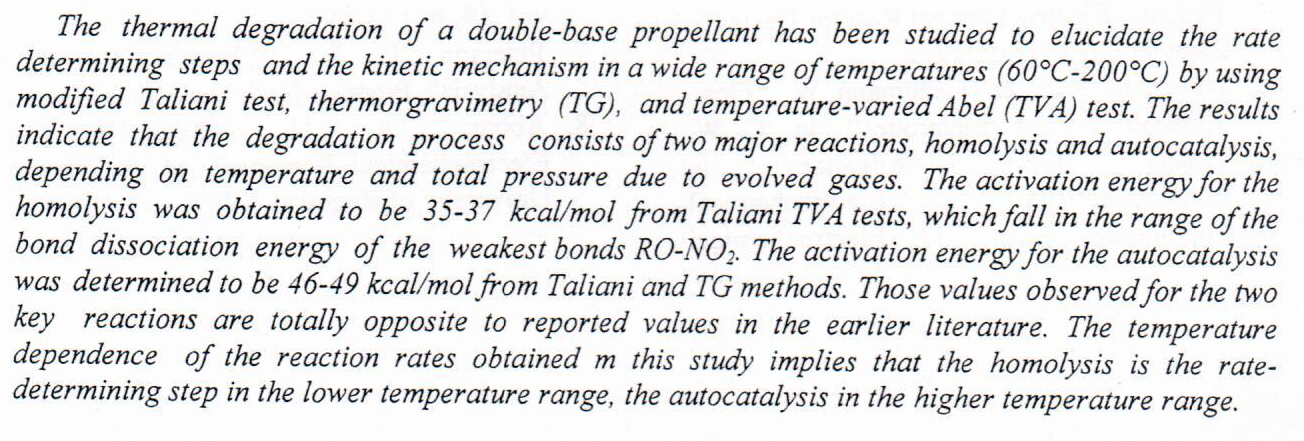
Kinetic Mechanism on Thermal Degradation of a Nitrate Ester Propellant

 (1)
(1)
 (1)
(1)



Electro-kinetic remediation technology is one of the developing technologies that offer great promise for the cleanup of soils contaminated with heavy metals. A numerical model was formulated to simulate copper (Cu) transport under an electric field using one-dimensional diffusion-advection equations describing the contaminant transport driven by chemical and electrical gradients in soil during the electro-kinetic remediation as a function of time and space. This model included complex physicochemical factors affecting the transport phenomena, such as soil pH value, aqueous phase reaction, adsorption, and precipitation. One-dimensional finitedifference computer program successfully predicted meaningful values for soil pH profiles and Cu
... Show More
(4)
This paper investigates a new approach to the rapid control of an upper limb exoskeleton actuator. We used a mathematical model and motion measurements of a human arm to estimate joint torque as a means to control the exoskeleton’s actuator. The proposed arm model is based on a two-pendulum configuration and is used to obtain instantaneous joint torques which are then passed into control law to regulate the actuator torque. Nine subjects volunteered to take part in the experimental protocol, in which inertial measurement units (IMUs) and a digital goniometer were used to measure and estimate the torque profiles. To validate the control law, a Simscape model was developed to simulate the arm model and control law in which measurem
... Show More
(4)
(3)
This work is aiming to study and compare the removal of lead (II) from simulated wastewater by activated carbon and bentonite as adsorbents with particle size of 0.32-0.5 mm. A mathematical model was applied to describe the mass transfer kinetic.
The batch experiments were carried out to determine the adsorption isotherm constants for each adsorbent, and five isotherm models were tested to choose the best fit model for the experimental data. The pore, surface diffusion coefficients and mass transfer coefficient were found by fitting the experimental data to a theoretical model. Partial differential equations were used to describe the adsorption in the bulk and solid phases. These equations were simplified and the
... Show MoreThe world is confronted with the twin crisis of fossil fuel depletion and environmental degradation caused by fossil fuel usage. Biodiesel produced from renewable feedstocks such as Jatropha seed oil or animal fats by transesterification offers a solution. Although biodiesel has been produced from various vegetable oils such as Jatropha seed oil, the reaction kinetics studies are very few in literature, hence the need for this study. Jatropha curcas seed oil was extracted and analyzed to determine its free fatty acid and fatty acid composition. The oil was transesterified with methanol at a molar ratio of methanol to oil 8:1, using 1% sodium hydroxide catalyst, at different temperature
... Show More
(2)
thin films of se:2.5% as were deposited on a glass substates by thermal coevaporation techniqi=ue under high vacuum at different thikness
(36)
(29)
(36)
(30)
EM International
In the present study, semi – batch experiments were conducted to investigate the efficiency of ozone microbubbles (OMBs) in the treatment of aqueous dye solutions methylene orange under different reaction conditions such as effect of initial solution pH , ozone generation rate and initial MO-concentration. The results showed that the removal of MO by OMBs were very high at the acidic and alkaline media and upon increasing the generation rate of ozone from 0.498 to 0.83 mg/s, the removal efficiency dramatically increased from 75to 100% within 15 min. The rate of oxidation reaction followed a pseudo first- order kinetic model. The results demonstrated that OMBs is efficient in terms of the decline of methylene orange c
... Show More
(13)