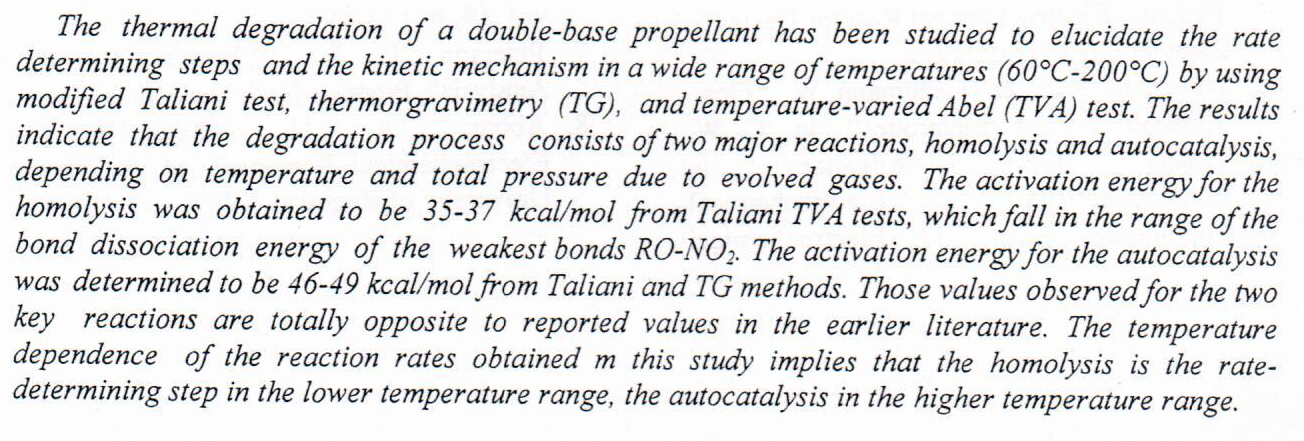
Kinetic Mechanism on Thermal Degradation of a Nitrate Ester Propellant

The researchers wanted to make a new azo imidazole as a follow-up to their previous work. The ligand 4-[(2-Amino-4-phenylazo)-methyl]-cyclohexane carboxylic acid as a derivative of trans-4- (aminomethyl) cyclohexane carboxylic acid diazonium salt, and synthesis a series of its chelate complexes with metalions, characterized these compounds using a variety technique, including elemental analysis, FTIR, LC-Mass, 1H-NMRand UV-Vis spectral process as well TGA, conductivity and magnetic quantifications. Analytical data showed that the Co (II) complex out to 1:1 metal-ligand ratio with square planner and tetrahedral geometry, respectively while 1:2 metal-ligand ratio in the Cu(II), Cr(III), Mn(II), Zn(II), Ru(III)and Rh(III)complexes with octahed
... Show More (43)
(43)
 (13)
(13)


A hand lay-up method was used to prepare Epoxy/ metal composites. Epoxy resin (EP) was used as a matrix with metal particles (Al, Cu, and Fe) as fillers.
The preparation method includes preparing square panels of composites with different weight percentage of fillers (10, 20, 30, 40, and 50%). Standard specimens (88mm in diameter) for thermal conductivity tests were prepared to measure thermal conductivity kexp.The result of experimental thermal conductivity kexp, for EP/metal composites show that, kexp increase with increasing weight percentage, For EP/ Al and EP/Cu composites, and it have have maximum values of 0.33 and 0.35 W/m.K, respectively. While kexp for EP/ Fe composite show slight increase with maximum value of 0.186 W/m.K.
(33)
(29)

Corrosion inhibitors are widely used in industry to reduce the corrosion rate of metals and alloys. Corrosion inhibitors adsorb onto metallic surfaces and insulate them from deterioration. Plants abundant in nature offer a cost-effective replacement for toxic chemical inhibitors on the market. The current research used the potentiostatic polarization technique at room temperature to explore the inhibitory impact of water hyacinth extract on the corrosion of low-carbon steel specimens in a 3.5% NaCl solution. The Tafel curve was used to assess corrosion inhibition activity, with the best inhibition efficiency reaching 79.36% at a concentration of 200 ppm. Cyclic polarization indicated the type of corrosion was general corrosion. The
... Show More
(1)
In this study, titanium dioxide (TiO2) nanoparticles incorporated with cement were synthesis by a simple casting method as a function concentration of TiO2 (0.2, 0.4, 0.8, 1, and 2 wt%). The prepared samples were characterized using the technique of Field Emission Scanning Electron Microscope (FESEM) and UV-Visible spectrophotometer, which was used to measure the adsorption spectra. The observed photocatalytic efficiency of TiO2 nanoparticles (NP) incorporated with cement was investigated by decomposing the dye methyl blue (MB) solution under sunlight irradiation. According to the slope, the value of the k constant at the best sample is 0.8wt%, k=0.8265 min-1. FESEM image of the TiO2
... Show More
In the present work a dynamic analysis technique have been developed to investigate and characterize the quantity of elastic module degradation of cracked cantilever plates due to presence of a defect such as surface of internal crack under free vibration. A new generalized technique represents the first step in developing a health monitoring system, the effects of such defects on the modal frequencies has been the main key quantifying the elasticity modulii due to presence any type of un-visible defect. In this paper the finite element method has been used to determine the free vibration characteristics for cracked cantilever plate (internal flaws), this present work achieved by different position of crack. Stiffness re
... Show MoreIn this paper, new brain tumour detection method is discovered whereby the normal slices are disassembled from the abnormal ones. Three main phases are deployed including the extraction of the cerebral tissue, the detection of abnormal block and the mechanism of fine-tuning and finally the detection of abnormal slice according to the detected abnormal blocks. Through experimental tests, progress made by the suggested means is assessed and verified. As a result, in terms of qualitative assessment, it is found that the performance of proposed method is satisfactory and may contribute to the development of reliable MRI brain tumour diagnosis and treatments.
(3)
(59)
(56)
A simple, accurate, and cost-efficient UV-Visible spectrophotometric method has been developed for the determination of naphazoline nitrate (NPZ) in pure and pharmaceutical formulations. The suggested method was based on the nucleophilic substitution reaction of NPZ with 1,2-naphthoquinone-4-sulfonate sodium salt in alkaline medium at 80°C to form an orange/red-colored product of maximum absorption (λmax) at 483 nm. The stoichiometry of the reaction was determined via Job's method and limiting logarithmic method, and the mechanism of the reaction was postulated. Under the optimal conditions of the reaction, Beerʼs law was obeyed within the concentration range 0.5–50 μg/mL, the molar absorptivity value (ε) was 5766.5 L × mol–1 × c
... Show More
(1)