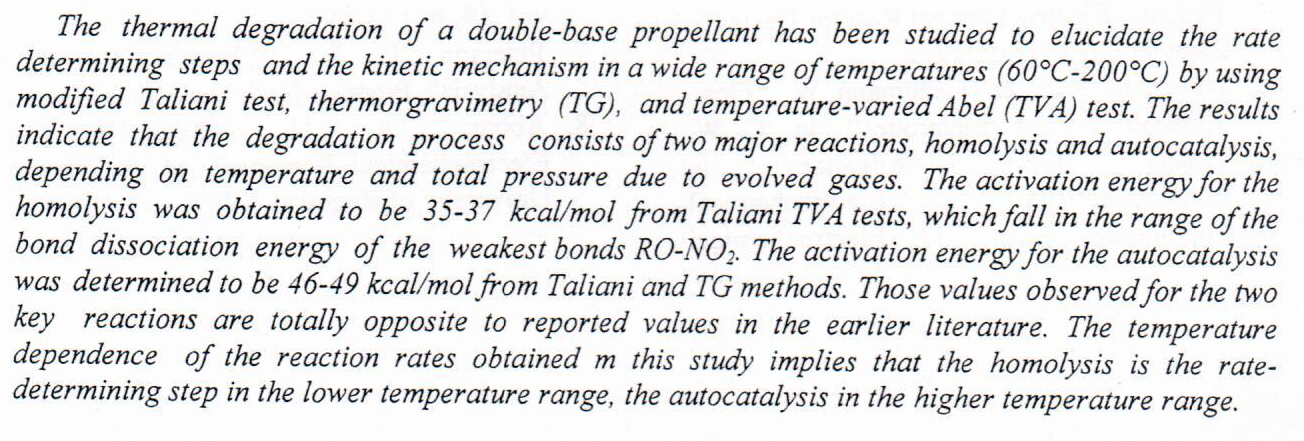
Kinetic Mechanism on Thermal Degradation of a Nitrate Ester Propellant

Polyvinyl chloride (PVC) finds use in various industries due to its versatility but is not thermostable, serving as a barrier to causing degradation and release of hydrochloric acid (HCl) under heat stress conditions. Lead and organotin compounds have traditionally been used for stabilizer purpose to discourage such degradation but pose serious ecological as well as health risks. As a counter measure, bio-based stabilizers from plant oils have become popular as a green and sustainable alternative. This review looks back at recent developments in plant oil-based stabilizers for PVC, focusing on the mechanisms of stabilization, sustainability, and cost-effectiveness. We review plant oils such as tung oil, castor oil, and soybean oil,
... Show More
The aim of this study to identify patterns of cerebral control (right and left) for second grade students in the collage of physical education and sports science of the University of Baghdad, as well as identify the definition of theThe Effect of Using the Bybee Strategy(5ES) according to Brain Control Patterns in Learning a Kinetic Series on Floor exercises in Artistic Gymnastics for menمجلة الرياضة المعاصرةالمجلد 19 العدد 1 عام 2020effect using the (Bybee) strategy (5ES) according to brain control patterns inlearning a Kinetic series on floor exercises In artistic gymnastics for men, andidentify the best combination between the four research groups learn, use Finderexperimental method research sample consi
... Show More
In the present study, activated carbon supported metal oxides was prepared for thiophene removal from model fuel (Thiophene in n-hexane) using adsorptive desulfurization technique. Commercial activated carbon was loaded individually with copper oxide in the form of Cu2O/AC. A comparison of the kinetic and isotherm models of the sorption of thiophene from model fuel was made at different operating conditions including adsorbent dose, initial thiophene concentration and contact time. Various adsorption rate constants and isotherm parameters were calculated. Results indicated that the desulfurization was enhanced when copper was loaded onto activated carbon surface. The highest desulfurization percent for Cu2O/AC and o
... Show MoreKinetics and mechanism studies of oxidation of some α-amino acids (Proline, Arginine, Alanine) (AA) by N-Bromosuccinimide (NBS) by using conductivity method was carried out. The kinetic study showed that the reaction was first order with respect to NBS and AA. The effect of addition of HClO4 to the reaction was negative on the rate of reaction. The reaction was carried out at different temperatures in which * * * , S , G were calculated. The rate of reaction of AA was as follows: Proline > Arginine > Alanine
Our research which is under the name "Polarization and Communication mechanism in the formation of green industrial products " The problem of the research focuses in identifying what is polarization and its function mechanisms , by displaying the inventive and creative cases of the designer in how to exploit the industrial products and its recycling process to attract the user and recipient by asserting on the values of beauty of the appearance of the industrial product with the attraction Of the user and the recipient with the new function of that product and how its different from the function achieved by the old product , with consideration of nature and its preservation . The results of the research were as following : The designer e
... Show More
This study used a continuous photo-Fenton-like method to remediate textile effluent containing azo dyes especially direct blue 15 dye (DB15). A Eucalyptus leaf extract was used to create iron/copper nanoparticles supported on bentonite for use as catalysts (E@B-Fe/Cu-NPs). Two fixed-bed configurations were studied and compared. The first one involved mixing granular bentonite with E@B-Fe/Cu-NPs (GB- E@B-Fe/Cu-NPs), and the other examined the mixing of E@B-Fe/Cu-NPs with glass beads (glass beads-E@B-Fe/Cu-NPs) and filled to the fixed-bed column. Scanning electron microscopy (SEM), zeta potential, and atomic forces spectroscopy (AFM) techniques were used to characterize the obtained particles (NPs). The effect of flow rate and DB15 concent
... Show More (3)
(3)
 (1)
(1)

The design of components subjected to contact stress as local compressive stress is important in engineering application especially in ball and socket Joining. Two kinds of contact stress are introduced in the ball and socket joint, the first is from normal contact while the other is from sliding contact. Although joining two long links (drive shaft in steering cars) will cause the effect of flexural and tensional buckling stress in hollow columns through the ball and socket ends on the failure condition of the joining mechanism. In this paper the consideration of the combined effect of buckling Load and contact stress on the ball and socket joints have been taken, epically on the stress distribution in the contact area. Different
... Show MoreThe removal of Ibuprofen antibiotics (IBU) by photo-degradation UV/H2O2/Fe+2 system was investigated in a batch reactor under different initial concentrations of H2O2 (100-500) mg/L, Fe+2 (10-40) mg/L, pH (3-9) and initial concentrations of IBU (10-80) mg/L, and their relationship with the degradation efficiency were studied. The result demonstrated that the maximum elimination of IBU was 85.54% achieved at 300 mg/L of H2O2, 30 mg/L of Fe+2, pH=3, and irradiation time of 150 min, for 10 mg/L of IBU. The results have shown that the oxidation reagent H2O2 plays a very important role in IBU degradation.
(9)
To evaluate and improve the efficiency of photovoltaic solar modules connected with linear pipes for water supply, a three-dimensional numerical simulation is created and simulated via commercial software (Ansys-Fluent). The optimization utilizes the principles of the 1st and 2nd laws of thermodynamics by employing the Response Surface Method (RSM). Various design parameters, including the coolant inlet velocity, tube diameter, panel dimensions, and solar radiation intensity, are systematically varied to investigate their impacts on energetic and exergitic efficiencies and destroyed exergy. The relationship between the design parameters and the system responses is validated through the development of a predictive model. Both single and mult
... Show More
(31)
(38)

The researchers wanted to make a new azo imidazole as a follow-up to their previous work. The ligand 4-[(2-Amino-4-phenylazo)-methyl]-cyclohexane carboxylic acid as a derivative of trans-4-(aminomethyl) cyclohexane carboxylic acid diazonium salt, and synthesis a series of its chelate complexes with metalions, characterized these compounds using a variety technique, including elemental analysis, FTIR, LC-Mass, 1H-NMRand UV-Vis spectral process as well TGA, conductivity and magnetic quantifications. Analytical data showed that the Co (II) complex out to 1:1 metal-ligand ratio with square planner and tetrahedral geometry, respectively while 1:2 metal-ligand ratio in the Cu(II), Cr(III), Mn(II), Zn(II), Ru(III)and Rh(III)complexes
... Show More
(43)
(13)