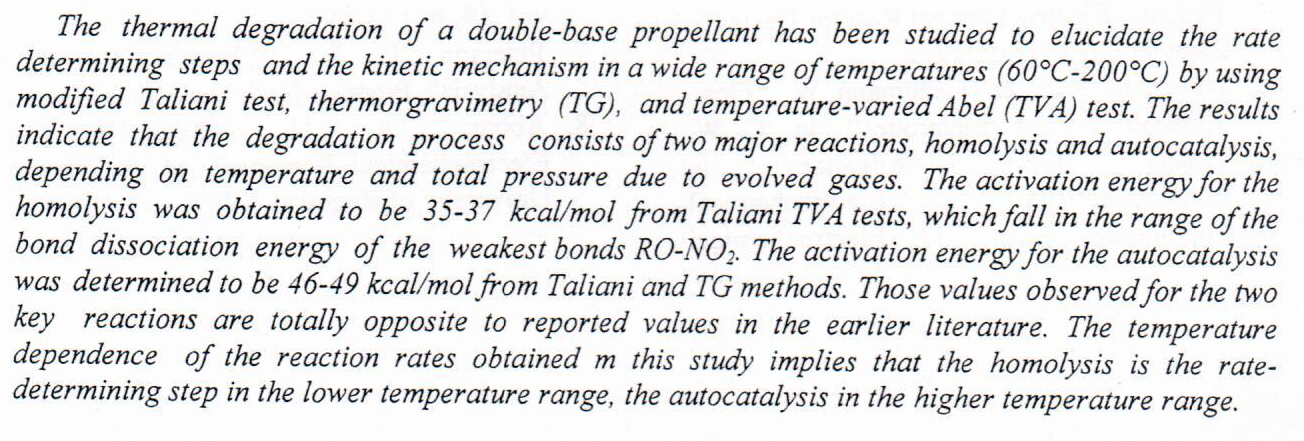
Kinetic Mechanism on Thermal Degradation of a Nitrate Ester Propellant

This researchable paper aims to focus of the role & mechanism of market makers in Iraqi stock market through analyzing its role in other Arabian as well as global stock ones, especially in current period through activate the use of bonds, shares, and trying to create a continued price balance. Then decreasing the opportunity having gaps between highest and lowest level without reasonable causes. In addition trying to deactivate the common decision without supported information. Moreover, this paper aims to explain the rules of increasing liquidity and having balance to lead the market into positive direction. Thus, for achieving the above-mentioned requirements, such conditions should be underlined by market makers as well as t
... Show More
The present study is concerned with the role of income tax in implementing economic goals in Iraq and treating the problems and pitfalls in the Iraq economy.
The study also aims at investigating the role of income tax in attracting promising favorite effects into economy.
The study was performed on data covering the period (2003 - 2012) with respect to the variables of (income tax, oil profits) as independent variables and (private consuming expenditure, private investmental expenditure, and standard figure of prices) as dependent variables. To analyze these data, a number of statistical descriptive and analytical techniques were used such as (percentage, standard variance, mediums, F test, T test and SPSS). It has been c
... Show MoreIn the present work, bentonite clay was used as an adsorbent for the removal of a new prepared mono azo dye, 4-[6-bromo benzothiazolyl azo] thymol (BTAT) using batch adsorption method. The effect of many factors like adsorption time, adsorbent weight, initial BTAT concentration and temperature has been studied. The equilibrium adsorption data was described using Langmuir and frundlich adsorption isotherm. Based on kinetics study, it was found that the adsorption process follow pseudo second order kinetics. Thermodynamics data such as Gibbes Free energy ∆Gᵒ, entropy ∆Sᵒ and ∆Hᵒ were also determined using Vant Hoff plot.
 (5)
(5)

In the present work, the thermo-fluid characteristics of a heat exchanger formed of helical coiled tubes immersed in cold water are investigated experimentally. Two types of helical coiled tube are tested, a conventional vertical single helical coiled tube and a new triple vertical helical coiled tube in parallel connection called as meshed coils. The effect of hot water flow rates inside the tubes (ranges from 2.67 to 7.08 l/min), and its inlet temperatures (namely 50, 60, 70 and 80 °C) are investigated. The experimental results show that increasing the flow rate inside the meshed coils leads to decrease the temperature difference between inlet and outlet. An enhancement of heat transfer for meshed coils compared to single coil has been n
... Show More
(13)
 (10)
(10)
Aleppo bentonite was investigated to remove ciprofloxacin hydrochloride from aqueous solution. Batch adsorption experiments were conducted to study the several factors affecting the removal process, including contact time, pH of solution, bentonite dosage, ion strength, and temperature. The optimum contact time, pH of solution and bentonite dosage were determined to be 60 minutes, 6 and 0.15 g/50 ml, respectively. The bentonite efficiency in removing CIP decreased from 89.9% to 53.21% with increasing Ionic strength from 0 to 500mM, and it increased from 89% to 96.9% when the temperature increased from 298 to 318 K. Kinetic studies showed that the pseudo second-order model was the best in describing the adsorption sys
... Show More
(9)
(6)

In this work, a convex lens concentrating solar collector is designed and manufactured locally by using 10 convex lenses (concentrator) of a diameter 10cm and one Copper absorber tube of a diameter 12.5mm and 1mm in thickness 1m length. Two axes manual Tracking system also constructed to track the sun continuously in two directions. The experiments are made on 17th of May 2015 in climatic conditions of Baghdad. The experimental data are fed to a computer program to solve the thermal performing equation, to find efficiency and actual useful energy. Then this data is used in numerical CFD software for three different absorber diameters (12.5 mm, 18.75 mm and 25 mm). From the results that obtained the maximum the
... Show More
(58)
(55)
Fatty Acid Methyl Ester (FAME) produced from biomass offers several advantages such as renewability and sustainability. The typical production process of FAME is accompanied by various impurities such as alcohol, soap, glycerol, and the spent catalyst. Therefore, the most challenging part of the FAME production is the purification process. In this work, a novel application of bulk liquid membrane (BLM) developed from conventional solvent extraction methods was investigated for the removal of glycerol from FAME. The extraction and stripping processes are combined into a single system, allowing for simultaneous solvent recovery whereby low-cost quaternary ammonium salt-glycerol-based deep eutectic solvent (DES) is used as the membrane phase.
... Show More
(11)
(10)
(63)
(50)