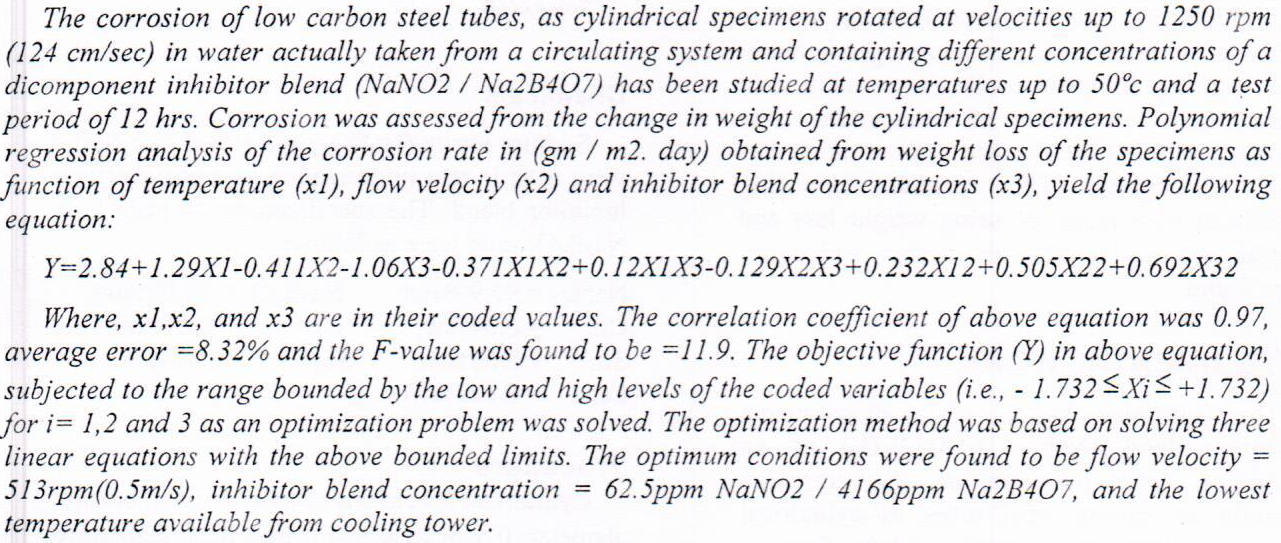
The Influence of Temperature and Flow Velocity on the Corrosion Inhibition of Low Carbon Tubes in Recirculating Water System by a Dicomponent Inhibitor Blend

Zinc oxide (ZnO) nanostructures were synthesized through the hydrothermal method at various conditions growth times (6,7 and 8 hrs.) and a growth temperature (70, 90, and 100 ºC). The prepared ZnO nanostructure samples were described using scanning electron microscopy (SEM) and X-ray diffractometer to distinguish their surface morphologies and crystal structures. The ZnO samples were confirmed to have the same crystal type, with different densities and dimensions (diameter and length). The obtained ZnO nanostructures were used to manufacture gas sensors for NO2 gas detection. Sensing characteristics for the fabricated sensor to NO2 gas were examined at different operating temperatures (180, 200, 220, and 240) ºC with a low gas concentrati
... Show More (3)
(3)
 (1)
(1)


The solidification process in a multi-tube latent heat energy system is affected by the natural convection and the arrangement of heat exchanger tubes, which changes the buoyancy effect as well. In the current work, the effect of the arrangement of the tubes in a multi-tube heat exchanger was examined during the solidification process with the focus on the natural convection effects inside the phase change material (PCM). The behavior of the system was numerically analyzed using liquid fraction and energy released, as well as temperature, velocity and streamline profiles for different studied cases. The arrangement of the tubes, considering seven pipes in the symmetrical condition, are assumed at different positions in the system, i
... Show More
(22)
(23)

In this study, polymeric coating was developed by incorporating nano graphene in the polymer blend with applications to oil storage tanks. The oil storage tanks samples were brought from the oil Pipeline Company / Doura refinery in Baghdad. The coating polymer was formed with a blend (epoxy resin and repcoat ZR). The proportion of mixing the mixture was 3:1:1 epoxy resin 21.06 gm: repcoat ZR 10.53 gm: hardener 10.53 gm. The blend/graphene was prepared using in stui-polymerization method with different weight percentage 1, 3, 5, and 7 wt % added to blend. The resulting solution was put in a glass tube on a magnetic stirrer for one hour at a temperature of 40 °C. The result of contact angle and wate
... Show More
(2)
The Corrosion protection effectiveness of Alimina(Al2O3,50nm)and Zinc oxide (ZnO,30nm) nanoparticales were studied on carbon steel and 316 stainless steel alloys in saline water (3.5%NaCl)at four temperatures: (20,30,40,50 OC)using three electrodes potentiostat. An average corrosion protection efficiencies of 65 %and 80% was achieved using Al2O3 NP's on carbon steel and stainless steel samples respectively, and it seems that no effect of rising temperature on the performances of the coated layers. While ZnO NP'S showed protection efficiency around 65% for the two alloys and little effected by temperature rising on the performanes of the coated layers. The morphology of the coated spesiemses was examined by Atomic force microscope.
(2)
In this research, non-thermal plasma system of argon gas is designed to work at normal atmospheric pressure and suitable for work in medical and biotechnological applications. This technique is applied in the treatment of the Staphylococcus epidermidis bacteria and show the role of the flow rate of Argon gas on the killing rate of bacteria, and it obtained a 100 % killing rate during the time of 5 minutes at the flow Argon gas of 5 liters/ min.
(1)
(15)
(9)
(1)
This paper investigates the effect of magnetohydrodynamic (MHD) of an incompressible generalized burgers’ fluid including a gradient constant pressure and an exponentially accelerate plate where no slip hypothesis between the burgers’ fluid and an exponential plate is no longer valid. The constitutive relationship can establish of the fluid model process by fractional calculus, by using Laplace and Finite Fourier sine transforms. We obtain a solution for shear stress and velocity distribution. Furthermore, 3D figures are drawn to exhibit the effect of magneto hydrodynamic and different parameters for the velocity distribution.
(3)
(2)
