The Influence of Temperature and Flow Velocity on the Corrosion Inhibition of Low Carbon Tubes in Recirculating Water System by a Dicomponent Inhibitor Blend

The corrosion inhibition of low carbon steel in1N HCl solution in the presence of peach juice at temperature (30,40,50,and 60)°C at concentration ( 5, 10, 20, 30, 40and 50 cm3/L)were studied using weight loss and polarization techniques. Results show that the inhibition efficiency was increased with the increase of inhibitor concentration and increased with the increase of temperature up to 50ºC ,above 50ºC (i.e. at 60 ºC) the values of efficiency decreases. Activation parameters of the corrosion process such as activation energies, Ea, activation enthalpies, ΔH, and activation entropies, ΔS, were calculated. The adsorption of inhibitor follows Langmuir isotherm. Maximum inhibition efficiency obtained was a bout 91% at 50ºC in the
... Show MoreCorrosion rate tests were carried out on carbon steel under concentration cells conditions of oxygen and sodium chloride. The effect of aeration in one compartment on the corrosion rate of both coupled metals was determined. In addition, the effects of time and temperatures on the corrosion rate of both coupled metals and galvanic currents between them were investigated. Corrosion potentials for the whole range of operating conditions under concentration cell conditions were also studied. The results showed that under aeration condition, the formation of concentration cell caused a considerable corrosion rate of the Carbon steel specimens coupled in different concentrations of O2 and NaCl due to the galvanic effect
... Show More (6)
(6)

The objective of the present study is to determine the effect of Kaolin as a fuel oil additive to minimize the fireside corrosion of superheater boiler tubes of ASTM designation (A213-T22) by increasing the melting point of the formed slag on the outside tubes surface, through the formation of new compounds with protective properties to the metal surface. The study included measuring corrosion rates at different temperatures with and without additive use with various periods of time, through crucible test method and weight loss technique.
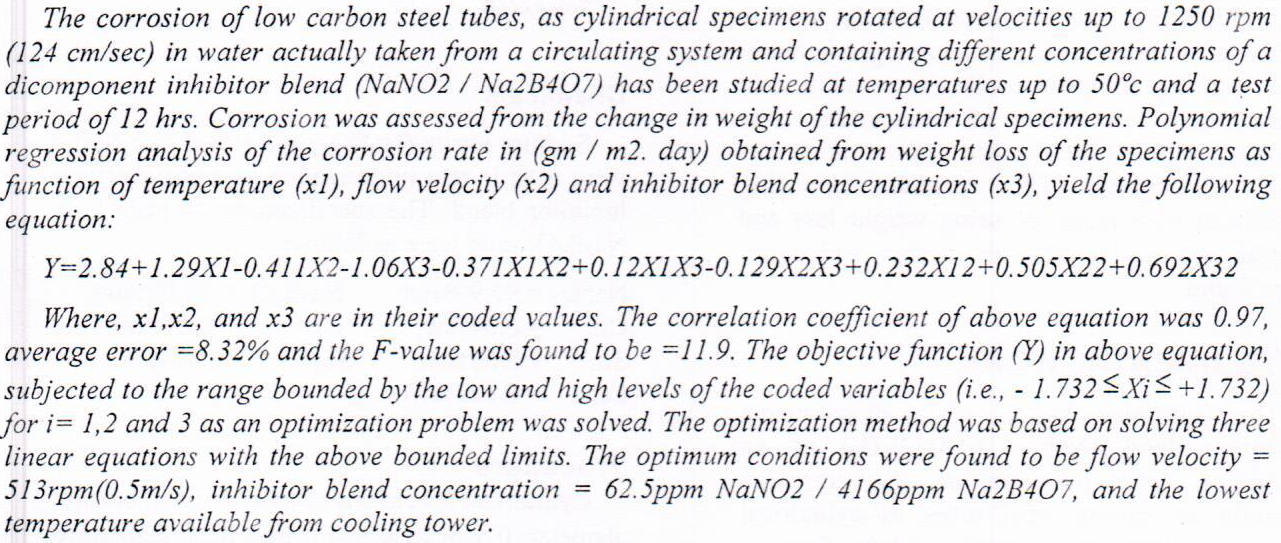
A mathematical model represents the relation between corrosion rate and the studied variables, is obtained using statistical regression analysis. Using this model,
... Show MoreThis research has presented a solution to the problem faced by alloys: the corrosion problem, by reducing corrosion and enhancing protection by using an inhibitor (Schiff base). The inhibitor (Schiff base) was synthesized by reacting of the substrates materials (4-dimethylaminobenzaldehyde and 4-aminoantipyrine). It was diagnosed by infrared technology IR, where the IR spectrum and through the visible beams proved that the Schiff base was well formed and with high purity. The corrosion behavior of carbon steel and stainless steel in a saline medium (artificial seawater 3.5%NaCl) before and after using the inhibitor at four temperatures: 20, 30, 40, and 50 C° was studied by using thr
... Show MoreThis research has presented a solution to the problem faced by alloys: the corrosion problem, by reducing corrosion and enhancing protection by using an inhibitor (Schiff base). The inhibitor (Schiff base) was synthesized by reacting of the substrates materials (4-dimethylaminobenzaldehyde and 4-aminoantipyrine). It was diagnosed by infrared technology IR, where the IR spectrum and through the visible beams proved that the Schiff base was well formed and with high purity. The corrosion behavior of carbon steel and stainless steel in a saline medium (artificial seawater 3.5%NaCl) before and after using the inhibitor at four temperatures: 20, 30, 40, and 50 C° was studied by using three electrodes potentiostat. The corrosion behavior was
... Show More (21)
(7)
(21)
(7)

This research has presented a solution to the problem faced by alloys: the corrosion problem, by reducing corrosion and enhancing protection by using an inhibitor (Schiff base). The inhibitor (Schiff base) was synthesized by reacting of the substrates materials (4-dimethylaminobenzaldehyde and 4-aminoantipyrine). It was diagnosed by infrared technology IR, where the IR spectrum and through the visible beams proved that the Schiff base was well formed and with high purity. The corrosion behavior of carbon steel and stainless steel in a saline medium (artificial seawater 3.5%NaCl) before and after using the inhibitor at four temperatures: 20, 30, 40, and 50 C° was studied by using three electrodes potentiostat. The corrosion behavior
... Show More
(21)
(7)

The driving idea for the present work was to combine the effect of polyvinyl alcohol (PVA) as corrosion inhibitor with the distance between the anodic and cathodic elements of the galvanic cell, beside their area ratio, in scope of synergistic suppression of galvanic corrosion on Cu/Fe model couple, using weight loss method. The performance affecting galvanic corrosion process has been tested for three major factors affect the process:
1. Four PVA inhibitor concentrations were selected to be (0, 1000, 4000 and 7000 ppm) in simulated cooling water.
2. Two cathode: anode area ratios as 1:1 and 2.4:1.
3. Two distances apart cathode – anode as 3 and 7 cm.
Maximum corrosion inhibition achieved was 86% which indicates that increa
(7)
(5)
Visualization of water flow around different bluff bodies at different Reynolds number ranging (1505 - 2492) was realized by designing and building a test rig which contains an open channel capable to ensure water velocity range (4-8cm/s) in this channel. Hydrogen bubbles generated from the ionized water using DC power supply are visualized by a light source and photographed by a digital camera. Flow pattern around a circular disk of (3.6cm) diameter and (3mm) thickness, a sphere of (3.8cm) diameter and a cylinder of
(3.2cm) diameter and (10cm) length are studied qualitatively. Parameters of the vortex ring generated in the wake region of the disk and the separation angle of water stream lines from the surface of the sphere are plott
(1)
