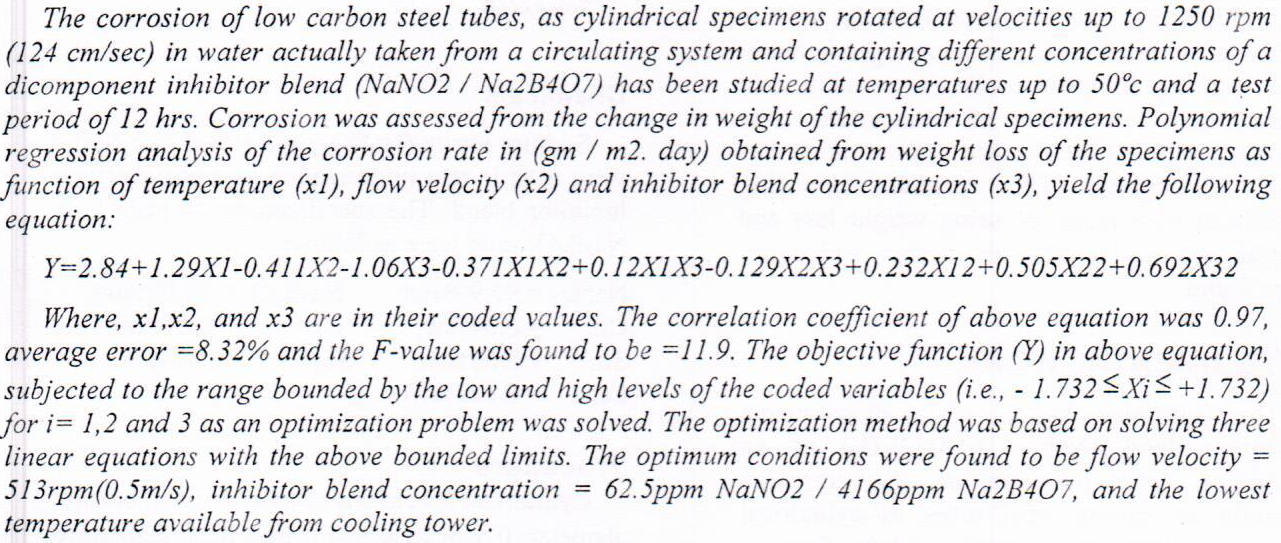
The Influence of Temperature and Flow Velocity on the Corrosion Inhibition of Low Carbon Tubes in Recirculating Water System by a Dicomponent Inhibitor Blend

Samples prepared by using carbon black as a filler material and phenolic resin as a binder. The samples were pressed in a (3) cm diameter cylindrical die to (250)MPa and treated thermally within temperature range of (600-1000)oC for two and three hours. Physical properties tests were performed, like density, porosity, and X-ray tests. Moreover vicker microhardness and electric resistivity tests were done. From the results, it can be concluded that density was increased while porosity was decreased gradually with increasing temperature and treating time. In microhardness test, it found that more temperature and treating time cause more hardness. Finally the resistivity was decreased in steps with temperature and treating time. It can be c
... Show MoreAn experimental investigation of the variation of argon discharge current with a glow and afterglow time intervals of a square discharge voltage was carried out at low pressure (6-11 mbar). The discharge was created between two circular metal electrodes of diameter (7.5 cm), separated horizontally by a distance (10 cm) at the two ends of a Pyrex cylindrical tube. A composite of two Gaussian functions has been suggested to fit and explain the variation graphs clearly. It is shown that the necessary times of glow and afterglow needed to attain a maximum discharge current are (70 us) and (60 us), respectively. The discharge current is observed to drop to the lowest value when the two times are serially longer than (85 us) and (72 u
... Show More

The corrosion inhibiting properties of the new furan derivative 5-(furan-2-ylmethylsulfonyl-4-phenyl-2,4- dihydro [1,2,4] triazole-3-thione in acidic solution (1.0 M HCl) were explored utilizing electrochemical, surface morphology (AFM), and quantum chemical calculations approaches. The novel furan derivative 5-(furan-2-ylmethylsulfonyl-4-phenyl-2,4- dihydro [1,2,4] triazole-3-thione shows with an inhibitory efficiency value of 99.4 percent at 150 ppm, carbon steel corrosion in acidic medium is effectively inhibited, according to the results. The influence of temperature on corrosion prevention was studied using adsorption parameters and activation thermodynamics. The novel furan derivative creates a protective layer over the metallic surfa
... Show More (10)
(10)
 (3)
(3)
(10)
(10)
(3)
(3)
(10)
(10)

A new benzylidene derivative, namely N-benzylidene-5-phenyl-1,3,4-thiadiazol-2-amine (BPTA), has been synthesized and instrumentally confirmed with Elemental Analysis (CHN), Nuclear Magnetic Resonance (NMR), and Fourier Transform Infrared Spectroscopy (FT-IR). Titanium Dioxide (TiO2) nanoparticles (NPs) were synthesized and characterized by X-ray. The mutualistic complementary dependence of BPTA with TiO2 nanoparticles as anti-corrosive inhibitor on mild steel (MS) in 1.0 M hydrochloric acid has been tested at various concentrations and various temperatures. The methodological work was achieved by gravimetric measurement methods complemented with surface analysis. The synthesized inhibitor concentrations were 0.1 mM to 0.5 mM and the temper
... Show More
(80)
This paper was aimed to evaluate the polyurethane (PU) and polyurethane/polyvinyl chloride (90 wt. % / 10 wt. %) as organic coating of carbon steel substrate against marine environment (3.5 wt.% NaCl aqueous solution) as a severe corrosion environment . The electrochemical impedance spectroscopy (EIS) and fitting impedance data by ZsimpWin 3.22 software were used to estimate the physical barrier of the samples for different exposure times. Different equivalent electrical circuits were proposed for the physical barrier at different immersion times to get appropriate fitting .Both PU and PU/PVC coatings showed excellent corrosion protection ability for steel .The PU/PVC coating showed better protection and stability than PU coating against
... Show MoreThis work involves three parts , first part is manufacturing different types of laminated below knee prosthetic socket materials with different classical laminated materials used in Baghdad center for prosthetic and orthotic (4perlon layers+2carbon fiber layer+4 perlon layers) , two suggested laminated materials(3perlon layers+2carbon fiber layer+3 perlon layers) and (3perlon layers+1carbon fiber layer+3 perlon layers) ) in order to choose perfect laminated socket . The second part tests (Impact test) the laminated materials specimens used in socket manufacturing in order to get the impact properties for each socket materials groups using an experimental rig designed especially for this purpose. The interface pressure between
... Show More
(1)
The corrosion protection of low carbon steel in 2.5 M HCl solution by kiwi juice was studied at different temperatures and immersion times by weight loss technique. To study the determination of the optimum conditions from statistical design in evaluation of a corrosion inhibitor, three variables, were considered as the most dominant variables. These variables are: temperature, inhibitor concentration (extracted kiwi juice) and immersion time at static conditions.
These three variables are manipulated through the experimental work using central composite rotatable Box – Wilson Experimental Design (BWED) where second order polynomial model was proposed to correlate the studied variables with the corrosion rate o
... Show MoreNowadays, energy demand continuously rises while energy stocks are dwindling. Using current resources more effectively is crucial for the world. A wide method to effectively utilize energy is to generate electricity using thermal gas turbines (GT). One of the most important problems that gas turbines suffer from is high ambient air temperature especially in summer. The current paper details the effects of ambient conditions on the performance of a gas turbine through energy audits taking into account the influence of ambient conditions on the specific heat capacity ( , isentropic exponent ( ) as well as the gas constant of air . A computer program was developed to examine the operation of a power plant at various ambient temperature
... Show More
(4)
(2)