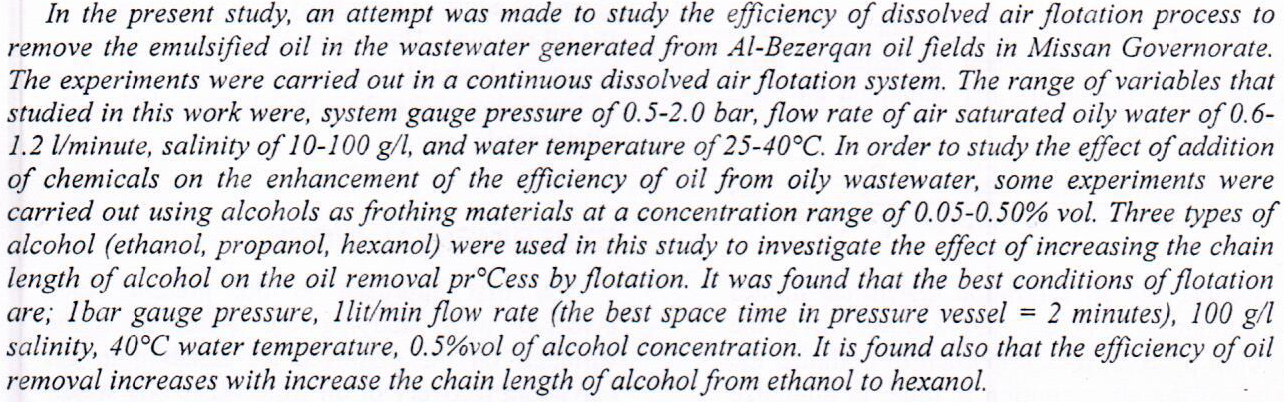
Oil Removal from Wastewater of Al-Bezerqan Crude Oil Fields by Air Flotation

ناقش البحث في طياته عدداً من القضايا الرئيسة المتعلقة بالتقييم الاستراتيجي والإطار العام للخطة الاستراتيجية المقترحة لشركة نفط ميسان للسنوات الخمس المقبلة (2020_2024)، وهدف هذا البحث يتمحور في تقييم عملية صياغة استراتيجية شركة نفط ميسان لتحديد نقاط القوة وتعضيدها ومواطن الضعف ومحاولة معالجتها لتجنب الوقوع بها عند وضع استراتيجية للسنوات القادمة، وعلى هذا الاساس فان مشكلة البحث تكمن في مدى نجاح الاستراتي
... Show More
The antimicrobial activity of ginger extracts ( cold-water, hot-water, ethanolic and essential oil ) against some of pathogenic bacteria ( Escherichia coli , Salmonella sp , Klebsiella sp , Serratia marcescens, Vibrio cholerae , Staphylococcus aureus , Streptococcus sp) was investigated using Disc diffusion method , and the results were compared with the antimicrobial activity of 12 antibiotics on the same bacteria . The results showed that the ginger extracts were more effective on gram-positive bacteria than gram-negative . V. cholerae and S. marcescens,were the most resistant bacteria to the extracts used , while highest inhibition was noticed against Streptococcus sp (28 mm) . The ethanolic extract showed the broadest antibacterial ac
... Show More (7)
(7)
Crude oil is one of the most important sources of energy in the world. To extract its multiple components, we need oil refineries. Refineries consist of multiple parts, including heat exchangers, furnaces, and others. It is known that one of the initial operations in the refineries is the process of gradually raising the temperature of crude oil to 370 degrees centigrade or higher. Hence, in this investigation the focus is on the furnaces and the corrosion in their tubes. The investigation was accomplished by reading the thickness of the tubes for the period from 2008 to 2020 with a test in every two year, had passed from their introduction into the work. Where the thickness of more than one point was measured on each tube in the sa
... Show More (7)
(8)
(7)
(8)

Nanofluid treatment of oil reservoirs is being developed to enhance oil recovery and increase residual trapping capacities of CO2 at the reservoir scale. Recent studies have demonstrated good potential for silica nanoparticles for enhanced oil recovery (EOR) at ambient conditions. Nanofluid composition and exposure time have shown significant effects on the efficiency of EOR. However, there is a serious lack of information regarding the influence of temperature on nanofluid performance; thus the effects of temperature, exposure time and particle size on wettability alteration of oil-wet calcite surface were comprehensively investigated; moreover, the stability of the nanofluids was examined. We found that nanofluid treatment is more efficie
... Show More
(168)
(160)

The research seeks to clarify the problems related to the aspects of the financial and accounting process resulting from entering into contractual arrangements with a period of more than 20 years, among which is the research problem represented by the lack of clarity of the foundations and procedures for the recognition of oil costs and additional costs borne by foreign invested companies, which led to a weakening of their credibility and reflection. Negatively "on the measurement and accounting disclosure of financial reports prepared by oil companies, and the research aims to lay down sound procedures for measuring and classifying oil costs and additional costs paid to foreign companies, and recognizing and recording them in th
... Show MoreFluidization process is widely used by a great assortment of industries worldwide and represents a trillion dollar industry [6]. They are currently used in separation, classification, drying and mixing of particles, chemical reactions and regeneration processes; one of these processes is the mass transfer from an immersed surface to a gas fluidized bed
There are still areas around the world suffer from severe shortage of freshwater supplies. Desalination technologies are not widely used due to their high energy usage, cost, and environmental damaging effects. In this study, a mathematical model of single-bed adsorption desalination system using silica gel-water as working pair is developed and validated via earlier experiments. A very good match between the model predictions and the experimental results is recorded. The objective is to reveal the factors affecting the productivity of fresh water and cooling effect in the solar adsorption system. The proposed model is setup for solving within the commercially-available software (Engineering Equation Solver). It is implemented to so
... Show More
(8)
(6)
The removal of COD from wastewater generated by petroleum refinery has been investigated by adopting electrocoagulation (EC) combined with adsorption using activated carbon (AC) derived from avocado seeds. The process variables influencing COD removal were studied: current density (2–10 mA/cm2), pH (4–9), and AC dosage (0.2–1 g/L). Response surface methodology (RSM) based on Box–Behnken design (BBD) was used to construct a mathematical model of the EC/AC process. Results showed that current density has the major effect on the COD removal with a percent of contribution 32.78% followed by pH while AC dosage has not a remarkable effect due to the good characteristics of AC derived from avocado seeds. Increasing current density gives be
... Show More
(4)
(5)
(7)
(4)
(5)