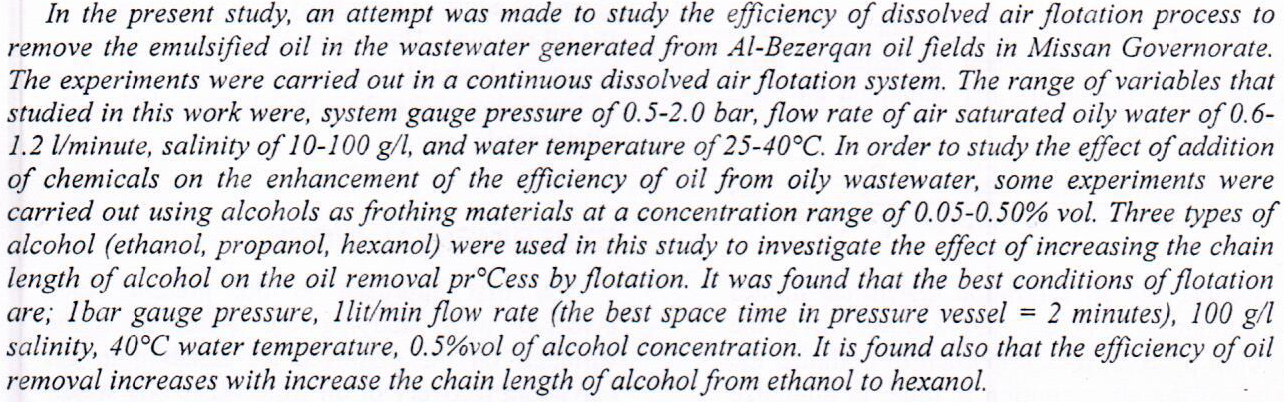
Oil Removal from Wastewater of Al-Bezerqan Crude Oil Fields by Air Flotation

This study investigates the application of hydraulic acid fracturing to enhance oil production in the Mishrif Formation of the Al-Fakkah oilfield due to declining flow rates and wellhead pressures resulting from asphaltene deposition and inadequate permeability. Implementing acid fracturing, an established technique for low-permeability carbonate reserves, was essential due to the inadequacy of prior solvent cleaning and acidizing efforts. The document outlines the protocols established prior to and following the treatment, emphasizing the importance of careful oversight to guarantee safety and efficacy. In the MiniFrac treatment, 150 barrels of #30 cross-linked gel were injected at 25 barrels per minute, followed by an overflush wi
... Show More

In this work, measurements of activity concentration of naturally occurring radioactive materials (NORM) isotopes and their related hazard indices for several materials such as crude oil, sludge and water in Ahdeb oil fields in Waste governorate using high pure germanium coaxial detection technique. The average values for crude oil samples were174.72Bq/l, 43.46Bq/l, 355.07Bq/l, 264.21Bq/l, 122.52nGy/h, 0.7138, 1.1861, 0.601 mSv/y, 0.1503mSv/y and 1.8361 for Ra-226, Ac-228, K-40, Ra eq, D, H-external and H-internal respectively. According to the results; the ratio between 238U to 232Th was 4, which represents the natural ratio in the crust earth; therefore, one can be strongly suggested that the geo-stricture of the
... Show More
The work reported in this study focusing on the abrasive wear behavior for three types of pipes used in oil industries (Carbone steel, Alloy steel and Stainless steel) using a wear apparatus for dry and wet tests, manufactured according to ASTM G65. Silica sand with
hardness (1000-1100) HV was used as abrasive material. The abrasive wear of these pipes has been measured experimentally by measuring the wear rate for each case under different sliding speeds, applied loads, and sand conditions (dry or wet). All tests have been conducted using sand of particle size (200-425) µm, ambient temperature of 34.5 °C and humidity 22% (Lab conditions).
The results show that the material loss due to abrasive wear increased monotonically with
 (1)
(1)
This study investigates the application of hydraulic acid fracturing to enhance oil production in the Mishrif Formation of the Al-Fakkah oilfield due to declining flow rates and wellhead pressures resulting from asphaltene deposition and inadequate permeability. Implementing acid fracturing, an established technique for low-permeability carbonate reserves, was essential due to the inadequacy of prior solvent cleaning and acidizing efforts. The document outlines the protocols established prior to and following the treatment, emphasizing the importance of careful oversight to guarantee safety and efficacy. In the MiniFrac treatment, 150 barrels of #30 cross-linked gel were injected at 25 barrels per minute, followed by an overflush wi
... Show More
The oil exports play a vital role in supporting economic development and raise the economic growth. The oil exports can increase the economic growth via three main channels which are supporting the productive, distributive and service sectors; increasing the investment and capital formation; and increasing the employment rate.
However, the oil exports did not have an important role in increasing the economic growth in Iraq. Therefore, it also did not provide the required support to other economic sectors, neither participated in increase the employees’ skills nor increase the investment rate. It may slightly contribute in enhancement the infrastructure that can attract the public and private investments
... Show More
This research was aimed to evaluate activity of Rosemary volatile oil and Nisin A in vivo and on B. cereus isolated from some canned meat products in vitro. The results showed that the activity of Rosemary volatile oil (2000 µg/ml) and Nisin A (350 µg\ml) attained to 27 and 19 mm inhibitory zone diameter respectively in well diffusion method. The viable plate count from samples of canned meat treated with effective concentration of Rosemary volatile oil and Nisin A were examined. The samples with Rosemary volatile oil was not showed any CFU/g after 9 days of preservation while sample with Nisin A and control observed 49 and 45 CFU/g respectively. In vivo experiment on mice, two weeks after oral dose of Rosemary volatile oil (2000
... Show More (25)
(14)
(25)
(14)

The study aims at showing the effect of basil oil on the sensory properties of the laboratory biscuits. the results show the sensory valuation before and after the storage. the (A4) equation exceeds 15% of T exchange (3 , 4 , 5 g. basil 19 , 55 g . fats )in most of the studied sensuous qualities. Then, the (A5) equation of 20% exchange percentage (4.60g. basil oil + 18.40g. fats). Then, the (A3) equation of 10% exchange percentage (2.30g. basil oil + 20.70g. fats). Then the (A2) equation of 5% exchange percentage (1.5g. basil oil + 21.85g. fats). Finally, the control equation (A1) received the lower value of sensuous evaluation and general acceptance. Abstract differences also appeared at denotation level 0.05 between the (A2)
... Show More
The aim of this study was to investigate the effect of operating variables on, the percentage of removed sludge (PSR) obtained during re-refining of 15W-40 Al-Durra spent lubricant by solvent extraction-flocculation treatment method. Binary solvents were used such as, Heavy Naphtha (H.N.): MEK (N:MEK), H.N. : n-Butanol (N:n-But), and H.N. : Iso-Butanol (N:Iso:But). The studied variables were mixing speed (300-900, rpm), mixing time (15-60, min), and operating temperature (2540, oC). This study showed that the studied operating variables have effects where, increasing the mixing time up to 45 min for H.N.: MEK, H.N.: n-Butanol and 30 min for H.N.: Iso-Butanol increased the PSR, after that percentage was decreased; increasing t
... Show MoreAn investigation was conducted to suggest relations for estimating yield and properties of the improved light lubricating oil fraction produced from furfural extraction process by using specified regression.
Mass transfer in mixer-settler has been studied. Mass transfer coefficient of continuous phase, mass transfer coefficient of dispersed phase and the overall mass transfer coefficient extraction of light lubes oil distillate fraction by furfural are calculated in addition to all physical properties of individual components and the extraction mixtures.
The effect of extraction variables were studied such as extraction temperature which ranges from 70 to 110°C and solvent to oil ratio which ranges from 1:1 to 4:1 (wt/wt
... Show MoreThis study focuses on the use of an optimum amount of Sodium Polyacrylate (SP) for designing cement slurry with the high performance of rheological properties and displacement efficiency. A laboratory study has been carried out on the cement slurry which prepared with SP as superabsorbent polymer. SP has been providing an internal water source that helps in the hydration process, and curing and ultimately increases the cement strength. Also improves the cement performance by improving the cement stability. Several batches were prepared to determine the proper amount of SP to add it in the cement slurry. Also, we studied its effect on cement density, amount of free water in order to observe the rheological properties, and thickening time.
... Show More