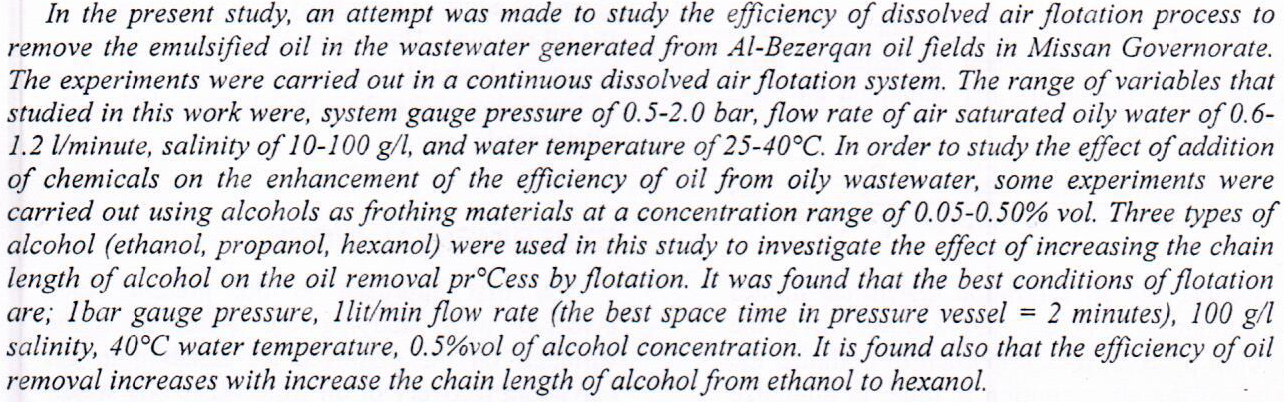
Oil Removal from Wastewater of Al-Bezerqan Crude Oil Fields by Air Flotation

This study was aimed to investigate the response surface methodology (RSM) to evaluate the effects of various experimental conditions on the removal of levofloxacin (LVX) from the aqueous solution by means of electrocoagulation (EC) technique with stainless steel electrodes. The EC process was achieved successfully with the efficiency of LVX removal of 90%. The results obtained from the regression analysis, showed that the data of experiential are better fitted to the polynomial model of second-order with the predicted correlation coefficient (pred. R2) of 0.723, adjusted correlation coefficient (Adj. R2) of 0.907 and correlation coefficient values (R2) of 0.952. This shows that the predicted models and experimental values are in go
... Show More (17)
(17)

The removal of cadmium ions from simulated groundwater by zeolite permeable reactive barrier was investigated. Batch tests have been performed to characterize the equilibrium sorption properties of the zeolite in cadmium-containing aqueous solutions. Many operating parameters such as contact time, initial pH of solution, initial concentration, resin dosage and agitation speed were investigated. The best values of these parameters that will achieved removal efficiency of cadmium (=99.5%) were 60 min, 6.5, 50 mg/L, 0.25 g/100 ml and 270 rpm respectively. A 1D explicit finite difference model has been developed to describe pollutant transport within a groundwater taking the pollutant sorption on the permeable reactive barrier (PRB), which i
... Show More
(2)
Smart water flooding (low salinity water flooding) was mainly invested in a sandstone reservoir. The main reasons for using low salinity water flooding are; to improve oil recovery and to give a support for the reservoir pressure.
In this study, two core plugs of sandstone were used with different permeability from south of Iraq to explain the effect of water injection with different ions concentration on the oil recovery. Water types that have been used are formation water, seawater, modified low salinity water, and deionized water.
The effects of water salinity, the flow rate of water injected, and the permeability of core plugs have been studied in order to summarize the best conditions of low salinity
... Show More
(3)
This research was aimed to study the efficiency of microfiltration membranes for the treatment of oily wastewater and the factors affecting the performance of the microfiltration membranes experimental work were includes operating the microfiltration process using polypropylene membrane (1 micron) and ceramic membrane (0.5 micron) constructed as candle; two methods of operation were examined: dead end and cross flow. The oil emulsion was prepared using two types of oils: vegetable oil and motor oil (classic oil 20W-50). The operating parameters studied are: feed oil concentration 50 – 800 mg/l, feed flow rate 10 – 40 l/h, and temperature 30 – 50 oC, for dead end and cross flow microfiltration.
It was found that water flux decrea
 (9)
(9)
(9)
(9)
 (60)
(60)
(60)
(60)
 (6)
(5)
(12)
(3)
(6)
(5)
(12)
(3)
Polyacrylonitrile nanofiber (PANFS), a well-known polymers, has been extensively employed in the manufacturing of carbon nanofibers (CNFS), which have recently gained substantial attention due to their excellent features, such as spinnability, environmental friendliness, and commercial feasibility. Because of their high carbon yield and versatility in tailoring the final CNFS structure, In addition to the simple formation of ladder structures through nitrile polymerization to yield stable products, CNFS and PAN have been the focus of extensive research as potential production precursors. For instance, the development of biomedical and high-performance composites has now become achievable. PAN homopolymer or PAN-based precursor copol
... Show More
Polyacrylonitrile nanofiber (PANFS), a well-known polymers, has been extensively employed in the manufacturing of carbon nanofibers (CNFS), which have recently gained substantial attention due to their excellent features, such as spinnability, environmental friendliness, and commercial feasibility. Because of their high carbon yield and versatility in tailoring the final CNFS structure, In addition to the simple formation of ladder structures through nitrile polymerization to yield stable products, CNFS and PAN have been the focus of extensive research as potential production precursors. For instance, the development of biomedical and high-performance composites has now become achievable. PAN homopolymer or PAN-based precursor copolymer can
... Show More