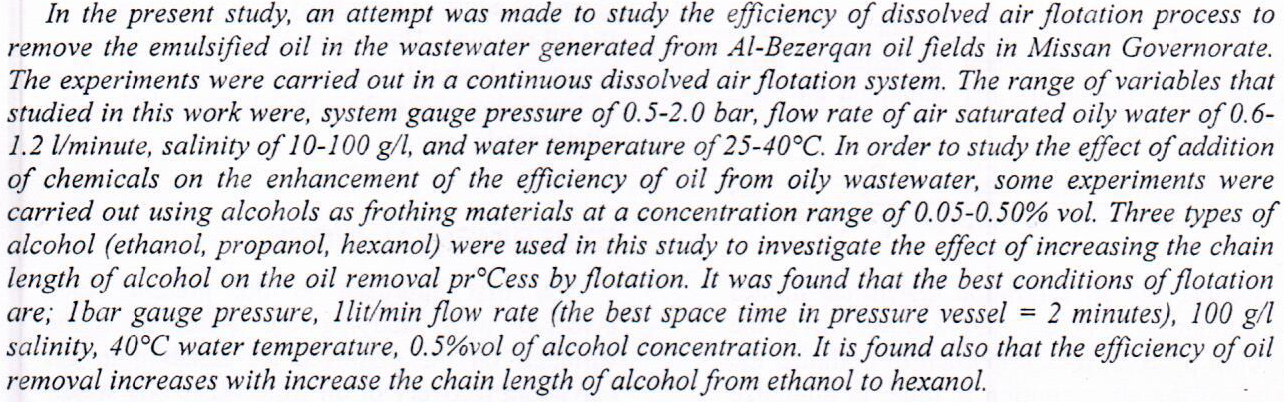
Oil Removal from Wastewater of Al-Bezerqan Crude Oil Fields by Air Flotation

The implementation of nanotechnology in all industries is one of most significant research fields. Nanoparticles have shown a promising application in subsurface fields. On the other hand, various surfactants have been used in the oil industry to reduce oil/water interfacial tension and also widely used to stabilize the nano-suspensions. The primary objective of this study was to investigate the improvements of surfactants ability in term of interfacial tension (γ) reduction utilizing addition of silicon dioxide nanoparticles at different temperatures and salinity. The pendant drop technique has been used to measure γ and electrical conductivity has been used to measure the critical micelle concentration (CMC). The synergistic effects of
... Show More (46)
(46)
 (53)
(53)



Empirical equation has been presented to predict the optimum hydrodynamic
pressure gradient with optimum mud flow rate (one equation) of five Iraqi oil wells
to obtain the optimum carrying capacity of the drilling fluid ( optimum transport
cuttings from the hole to the surface through the annulus).
This equation is a function of mud flow rate, mud density and penetration
rate without using any charts or graphs.
The correlation coefficient accuracy is more than 0.9999.
History matching is a significant stage in reservoir modeling for evaluating past reservoir performance and predicting future behavior. This paper is primarily focused on the calibration of the dynamic reservoir model for the Meshrif formation, which is the main reservoir in the Garraf oilfield. A full-field reservoir model with 110 producing wells is constructed using a comprehensive dataset that includes geological, pressure-volume-temperature (PVT), and rock property information. The resulting 3D geologic model provides detailed information on water saturation, permeability, porosity, and net thickness to gross thickness for each grid cell, and forms the basis for constructing the dynamic reservoir model. The dynamic reservoir mo
... Show More
Efficient cuttings transport and hole cleaning are very important factors for obtaining an effective drilling operation. In an inclined and horizontal drilling, hole cleaning issue is a common and complex problem.
The scope of this research is to study the drilling parameters which affect hole cleaning in Iraqi directional wells through studying and analyzing some drilled wells ( vertical , directional (30 degree) , directional (60 degree) and horizontal ).An excel sheet is prepared to calculate carrying capacity index which represents an indicator for good hole cleaning in different sections. The study indicated through the field investigations, practical experiences and theoretical calculations tha
... Show MoreThis project introduces a prospective material for photonic laser applications. The material is olive oil which is classified as organic compound, having a good nonlinear optical properties candidate to be used in photonic applications. A high purity sample of olive oil has been used. The theoretical calculation to generate third harmonic wave using olive oil has been determine using MATLAB program. THG (λ=355nm) intensity has been determined at two cases of sample thicknesses 1mm and 10mm. The minimum threshold incident intensity to obtain THG intensity are equal Iω=7530 mW/cm2 at L=1mm and Iω= 6220 mW/cm2 at L=10mm. The possibility of generation of third harmonic in olive oil inside
... Show MoreIron , Cobalt , and Nickel powders with different particle sizes were subjected to sieving and He-Ne laser system to determine the particle size . 1wt% from each powders was blended carefully with 99wt% from Iraqi oil . Microscopic examination were carried for all samples to reveal the particle size distribution . A Siemens type SRS sequential wavelength dispersive(WDS) X-ray spectrometer was used to analyze all samples , and the XRF intensity were determined experimentally and theoretically for all suspended samples , Good agreement between theoretical and experimental results were found .
Iraqi crude Atmospheric residual fraction supplied from al-Dura refinery was treated to remove metals contaminants by solvent extraction method, with various hydrocarbon solvents and concentrations. The extraction method using three different type solvent (n-hexane, n-heptane, and light naphtha) were found to be effective for removal of oil-soluble metals from heavy atmospheric residual fraction. Different solvents with using three different hydrocarbon solvents (n-hexane, n-heptane, and light naphtha) .different variables were studied solvent/oil ratios (4/1, 8/1, 10/1, 12/1, and 15/1), different intervals of perceptual (15, 30-60, 90 and 120 min) and different temperature (30, 45, 60 and 90 °C) were used. The metals removal percent we
... Show More
(1)
The degradation of Toluidine Blue dye in aqueous solution under UV irradiation is investigated by using photo-Fenton oxidation (UV/H2O2/Fe+). The effect of initial dye concentration, initial ferrous ion concentration, pH, initial hydrogen peroxide dosage, and irradiation time are studied. It is found put that the removal rate increases as the initial concentration of H2O2 and ferrous ion increase to optimum value ,where in we get more than 99% removal efficiency of dye at pH = 4 when the [H2O2] = 500mg / L, [Fe + 2 = 150mg / L]. Complete degradation was achieved in the relatively short time of 75 minutes. Faster decolonization is achieved at low pH, with the optimal value at pH 4 .The concentrations of degradation dye are detected by spectr
... Show More
Iraqi crude Atmospheric residual fraction supplied from al-Dura refinery was treated to remove metals contaminants by solvent extraction method, with various hydrocarbon solvents and concentrations. The extraction method using three different type solvent (n-hexane, n-heptane, and light naphtha) were found to be effective for removal of oil-soluble metals from heavy atmospheric residual fraction. Different solvents with using three different hydrocarbon solvents (n-hexane, n-heptane, and light naphtha) .different variables were studied solvent/oil ratios (4/1, 8/1, 10/1, 12/1, and 15/1), different intervals of perceptual (15, 30-60, 90 and 120 min) and different temperature (30, 45, 60 and 90 °C) were used. The metals removal perce
... Show More
(1)
