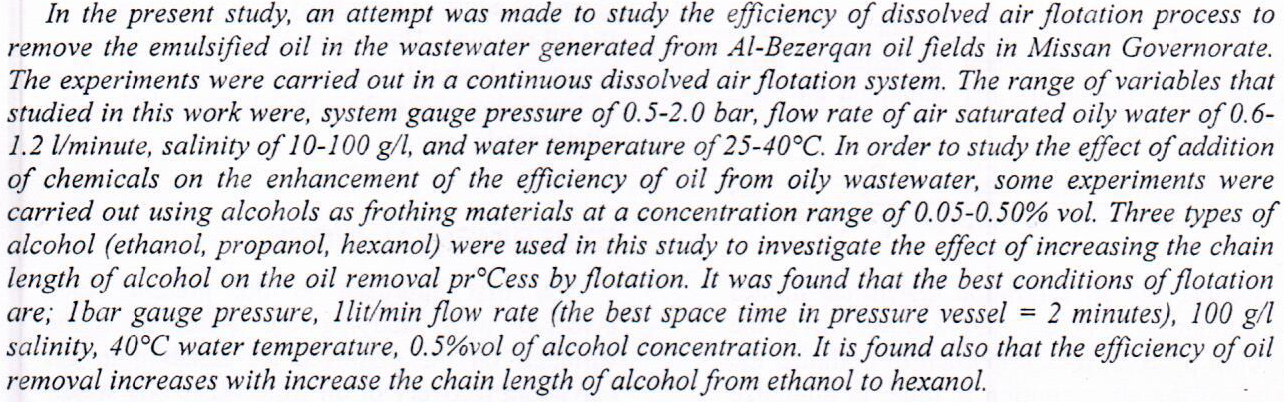
Oil Removal from Wastewater of Al-Bezerqan Crude Oil Fields by Air Flotation

The current study examines the combined impacts of ultrasonic waves and nano silica (NS) on reducing the viscosity Sharqy Baghdad heavy crude oil with an API gravity of 20.32. NS of an average particle size of 59.93 nm and 563.23 m²/g surface area were produced utilizing the sol-gel technique from Iraqi sand. The XRD analysis indicates the existence of an amorphous silica, the SEM analysis showed that NS tends to agglomerate, and the FTIR spectra exhibited the presence of siloxane and silanol groups. In addition, the TGA analysis demonstrated a total weight loss of 15.62%, validating the thermal stability of the NS. The experiments included a study of the impact of ultrasonic power, exposure time, duty cycle, temperature, and the c
... Show More (3)
(3)

The current study examines the combined impacts of ultrasonic waves and nano silica (NS) on reducing the viscosity Sharqy Baghdad heavy crude oil with an API gravity of 20.32. NS of an average particle size of 59.93 nm and 563.23 m²/g surface area were produced utilizing the sol-gel technique from Iraqi sand. The XRD analysis indicates the existence of an amorphous silica, the SEM analysis showed that NS tends to agglomerate, and the FTIR spectra exhibited the presence of siloxane and silanol groups. In addition, the TGA analysis demonstrated a total weight loss of 15.62%, validating the thermal stability of the NS. The experiments included a study of the impact of ultrasonic power, exposure time, duty cycle, temperature, and the c
... Show More
(3)
Three isolates of P. aeruginosa were isolated from burnt patients. The ability of these isolates for adhesion and formation of slime layer were tested, the result showed that all isolates were able to adherence on the smooth surface. The sensitivity of P. aeruginosa isolates for antibiotics were tested , all isolates were sensitive to Gentamycin, Piperacillin and Amikacin Ciprofloxacin, and resist to Tetracyclin, Amoxicillin, Cephalexine , Ceftriaxone. Ciprofloxacin and Amikacin were found effective against P. aeruginosa isolates with MIC values of 3.8 μg/ ml for Ciprofloxacin and 0.244 μg/ ml for Amikacin The antibacterial effect of Different concentrations of Aloe
... Show More
 (14)
(11)
(14)
(11)


Abstract. The main technique for removing bacteria from water for various applications is chemical disinfection. However, this method has many disadvantages such as producing disinfectant by-products (DBPs), biofilm formation and either rendering the water unpotable (at high residual disinfection) or leaving a potential for lethal diseases such as Cholera (if the residual disinfection is too low). Recently, a process was developed for continuous removal of bacteria from water using the principle of froth flotation through compressed air only without any chemicals (Hassan, 2015). This work examines the extent to which chemical free froth flotation can purify drinking water. The experiments were carried out using two flotation columns
... Show More
The world is confronted with the twin crisis of fossil fuel depletion and environmental degradation caused by fossil fuel usage. Biodiesel produced from renewable feedstocks such as Jatropha seed oil or animal fats by transesterification offers a solution. Although biodiesel has been produced from various vegetable oils such as Jatropha seed oil, the reaction kinetics studies are very few in literature, hence the need for this study. Jatropha curcas seed oil was extracted and analyzed to determine its free fatty acid and fatty acid composition. The oil was transesterified with methanol at a molar ratio of methanol to oil 8:1, using 1% sodium hydroxide catalyst, at different temperature
... Show More
(2)
The estimation of the initial oil in place is a crucial topic in the period of exploration, appraisal, and development of the reservoir. In the current work, two conventional methods were used to determine the Initial Oil in Place. These two methods are a volumetric method and a reservoir simulation method. Moreover, each method requires a type of data whereet al the volumetric method depends on geological, core, well log and petrophysical properties data while the reservoir simulation method also needs capillary pressure versus water saturation, fluid production and static pressure data for all active wells at the Mishrif reservoir. The petrophysical properties for the studied reservoir is calculated using neural network technique
... Show More
(12)
Changing oil-wet surfaces toward higher water wettability is of key importance in subsurface engineering applications. This includes petroleum recovery from fractured limestone reservoirs, which are typically mixed or oil-wet, resulting in poor productivity as conventional waterflooding techniques are inefficient. A wettability change toward more water-wet would significantly improve oil displacement efficiency, and thus productivity. Another area where such a wettability shift would be highly beneficial is carbon geo-sequestration, where compressed CO2 is pumped underground for storage. It has recently been identified that more water-wet formations can store more CO2. We thus examined how silica based nanofluids can induce such a wettabil
... Show More
(406)
Abstract
Sovereign wealth funds are an important tool for achieving economic stability and avoiding the local economy from external shocks, including the shocks of international oil prices. The spread of these funds is the result of large current account surpluses in many Asian and oil-exporting economies. These surpluses are due to higher commodity prices Has led to a rapid accumulation of foreign assets in central banks. Many countries with rent economies face the problem of their dependence on non-renewable natural resources, especially the oil countries, including Iraq. Oil revenues are more than 97% of oil exports, so they suffer from structural imbal
... Show More
The stratigraphic sequence of Cenomanian-Early Turonian is composed of Ahmadi, Rumaila, and Mishrif formations in the Rifai, Noor and Halfaya Oil Fields within the Mesopotamian Zone of Iraq, which is bounded at top and bottom by unconformity surfaces. The microfacies analysis of the study wells assisted the recognition of five main environments (open marine, basinal, shallow open marine, Rudist biostrome, and lagoon); these microfacies were indicative of a normal lateral change facies from shallow water facies to deeper water and open marine sediments.
Ahmadi Formation (Early Cenomanian) is characterized by open marine sediments during the transgressive conditions, and would be
... Show More
(4)
(2)