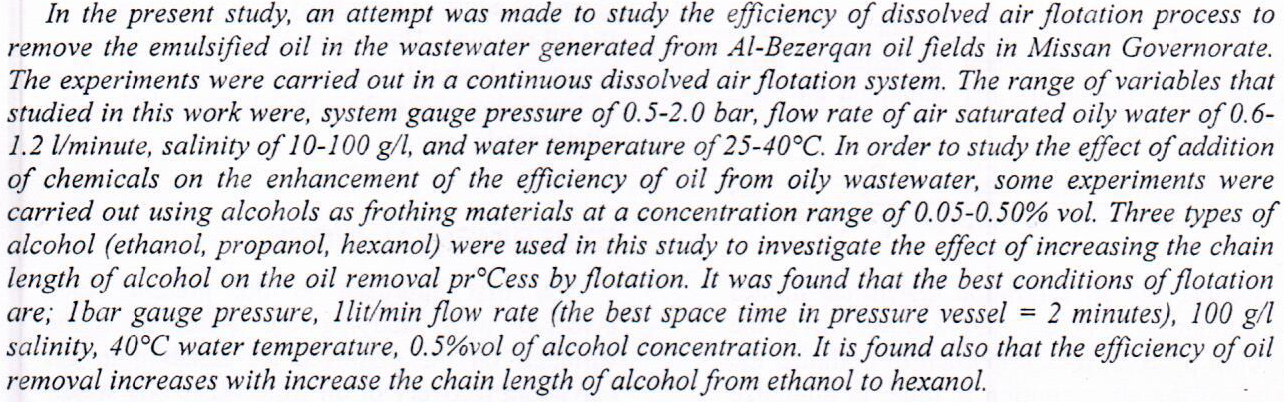
Oil Removal from Wastewater of Al-Bezerqan Crude Oil Fields by Air Flotation

This study investigates the treatment of used lubricating oils from AL-Mussaib Gas Power Station Company-Iraq, which was treated with different extractive solvents (heptane and 2-propanol). The performance activity of these solvents in the extraction process was examined and evaluated experimentally. Operating parameters were solvent to oil ratios of (1:2, 1:4, 1:6, and 1:8), mixing time (20, 35, 50, and 65 min), temperatures (30, 40, 50, and 60 ºC), and mixing speed (500 rpm). These parameters were studied and analyzed. The quality is determined by the measuring and assessment of important characteristics specially viscosity, viscosity index, specific gravity, pour point, flash point, and ash content. The results confirm that the
... Show More (7)
(7)

The current study aims to show the importance of plant products as mosquitocides against Culex quinquefasciatus. Castor oil Nanoemulsions were subedit in various ratios including castor oil, ethanol, tween 80, and deionized water by using ultrasonication. Thermodynamic, centrifugation, PH, assay which improved that the formula of 10 ml of castor oil, ethanol 5ml, tween 80 (14 ml) and deionized water 71ml was more stable than other formulas. The stable formula of castor oil nanoemulsion was characterized by transmission electron microscopy (TEM) and dynamic light scattering (DLS). Nanoemulsion droplets were spherical in shape and were found to have a Z-average diameter of 87.4nm. A concentration of ca
... Show More (4)
(3)
(4)
(3)

Large quantities of petroleum-contaminated soil are generated with increased global energy consumption and crude oil production. This theoretical study evaluates the treatment of 1 ton of petroleum-contaminated soil using seven methods: incineration, physical washing, chemical washing, thermal pyrolysis, Fenton-oxidation-pyrolysis, the biological treatment, and asphaltenes. Data were based on experimental results from the Nahran Bin Omar oil lake in Basra Governorate, Iraq, (2019–2021). The methods were compared by waste generation, treatment cost, and duration. Results indicate that using petroleum-contaminated soil as a raw material for asphalt manufacturing is most beneficial since it is sold as a raw material. Incineration is faster a
... Show More
In the present work, the efficiency of Tri-octyl Methyl Ammonium Chloride (TOMAC) ionic liquid was investigated as new and green demulsifier for three types of Iraqi crude oil emulsions (Nafut Khana (NK), Kirkuk and Basrah). The separation efficiency was studied at room temperature and by using microwave heating technique. Several batch experiments were done to specify the suitable conditions for the emulsification and demulsification which were specified as 45 minutes and 3000 rpm for crude oil emulsification while the ionic liquid doses were (500,300,150,50) ppm and the conditions of microwave heating were 1000 watt and 50 second as irradiation time. The results were very encouraging especially for NK and Kirkuk crude oil emulsions whe
... Show MoreThis study aimed to assess the efficiency of Nerium oleander in removing three different metals (Cd, Cu, and Ni) from simulated wastewater using horizontal subsurface flow constructed wetland (HSSF-CW) system. The HSSF-CW pilot scale was operated at two hydraulic retention times (HRTs) of 4 and 7 days, filled with a substrate layer of sand and gravel. The results indicated that the HSSF-CW had high removal efficiency of Cd and Cu. A higher HRT (7 days) resulted in greater removal efficiency reaching up to (99.3% Cd, 99.5% Cu, 86.3% Ni) compared to 4 days. The substrate played a significant role in removal of metals due to adsorption and precipitation. The N. oleander plant also showed a good tolerance to the uptake of Cd, Cu, and Ni ions fr
... Show More
(21)
This study aimed to assess the efficiency of Nerium oleander in removing three different metals (Cd, Cu, and Ni) from simulated wastewater using horizontal subsurface flow constructed wetland (HSSF-CW) system. The HSSF-CW pilot scale was operated at two hydraulic retention times (HRTs) of 4 and 7 days, filled with a substrate layer of sand and gravel. The results indicated that the HSSF-CW had high removal efficiency of Cd and Cu. A higher HRT (7 days) resulted in greater removal efficiency reaching up to (99.3% Cd, 99.5% Cu, 86.3% Ni) compared to 4 days. The substrate played a significant role in removal of metals due to adsorption and precipitation. The N. oleander plant also showed a good tolerance to the uptake of Cd, Cu, and Ni ions fr
... Show More
(23)
(21)

Electrochemical oxidation in the presence of sodium chloride used for removal of phenol and any other organic by products formed during the electrolysis by using MnO2/graphite electrode. The performance of the electrode was evaluated in terms fraction of phenol and the formed organic by products removed during the electrolysis process. The results showed that the electrochemical oxidation process was very effective in the removal of phenol and the other organics, where the removal percentage of phenol was 97.33%, and the final value of TOC was 6.985 ppm after 4 hours and by using a speed of rotation of the MnO2 electrode equal to 200 rpm.
(6)
(3)
(30)
(25)