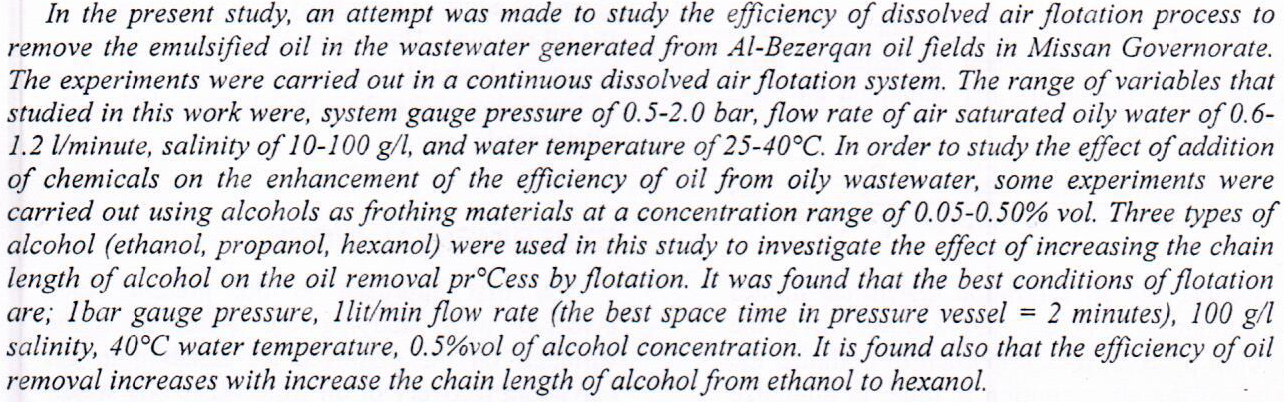
Oil Removal from Wastewater of Al-Bezerqan Crude Oil Fields by Air Flotation

يختبر البحث الحالي التأثيرات المشتركة للإشعاع بالموجات فوق الصوتية والمادة المانحة للهيدروجين على لزوجة النفط الخام الثقيل. تمت دراسة تأثير زمن التعرض للموجات فوق الصوتية والطاقة ودورة التشغيل ودرجة الحرارة على لزوجة النفط الخام العراقي الثقيل الذي يملك قيمة .20.32 = API كما تم فحص لزوجة عينات النفط الخام التي تم خلطها بمانح الهيدروجين (Decalin) وإخضاعها للمعالجة بالموجات فوق الصوتية في ظل الظروف المثا
... Show More (5)
(5)
 (3)
(3)


Oily wastewater is one of the most challenging streams to deal with especially if the oil exists in emulsified form. In this study, electrospinning method was used to prepare nanofiberous polyvinylidene fluoride (PVDF) membranes and study their performance in oil removal. Graphene particles were embedded in the electrospun PVDF membrane to enhance the efficiency of the membranes. The prepared membranes were characterized using a scanning electron microscopy (SEM) to verify the graphene stabilization on the surface of the membrane homogeneously; while FTIR was used to detect the functional groups on the membrane surface. The membrane wettability was assessed by measuring the contact angle. The PVDF and PVDF / Graphene membranes efficiency
... Show More
(3)

The adsorption of copper ions onto produced activated carbon from banana peels (with particle size 250 µm) in a single component system with applying magnetic field has been studied using fixed bed adsorber. The fixed bed breakthrough curves for the copper ions were investigated. The adsorption capacity for Cu (II) was investigated. It was found that 1) the exposure distance (E.D) and strength of magnetic field (B), affected the degree of adsorption; and 2) experiments showed that removal of Cu ions and accumulative adsorption capacity of adsorbent increase as the exposure distance and strength of magnetic field increase.
Biosorption of cadmium ions from simulated wastewater using rice husk was studied with initial concentration of 25 mg/l. Equilibrium isotherm was studied using Langmuir, Freundlich, BET and Timken models. The results show that the Freundlich isotherm is the best fit model to describe this process with high determination coefficient equals to 0.983. There was a good compliance between the experimental and theoretical results. Highest removal efficiency 97% was obtained at 2.5g of adsorbent, pH 6 and contact time 100 min.
The performance of a batch undivided electrochemical reactor with a rotating cylinder electrode of woven-wire (60 mesh size), stainless steel 316, is examined for the removal of copper from synthetic solution of o.5 M sodium chloride containing 125 ppm at pH ≈ 3.5. The effect of total applied current, rotation speed on the figures of merit of the reactor is analyzed. For an applied current of 300 mA at 100 rpm, the copper concentration decreased from 125 to mg l-1 after 60 min of electrolysis with a specific energy consumption of 1.75 kWh kg-1 and a normalized space velocity of 1.62 h-1. The change in concentration was higher when the total applied currents were increased because of the turbulence
... Show More
(10)
(7)
The Early-Middle Miocene succession in Iraq is represented by the Serikagni, Euphrates and Dhiban formations, which deposited during the Early Miocene. The Jeribe and Fatha successions were deposited during Middle Miocene age. This study includes microfacies analysis, depositional environments, sequence stratigraphy and basin development of Early – middle Miocene in Hamrin and Ajeel oil fields and Mansuriyha Gas Field. The study area includes four boreholes in three oil fields located in central Iraq: Hamrin (Hr-2) and Ajeel (Aj-13, and 19) oil feilds, and Mansuriyha (Ms-2) Gas Field. Five facies associations were distinguished within the studied fields: deep marine, slop, platform-margin, open marine, restricted interior platform
... Show More
(5)
(6)
(4)
This study utilizes streamline simulation to model fluid flow in the complex subsurface environment of the Mishrif reservoir in Iraq's Buzurgan oil field. The reservoir faces challenges from high-pressure depletion and a substantial increase in water cut during production, prompting the need for innovative reservoir management. The primary focus is on optimizing water injection procedures to reduce water cuts and enhance overall reservoir performance. Three waterflooding tactics were examined: normal conditions without injectors or producers, normal conditions with 30 injectors and 80 producers and streamline simulation using the frontsim simulator. Three main strategies were employed to streamline water injection in targeted areas.
... Show More
(2)
(1)