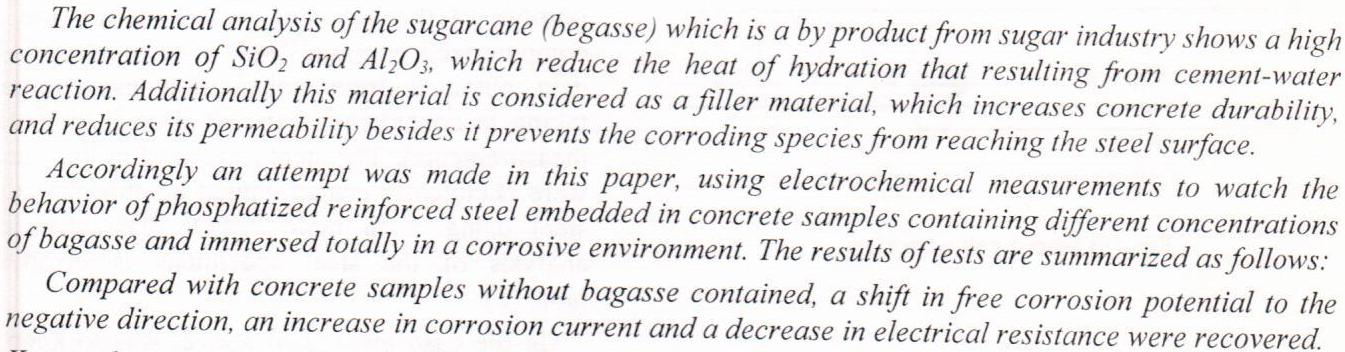
Electrochemical Behavior of Phosphotized Reinforcing Steel in Concrete in Presence of Sugar Can Ash

 (29)
(29)
 (21)
(21)



Global warming and environmental damage have become major problems. The production of Portland cement releases large quantities of gas, which cause pollution to the atmosphere. This problem can be solved via the use of sustainable materials, such as glass powder. This study investigates the effect of partial replacement of cement with sustainable glass powder at various percentages (0, 15, 20, and 25%) by weight of cement on some mechanical properties (compressive strength, flexural strength, absorption, and dry density) of Reactive Powder Concrete (RPC) containing a percentage of Polypropylene fibers (PRPC) of 1% by weight. Furthermore, steam curing was performed for 5 hours at 90oC after hardening the sample directly. The RPC was
... Show More
(17)
This research presents an experimental investigation on the influence of metakaolin replacement percentage upon some properties of different concrete types. Three types of concrete were adopted (self- compacted concrete, high performance concrete and reactive powder concrete) all of high sulphate (SO3) percentage from the fine aggregate weight, 0.75%. Three percentages of metakaolin replacement were selected to be studied (5, 7 and 10) %. Three types of concrete properties (compressive, flexural and splitting tensile strength) were adopted to achieve better understanding for the influence of adding metakaolin.. The output results indicated that the percentage of metakaolin had a different level of positive effect on the compressive strength
... Show MoreThis research is devoted to investigate relationship between both Ultrasonic Pulse Velocity and Rebound Number (Hammer Test) with cube compressive strength and also to study the effect of steel reinforcement on these relationships.
A study was carried out on 32 scale model reinforced concrete elements. Non destructive testing campaign (mainly ultrasonic and rebound hammer tests) made on the same elements. About 72 concrete cubes (15 X 15 X15) were taken from the concrete mixes to check the compressive strength.. Data analyzed.Include the possible correlations between non destructive testing (NDT) and compressive strength (DT) Statistical approach is used for this purpose. A new relationships obtained from correlations results is give
(9)
Several million tons of solid waste are produced each year as a result of construction and demolition activities around the world, and brick waste is one of the most widely wastes. Recently, there has been growing number in studies that conducted on using of recycling brick waste (RBW) to produce environmentally friendly concrete. The use of brick waste (BW) as potential partial cement or aggregate replacement materials is summarized in this review where the performance is discussed in the form of the mechanical strength and properties that related to durability of concrete. It was found that, because the pozzolanic activity of clay brick powder, it can be utilized as substitute for cement in replacement level up to 10%. Whereas,
... Show More
(11)
This paper demonstrates an experimental and numerical study aimed at comparing the influence of openings of different configurations on the flexural behavior of reinforced concrete gable roof beams. The experimental program consisted of testing six simply supported gable beams subjected to mid-point concentrated load. The variable which has been investigated in this work was opening's configuration (quadrilateral or circular) with the same upper and lower chords depth. The results indicate improvement in the beams’ flexural behavior when circular openings were used compared with that of quadrilateral openings, represented by an increase in ultimate load capacity and a decrease in deflection at the service limit. Also, there was an
... Show More
(18)
Several million tons of solid waste are produced each year as a result of construction and demolition activities around the world, and brick waste is one of the most widely wastes. Recently, there has been growing number in studies that conducted on using of recycling brick waste (RBW) to produce environmentally friendly concrete. The use of brick waste (BW) as potential partial cement or aggregate replacement materials is summarized in this review where the performance is discussed in the form of the mechanical strength and properties that related to durability of concrete. It was found that, because the pozzolanic activity of clay brick powder, it can be utilized as substitute for cement in replacement level up t
... Show More
(11)
The optimal design of any structural elements requires examining all environmental risks, emergency accidents, and standard load cases. Exposure to fire is one of the most common safety threats. Nowadays wide developments are achieved in the field of concrete technology, therefore, experimental and theoretical investigations should be performed on the characteristics of such developed materials under different loading conditions. This study investigates the impact of fire exposure on the mechanical characteristics of self-compacting concrete, specifically compressive and tensile strength, modulus of elasticity, and stress-strain relation. The adopted fire exposure consisted of six steady-state temperatures (300, 400, 500, 600, 700,
... Show More
(3)
(3)
In this research the hard chromium electroplating process, which is one of the common methods of overlay coating was used, by using chromium acid as source of chromium and sulphuric acid as catalyst since the ratio between chromic acid and sulphuric acid is (100 : 1) consequently. Plating process was made by applying current of density (40 Amp / dm2) and the range of solution temperature was (50 – 55oC) with different time periods (1-5 hr). A low carbon steel type (Ck15) was used as substrate for hard chromium electroplating. Solid carburization was carried out for hard chromium plating specimen at temperature (925oC) with time duration (2 hr) to be followed with quenching and tempering
... Show More