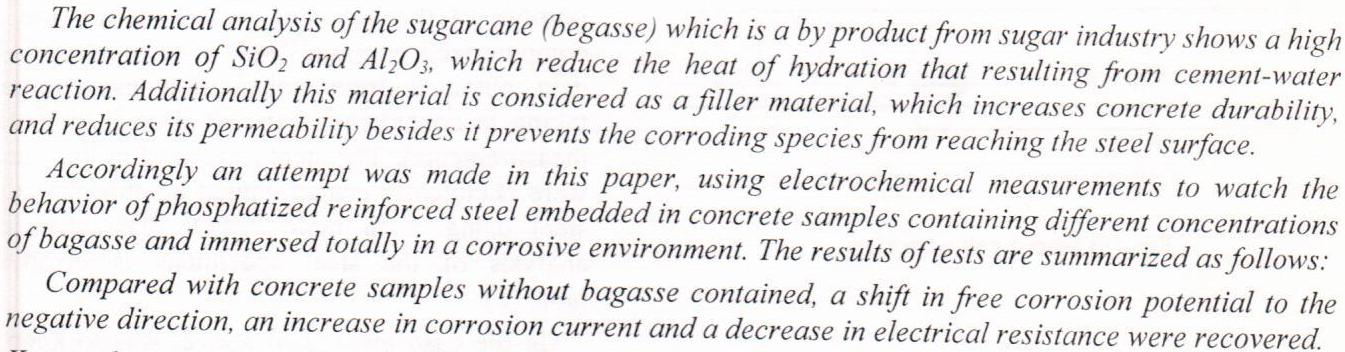
Electrochemical Behavior of Phosphotized Reinforcing Steel in Concrete in Presence of Sugar Can Ash


The corrosion behavior of bare and chemical conversion coated (through anodizing) aluminum ASA 606 I in stagnant chromic acid solutions . Solutions of 2, 6 & J O wt. % Cr03 at 45°C, have been investigated using polarization technique. The anodizing experiments were conducted under fixed conditions of 35 minute exposure time and 30 volt supplied voltage. The most important feature achieved was the great difference in behavior between the anodic polarization curves for bare and anodized aluminum in different concentrations of chromic acid solutions.
The aim of this study is to investigate the behavior of composite castellated beam in which the concrete slab and steel beam connected together with headed studs shear connectors. Four simply supported composite beams with various degree of castellation were tested under two point static loads. One of these beams was built up using standard steel beam, i.e. without web openings, to be a reference beam. The other three beams were fabricated from the same steel I-section with various three castellation ratios, (25, 35, and 45) %. In all beams the concrete slab has the same section and properties. Deflection at mid span of all beams was measured at each 10 kN load increment. The test results show that the castellation process leads to
... Show MoreIn this research a theoretical study has been carried out on the behavior and strength of simply supported composite beams strengthened by steel cover plate taking into consideration partial interaction of shear connectors and nonlinear behavior of the materials and shear connectors. Following the procedure that already has been adopted by Johnson (1975), the basic differential equations of equilibrium and compatibility were reduced to single differential equation in terms of interface slip between concrete slab and steel beam. Furthermore, in order to consider the nonlinear behavior of steel, concrete and shear connectors, the basic equation was rearranged so that all terms related to materials are isol
... Show Moreloaded reinforced concrete circular short columns. An experimental investigation into the behavior
of 24 short reinforced concrete columns with and without steel fibers was carried out. The columns
had a circular section (200 mm diameter and 900 mm long). Test variables include concrete
strength, spacing of spiral reinforcement, and inclusion of steel fibers. The axial stress and axial
strains were obtained and used to evaluate the effects of the presence of steel fibers. It was found
that the addition of steel fibers slightly improves the load carrying capacity of the tested columns
whereas it significantly enhances the ductility of these specimens. Test results also indicated that for
the same confinement parameter
 (1)
(1)

This study evaluated the effect of two different types of amino group-containing pharmacological inhibitors on titanium corrosion under acidic conditions. The first inhibitor examined was the antibiotic trimethoprim. The second inhibitor studied was the nonsteroidal anti-inflammatory drug voltaren. The results showed that titanium had a high corrosion current in the absence of a corrosion inhibitor, however, trimethoprim notably enhanced corrosion resistance and protection percentages of titanium (%IE) at higher concentrations by adhering to the metal surface, as evidenced by improved protection percentages. Furthermore, the results showed that as Voltaren concentration was increased, both corrosion resistance and inhibition efficie
... Show More
(1)

Previously, many empirical models have been used to predict corrosion rates under different CO2 corrosion parameters conditions. Most of these models did not predict the corrosion rate exactly, besides it determined effects of variables by holding some variables constant and changing the values of other variables to obtain the regression model. As a result the experiments will be large and cost too much. In this paper response surface methodology (RSM) was proposed to optimize the experiments and reduce the experimental running. The experiments studied effects of temperature (40 – 60 °C), pH (3-5), acetic acid (HAc) concentration (1000-3000 ppm) and rotation speed (1000-1500 rpm) on CO2 corrosion performance of t
... Show MoreTo achieve sustainability in the field of civil engineering, there has become a great interest in developing reactive powder concrete RPC through the use of environmentally friendly materials to reduce the release of CO2 gas produced from cement factories as well as contribute to the recycling of industrial wastes that have a great impact on environmental pollution.
In this study, reactive powder concrete was prepared using total binder content of 800 kg/m3, water to binder ratio (0.275), and micro steel fibers 1% by volume of concrete. The experimental program included replacing fly ash with (8, 12, 16) % by cement weight to find the optimal ratio, which achieved the best mechanical proper
... Show More
(17)
 (3)
(3)
(3)
(3)

The corrosion behavior of mild sleet in saturated aerated and de-aerated Ca(OH)2 solution was investigated using electrochemical measurements. The work was carried out with small coupons immersed in solutions containing different quantities of NaCl in presence of various NaN02 concentrations as corrosion inhibitors. It has been found thal:(1 ) In presence of NaCl, the time required to reach O2 evolution potential in de-aerated Ca(OH)2 polarized at 10μA/cm 2 is function of inhibitor concentration and it becomes lass as NaN02 increases compared with zero presence indicating the effectiveness of N
... Show More