Electrochemical Behavior of Phosphotized Reinforcing Steel in Concrete in Presence of Sugar Can Ash
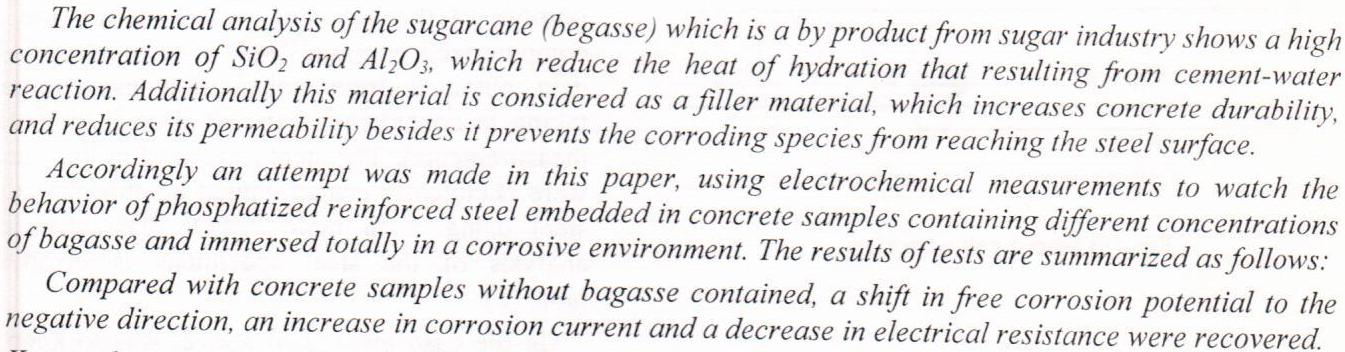

 (3)
(3)
 (3)
(3)


Reinforced concrete (RC) beams containing a longitudinal cavity have become an innovative development and advantage for economic purposes of light-weight members without largely affecting their resistance against the applied loads. This type of openings can also be used for maintenance purposes and usage space of communication lines, pipelines, etc. RC beams are primarily loaded in the plane of the members, which are two-dimensional in a plane stress state and the dominant structural behaviours include bending, shear, or combination of both. In the present study, six numerical models of RC beams with and without openings were simulated by using commercial finite element software ANSYS to evaluate the structural behaviours of those b
... Show More
(19)
(16)

The optimum design is characterized by structural concrete components that can sustain loads well beyond the yielding stage. This is often accomplished by a fulfilled ductility index, which is greatly influenced by the arrangement of the shear reinforcement. The current study investigates the impact of the shear reinforcement arrangement on the structural response of the deep beams using a variety of parameters, including the type of shear reinforcement, the number of lacing bars, and the lacing arrangement pattern. It was found that lacing reinforcement, as opposed to vertical stirrups, enhanced the overall structural response of deep beams, as evidenced by test results showing increases in ultimate loads, yielding, and cracking of
... Show More
(3)
(1)
The introduction of concrete damage plasticity material models has significantly improved the accuracy with which the concrete structural elements can be predicted in terms of their structural response. Research into this method's accuracy in analyzing complex concrete forms has been limited. A damage model combined with a plasticity model, based on continuum damage mechanics, is recommended for effectively predicting and simulating concrete behaviour. The damage parameters, such as compressive and tensile damages, can be defined to simulate concrete behavior in a damaged-plasticity model accurately. This research aims to propose an analytical model for assessing concrete compressive damage based on stiffness deterioration. The prop
... Show More
(35)
(32)
The optimum design is characterized by structural concrete components that can sustain loads well beyond the yielding stage. This is often accomplished by a fulfilled ductility index, which is greatly influenced by the arrangement of the shear reinforcement. The current study investigates the impact of the shear reinforcement arrangement on the structural response of the deep beams using a variety of parameters, including the type of shear reinforcement, the number of lacing bars, and the lacing arrangement pattern. It was found that lacing reinforcement, as opposed to vertical stirrups, enhanced the overall structural response of deep beams, as evidenced by test results showing increases in ultimate loads, yielding, and cracking of
... Show More
(3)
(1)
To accommodate utilities in buildings, different sizes of openings are provided in the web of reinforced concrete deep beams, which cause reductions in the beam strength and stiffness. This paper aims to investigate experimentally and numerically the effectiveness of using carbon fiber reinforced polymer (CFRP) strips, as a strengthening technique, to externally strengthen reinforced concrete continuous deep beams (RCCDBs) with large openings. The experimental work included testing three RCCDBs under five-point bending. A reference specimen was prepared without openings to explore the reductions in strength and stiffness after providing large openings. Openings were created symmetrically at the center of spans of the other specimens
... Show More
(35)
(32)
This paper aims to study the second-order geometric nonlinearity effects of P-Delta on the dynamic response of tall reinforced concrete buildings due to a wide range of earthquake ground motion forces, including minor earthquake up to moderate and strong earthquakes. The frequency domain dynamic analysis procedure was used for response assessment. Reinforced concrete building models with different heights up to 50 stories were analyzed. The finite element software ETABS (version 16.0.3) was used to analyze reinforced concrete building models.
The study reveals that the percentage increase in buildings' sway and drift due to P-Delta effects are nearly constant for specific building height irrespective of the seism
... Show More
(2)
Concrete pavements are essential to modern infrastructure, but their low tensile and flexural strengths can cause cracking and shrinkage. This study evaluates fiber reinforcement with steel and carbon fibers in various combinations to improve rigid pavement performance. Six concrete mixes were tested: a control mix with no fiber, a mix with 1% steel fiber (SF1%), a mix with 1% carbon fiber (CF1%), and three hybrid mixes with 1% fiber content: 0.75% steel /0.25% carbon fiber (SF0.75CF0.25), 0.25% steel /0.75% carbon fiber (SF0.25CF0.75), and 0.5% steel /0.5% carbon fiber ((SF0.5CF0.5). Laboratory experiments including compressive, flexural, and splitting tensile strength tests were conducted at 7, 28, and 90 days, while Finite Element Analys
... Show More
(1)
(1)
The incorporation of recycled concrete aggregate (RCA) into asphalt concrete supports circular economy goals by reducing reliance on virgin materials and minimizing construction waste. However, RCA’s inherent limitations, such as high porosity, microcracking, and poor interfacial bonding, compromise the structural integrity and durability of asphalt mixtures. This study introduces sugarcane molasses (SCM), a naturally derived, carbohydrate-rich byproduct of sugarcane refining, as a novel and eco-friendly surface treatment for RCA aimed at enhancing its compatibility with asphalt binders. SCM was applied at 5-6% by weight of RCA replacing coarse aggregate at varying levels (0-100%) to assess its effect on asphalt mixture performance. A com
... Show More
(15)
(15)