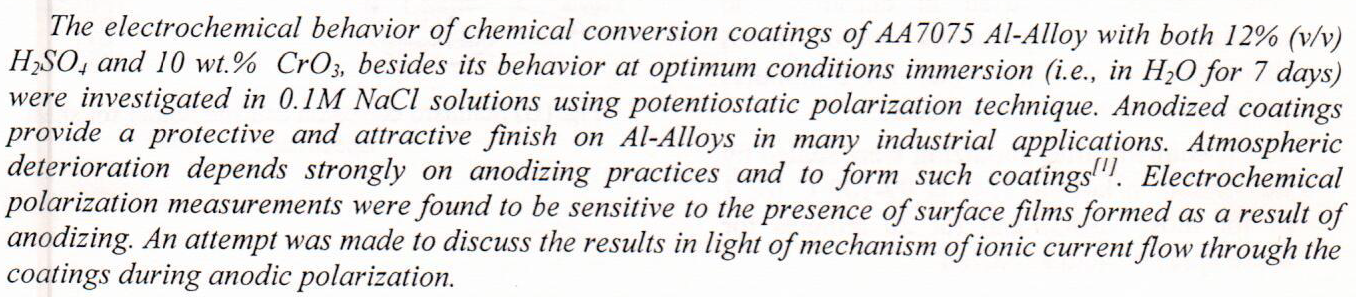
Electrochemical behavior of Anodized AA7075 Aluminum Alloy in 0.1M NaCl Solution as Investigated by Potentiostatic Polarization Ttechnique

 (2)
(2)
 (1)
(1)


Titanium dioxide (TiO2) nanotubes have gained particular interest as a material for gas sensors because of their vertical arrays, prepared by the anodization procedure. The presence of several oxygen vacancies in these nanotubes facilitates gas diffusion and provides additional active sites. This study examined the impact of voltages on the process of depositing iron nanoparticles onto arrays of TiO2 nanotubes (TNTs) for use as a gas sensor. The TNTs are manufactured using a straightforward and economical electrochemical anodization technique, specifically for gas sensor applications. By varying the deposition voltage (2-6 volts), ordered Fe-TNTs were efficiently manufactured using a simple two-step electrochemical process. It utili
... Show More
The performance of a batch undivided electrochemical reactor with a rotating cylinder electrode of woven-wire (60 mesh size), stainless steel 316, is examined for the removal of copper from synthetic solution of o.5 M sodium chloride containing 125 ppm at pH ≈ 3.5. The effect of total applied current, rotation speed on the figures of merit of the reactor is analyzed. For an applied current of 300 mA at 100 rpm, the copper concentration decreased from 125 to mg l-1 after 60 min of electrolysis with a specific energy consumption of 1.75 kWh kg-1 and a normalized space velocity of 1.62 h-1. The change in concentration was higher when the total applied currents were increased because of the turbulence
... Show MoreThis paper presents the study and analysis, analytically and numerical of circular cylindrical shell pipe model, under variable loads, transmit fluid at the high velocity state (fresh water). The analytical analysis depended on the energy observation principle (Hamilton Principle), where divided all energy in the model to three parts , strain energy, kinetic energy and transmitted energy between flow and solid (kinetic to potential energy). Also derive all important equations for this state and approach to final equation of motion, free and force vibration also derived. the relations between the displacement of model function of velocity of flow, length of model, pipe thickness, density of flowed with location coordinate x-axis and angle
... Show More
The Beggar (1965) is a story of isolation and depression which is written by the Egyptian novelist Naguib Mahfouz who is considered the father of Arabic Literature in the modern era. Specifically, he refers in his great novel called The Beggar that the man unable to achieve psychological revival after Nasser’s revolution, the man sacrificed his own job and his family for a desire that increases his feelings of alienation and depression which leads him to an emotional outcry against the indifferent. The main aim of the study highlights the concept of existential dilemma as a philosophical problem and personality crisis by the protagonist of The Beggar novel, Omer Al-Hamzawi who had acc
... Show More
Titanium alloy surface properties have an essential role in the interaction of dental implants with bone, and alteration of the surface of the implant could improve osseointegration. This study was designed to investigate the effect of different heat treatment temperatures on titanium alloy surface properties for dental implants. The effect of different temperatures of heat treatment (750°C, 850°C, 950°C and 1050°C) were investigated on the surface topography, surface chemistry, titanium oxide layer thickness, blood contact angle, & blood drop diameter of titanium alloy. The disks were prepared from titanium alloy (Ti-6Al-4V) and the samples were divided into five groups depending on the different temperatures of heat treatment. The hea
... Show MoreThe microdrilling and nanodrilling holes are produced by a Q-switched Nd :YAG laser (1064 nm) interaction with 8009 Al alloy using nanoparticles. Two kinds of nanoparticles were used with this alloy. These nanoparticles are tungsten carbide (WC) and silica carbide (SiC). In this work, the microholes and nanoholes have been investigated with different laser pulse energies (600, 700 and 800)mJ, different repetition rates (5Hz and 10Hz) and different concentration of nanoparticles (90%, 50% and 5% ). The results indicate that the microholes and nanoholes have been achieved when the laser pulse energy is 600 mJ, laser repetition rate is 5Hz, and the concentration of the nanoparticles (for the two types of n
... Show MoreThe microstructure and wear properties of 392 Al alloy with different Mg contents were studied using centrifugal casting. All melted alloys were heated to 800 ºC and poured into the preheated centrifugal casting mold (200-250 ºC) at different mould rotational speeds (1500, 1900 and 2300 r.p.m). It is clear from the results obtained that wear rate was dependent on the Mg content, applied load and mould rotational speed. Furthermore, wear test showed that the minimum wear rate was found in the inner layer of produced rings at mould rotational speed of 1900 r.p.m and Mg content of 5%.
The adsorption of hexavalent chromium by preparing activated carbon from date seeds with zinc chloride as chemical activator and granular date seeds was studied in a batch system. The characteristics of date seeds and prepared activated carbon (ZAC) were determined and found to have a surface area 500.01 m2/g and 1050.01 m2/g , respectively and iodine number of 485.78 mg/g and 1012.91 mg/g, respectively. The effects of PH value (2-12), initial sorbate concentration(50-450mg/L), adsorbent weight (0.004-0.036g) and contact time (30-150 min) on the adsorption process were studied . For Cr(VI) adsorption on ZAC, at 120 min time contact, pH solution 2 and 0.02 adsorbent weight will ach
... Show MoreTransference numbers of the aqueous zinc chloride and zinc sulphate solutions have been measured for the concentrations 0.03, 0.05, 0.07, 0.09 and 0.1 mol.dm-3at 298.15K, by using the modified Hittorf method. The dependence of transference number on concentration of each electrolyte was also investigated in an attempt to explain the value of the limiting transference number. The Longsworth method has been used for the extrapolation of zinc transference number in aqueous solutions, using the values of the limiting transference numbers of the appropriate values of the limiting equivalent conductance, it was possible to determine the corresponding values of the limiting ion conductance for the cations and anions of the electrolytes. The
... Show More