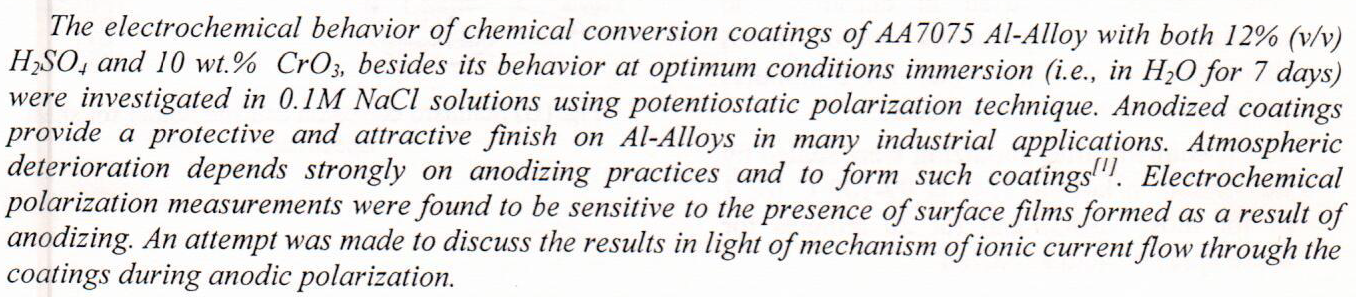
Electrochemical behavior of Anodized AA7075 Aluminum Alloy in 0.1M NaCl Solution as Investigated by Potentiostatic Polarization Ttechnique

This study utilized low-cost agricultural waste (molasses production waste powder) to extract copper ions from aqueous solutions. The present investigation explored a range of factors that influence the adsorption process, including temperature, pH, ionic strength, contact time, quantity of adsorbent, and particle size. Spectrophotometric analysis was used to determine the solution's absorbance both before and after the adsorption procedure. The Langmuir and Freundlich adsorption models were used to match the equilibrium data. The Freundlich model was determined to be the best isotherm model using the linear regression coefficient R2=0.9868. Thermodynamic parameters, including enthalpy, entropy, and Gibbs free energy, were calculate
... Show More

Competitive advantage is a substantial strategic objective for organizations. It requires high levels in the quality of products and services provided to customers, continuous improvement of costing , care for creativity and innovative employees, and speed unique to the marketing and financial engineering, and business re-engineering processes. The situation in this area, requires actors to attract and develop human resources, including help in proper implementation of the strategic tasks that targeted by those institutions. According to the opinions and viewpoints of management scholars, the competitive advantage resource is the most important issue for organizations in the third millennium, which can be a
... Show More
 (16)
(16)
 (2)
(2)
Electro-chemical Machining is significant process to remove metal with using anodic dissolution. Electro-chemical machining use to removed metal workpiece from (7025) aluminum alloy using Potassium chloride (KCl) solution .The tool used was made from copper. In this present the optimize processes input parameter use are( current, gap and electrolyte concentration) and surface roughness (Ra) as output .The experiments on electro-chemical machining with use current (30, 50, 70)A, gap (1.00, 1.25, 1.50) mm and electrolyte concentration (100, 200, 300) (g/L). The method (ANOVA) was used to limited the large influence factors affected on surface roughness and found the current was the large influence f
... Show MoreThis research was to determine the effect of rare earth metal (REM) on the as-cast microstructure of Mg-4Al alloy. The rare earth metal used here is Lanthanum to produce Mg-4Al-1.5La alloy. The microstructure was characterized by optical microscopy. The phases of this alloy were identified by X-ray diffraction. The microstructure of Mg-4Al consists of α-Mg and grain boundaries with precipitated phase particles. With the addition of Lanthanum, three distinct phases were identified in the X-ray diffraction patterns of the as cast Mg-4Al-1.5La: Mg, Al11La3, Al4La. The Mg17Al12 phase was not detected. The addition of Lanthanium increases the hardness and dec
... Show MoreBackground Alloys with the addition of zirconium and niobium eliminate the adverse effects of aluminum and vanadium on the nervous system, the possibility of metallosis and the initiation of diseases (including cancers or Alzheimer›s disease). In addition, they have better corrosion resistance, and a Young›s modulus value similar to longitudinal bone tissue. Therefore, only choosing appropriate materials does not guarantee proper functioning of the implants, the surfaces of the implants also have to be suitable to meet the requirements. The laser surface hardening process modifies the surface properties by imparting microstructural changes, whereas surface remelting induces changes in the surface topography, roughness, wettability and w
... Show More
An experimental investigation has been carried out for zinc-nickel (Zn-Ni) electro-deposition using the constant applied current technique. Weight difference approach method was used to determine the cathode current efficiency and deposit thickness. Also, the influence effect of current density on the deposition process, solderability, and porosity of the plating layer in microelectronic applications were examined. The bath temperature effect on nickel composition and the form of the contract was studied using Scanning Electron Microscope (SEM). Moreover, elemental nature of the deposition was analyzed by Energy Dispersive X-Ray (EDX).
It has been found that the best bath temperature
... Show MoreThe present research had dealt with preparing bars with the length of about (13 cm) and adiametar of (1.5 cm) of composite materials with metal matrix represented by (Al-Cu-Mg) alloy cast enforced by (ZrO2) particles with chosen weight percentages (1.5, 2.5 ,3.5, 5.5 %). The base cast and the composite materials were prepared by casting method by uses vortex Technique inorder to fix up (ZrO2) particles in homogeneous way on the base cast. In addition to that, two main groups of composite materials were prepared depending on the particles size of (ZrO2) , respectively. &n
... Show MoreThis research includes a study of dezincification by corrosion from brass alloys in three types of media, which are acidic solution, basic and slat solution in different percentages. The study show the higher dezincification occurs in basic solution which decrease the fatigue properties where the fatigue properties are inversely proportional with dezincification.