Electrochemical behavior of Anodized AA7075 Aluminum Alloy in 0.1M NaCl Solution as Investigated by Potentiostatic Polarization Ttechnique
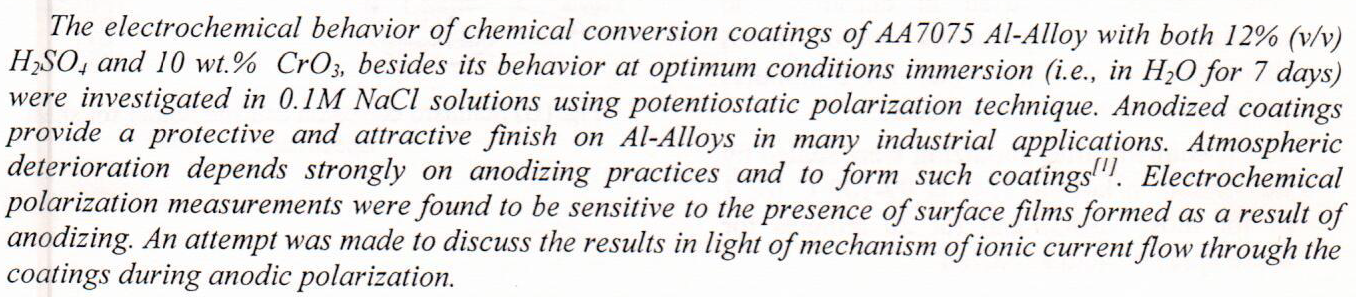

 (13)
(13)
 (15)
(15)



This article presents the simultaneous adsorption of bimetal Cu2+ and Zn2+ from an aqueous solution using activated carbon synthesized from a plum seed precursor by sulfuric acid and microwave activation: plum seeds chemically activated by 45% (w/w) sulfuric acid with 2:1 ratio for 4 h, then carbonized for 2 h at 700 °C and the product obtained activated in a microwave oven for 20 min at 700 W for final of activation. Plum seeds and activated carbon produced were characterized in terms of their physical and chemical composition using Brunauer–Emmett–Teller measurements, field emission scanning electr
... Show More
(2)
(1)
Pharmaceuticals have been widely remaining contaminants in wastewater, and diclofenac is the most common pharmaceutical pollutant. Therefore, the removal of diclofenac from aqueous solutions using activated carbon produced by pyrocarbonic acid and microwaves was investigated in this research. Apricot seed powder and pyrophosphoric acid (45 wt%) were selected as raw material and activator respectively, and microwave irradiation technique was used to prepare the activated carbon. The raw material was impregnated in pyrophosphoric acid at 80◦C with an impregnation ratio of 1: 3 (apricot seeds to phosphoric acid), the impregnation time was 4 h, whereas the power of the microwave was 700 watts with a radiation time of 20 min. A series o
... Show More
(19)
A novel series of liquid crystalline compounds containing 2,4-thiazolidinedione units with varying terminal alkyl chain lengths was successfully synthesized and characterized. The chemical structures of the synthesized compounds were confirmed by FT-IR, ¹H-NMR, and mass spectrometry. The mesomorphic behavior was investigated using polarized optical microscopy (POM) and differential scanning calorimetry (DSC). Compounds [V]₄, [V]₅, and [V]₆ exhibited enantiotropic nematic phases, while compound [V]₈ displayed a smectic A (SmA) phase. No liquid crystalline behavior was observed for compound [V]₃. The liquid crystalline properties were found to depend on the terminal-to-lateral chain length ratio, molecular geometry, and the nature
... Show More
(4)
(4)
The research aims to explore the difficulties that encounter teaching geography of cities as perceived by female students. A total of (113) third stage female students / Geography Dept / college of education for women were chosen as a sample for the study. To collect the required data, a questionnaire was used as an instrument; it consisted of six parts represent teaching difficulties. It was a three-point Likert scale instrument with 1 signifying ‘main difficulty, 2 ‘sub-difficulty, and 3 ‘no difficult'. The difficulties organized in descend order, to analyze data, SPSS tool was used. The results revealed that the difficulties of content ranged (2.15-1.18), difficulties of education techniques ranged (2.47-2.04), difficulties of t
... Show MoreThis study presents the effect of laser energy on burning loss of magnesium from the holes' drilled in aluminum alloy 5052. High energy free running pulsed Nd:Glass laser of 300 µs pulse duration has been used to perform the experiments. The laser energy was varied from 1.0 to 8.0 Joules, The drilling processes have been carried out under atmospheric pressure and vacuum inside a specially designed chamber. Microhardness of the blind drilled holes has been investigated .The results indicated that the magnesium loss could be manipulated by adjusting the focusing conditions of the laser beam. Almost, the obtained holes were free of cracks with low taper and low sputter deposition. .The holes performed under atmospheric conditions have high
... Show More
(2)
(1)