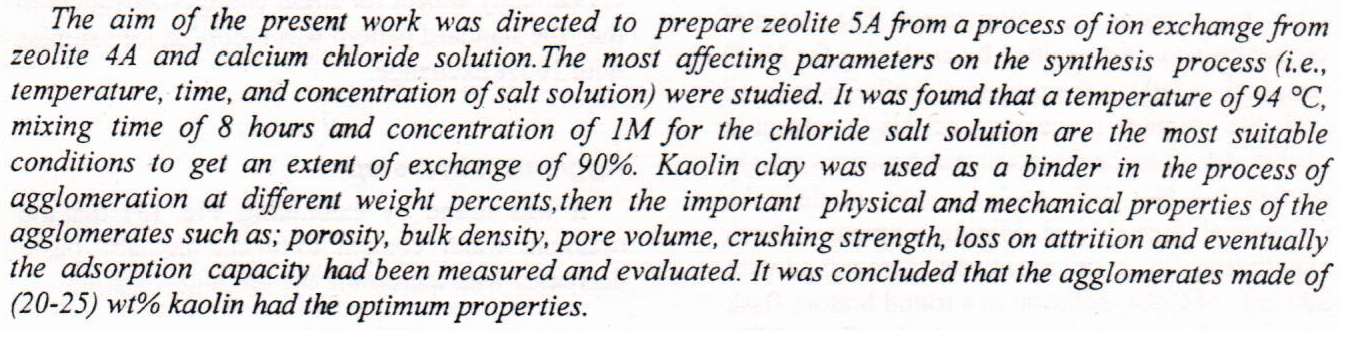
Preparation and Agglomeration of Zeolite 5A from Locally Available Raw Materials

In this work, polyvinylpyrrolidone (PVP), Multi-walled carbon nanotubes (MWCNTs) nanocomposite was prepared and hybrid with Graphene (Gr) by casting method. The morphological and optical properties were investigated. Fourier Transformer-Infrared (FT-IR) indicates the presence of primary distinctive peaks belonging to vibration groups that describe the prepared samples. Scanning Electron Microscopy (SEM) images showed a uniform dispersion of graphene within the PVP-MWCNT nanocomposite. The results of the optical study show decrease in the energy gap with increasing MWCNT and graphene concentration. The absorption coefficient spectra indicate the presence of two absorption peaks at 282 and 287 nm attributed to the π-π* electronic tr
... Show More (7)
(7)
 (5)
(5)


New isatinic hydrazone Schiff-base ligands, namely furan-2-carboxylic acid (2-oxo-1,2-dihydro-indol- 3-ylidene)-hydrazide (L1), thiophene-2-carboxylic acid (2- oxo-1,2-dihydro-indol-3-ylidene)-hydrazide (L2) and 2-(pyridine-2-yl-hydrazono)-1,2-dihydro-indol-3-one) (L3) are reported. The ligands were prepared by the condensation of furan-2-carboxylic acid hydrazide (L1), thiophene- 2-carboxylic acid hydrazide (L2), and 2-hydrazino pyridine (L3) with isatine. Monomeric complexes were prepared from the reaction of the corresponding metal chloride with the ligands. The ligands and their nine new complexes of the general formulae [M(Ln)2]Cl2 [where M = Co(II), Zn(II) and Cd(II); n = L1, L2 and L3] were characterised by spectroscopic methods (FTI
... Show More
(18)
(11)

In this study, the preparation and characterization of hyacinth plant /chitosan composite, as a heavy metal removal, were done. Water hyacinth plant (Eichhorniacrasspes) was collected from Tigris river in Baghdad. The root and shoot parts of plant were ground to powder. Composite materials were prepared at different ratios of plant part (from 2.9% to 30.3%, wt /wt) which corresponds to (30-500mg) of hyacinth plant (root and shoot) and chitosan. The results showed that all examined ratios of plant parts have an excellent absorption to copper (Cu (II)). Moreover, it was observed that 2.9% corresponds (30mg) of plant root revealed highest removal (82.7%) of Pb (II), while 20.23% of shoot removed 61% of Cd (II) within 24 hr
... Show More
(10)
(6)
This research aims to develop transdermal patches of Ondansetron hydrochloride (OSH) with different types of polymers, ethyl cellulose and, polyvinyl pyrrolidone k30 in a ratio (3:0.5,3:1,3:2,2:1,1:1) with propylene glycol 20%w/w as a plasticizer. Prepared transdermal patches were evaluated for physical properties. The compatibility between the drug and excipients was studied by Differential scanning calorimetry (DSC), where there is no interaction between the drug and polymers. From the statistical study, there is a statistical difference between all the prepared formulations p<0.05. In-vitro Release study of transdermal patches was performed by using a paddle over the disc. The release profile of OSH follow
... Show More
(3)
(1)
In this work, lead oxide nanoparticles were prepared by laser ablation of lead target immersed in deionized water by using pulsed Nd:YAG laser with laser energy 400 mJ/pulse and different laser pulses. The chemical bonding of lead oxide nps was investigated by Fourier Transform Infrared (FTIR); surface morphology and optical properties were investigated by Scanning Electron Microscope (SEM) and UV-Visible spectroscopy respectively, and the size effect of lead oxide nanoparticles was studied on its antibacterial action against two types of bacteria Gram-negitive (Escherichia coli) and Gram-positive (Staphylococcusaurus) by diffusion method. The antibacterial property results show that the antibacterial activity of the Lead oxide NPs was
... Show More
(21)
(13)
Abstract: In this research, nanofibers have been prepared by using an electrospinning method. Three types of polymer (PVA, VC, PMMA) have been used with different concentration. The applied voltage and the gap length were changed. It was observed that VC is the best polymer than the other types of polymers.
In this research, nanofibers have been prepared by using an electrospinning method. Three types of polymer (PVA, VC, PMMA) have been used with different concentration. The applied voltage and the gap length were changed. It was observed that VC is the best polymer than the other types of polymers.
(1)
(1)