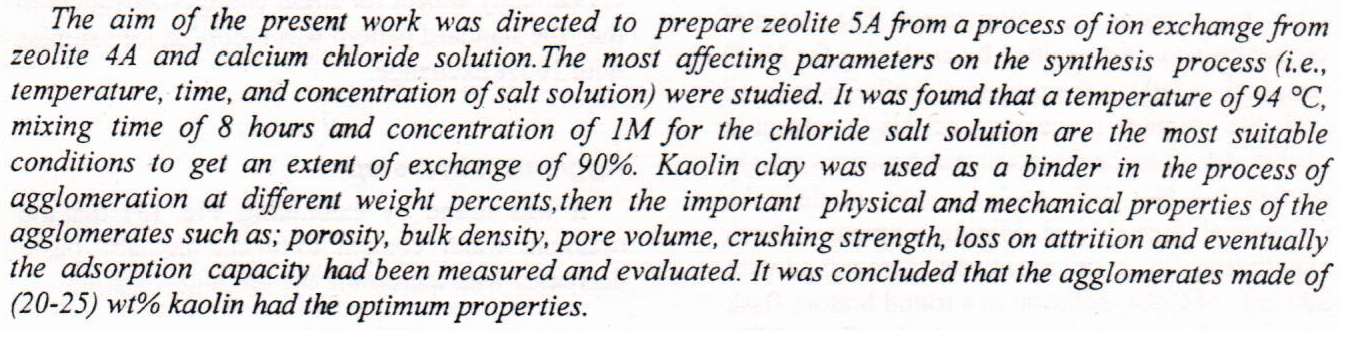
Preparation and Agglomeration of Zeolite 5A from Locally Available Raw Materials

In this investigation, the mechanical properties and microstructure of Metal Matrix Composites (MMCs) of Al.6061 alloy reinforced by ceramic materials SiC and Al2O3 with different additive percentages 2.5, 5, 7.5, and 10 wt.% for the particle size of 53 µm are studied. Metal matrix composites were prepared by stir casting using vortex technique and then treated thermally by solution heat treatment at 530 0C for 1 hr. and followed by aging at 175 0C with different periods. Mechanical tests were done for the samples before and after heat treatment, such as impact test, hardness test, and tensile test. Also, the microstructure of the metal matrix composites was examine
... Show More
 (23)
(23)
 (10)
(10)
 (2)
(1)
(2)
(1)

Water has been acknowledged as one of the key issues of humanity in modern society and worldwide economic advancements, especially with the continuing reductions in fresh-water supply. Solar energy, which is abundant as well as widely available in various fields, has the potential to solve the global challenges of long-term freshwater and energy reduction. Researchers are attempting to address the problem in a variety of methods. Due to the fact that solar energy is the foundation for freshwater, several researches have applied it for improving the effectiveness of solar desalination, evaporation, and wastewater treatment. One of the novel methods used for achieving this is known as “hydrogel,” which comes in a variety of forms. As a un
... Show More
(14)
(9)
Three series of monomers, polymers and thioester cyclic compounds containing 4H-1,2,4-triazol-3-thiol moiety were synthesized and examined for their liquid crystalline properties. All monomers, polymers and thioester compounds were characterized by elemental analysis and FTIR, 1 H-NMR and mass spectroscopy. The phase transition and mesomorphic properties were investigated by polarized optical microscope (POM) and differential scanning calorimetry (DSC). The monomer with terminal phenyl substituent display dimorphism nematic and smectic A (SmA) mesophases. The corresponding polymers derived from acrylic and phenyl acrylic acid monomers show nematic mesophase. The only thioester cyclic compound derived from terephtaloyl chloride show nemati
... Show More
(14)
A new scheme of plasma-mediated thermal coupling has been implemented which yields the temporal distributions of the thermal flux which reaches the metal surface, from which the spatial and temporal temperature profiles can be calculated. The model has shown that the temperature of evaporating surface is determined by the balance between the absorbed power and the rate of energy loss due to evaporation. When the laser power intensity range is 107 to108 W/cm2 the temperature of vapor could increase beyond the critical temperature of plasma ignition, i.e. plasma will be ignited above the metal surface. The plasma density has been analyzed at different values of vapor temperature and pressure using Boltzmann’s code for calculation of elec
... Show More
(3)
The distress of moisture induced damage in flexible pavement received tremendous attention over the past decades. The harmful effects of this distress expand the deterioration of other known distresses such as rutting and fatigue cracking. This paper focused on the efficiency of using the waste material of demolished concrete to prepare asphalt mixtures that can withstand the effect of moisture in the pavement. For this purpose, different percentages of waste demolished concrete (0, 10, 20, 30, 50, 70 and 100) were embedded as a replacement for coarse aggregate to construct the base course. The optimum asphalt contents were determined depending on the Marshall method. Then after, two parameters were founded to evaluate the moisture
... Show More
(14)
(8)
The influence of Cr3+ doping on the ground state properties of SrTiO 3 perovskite was evaluated using GGA-PBE approximation. Computational modeling results infered an agreement with the previously published literature. The modification of electronic structure and optical properties due to Cr3+ introducing into SrTiO 3 were investigated. Structural parameters assumed that Cr3+ doping alters the electronic structures of SrTiO 3 by shifting the conduction band through lower energies for the Sr and Ti sites. Besides, results showed that the band gap was reduced by approximately 50% when presenting one Cr3+ atom into the SrTiO 3 system and particularly positioned at Sr sites. Interestingly, substituting Ti site by Cr3+ led to eliminating the ban
... Show More
(1)