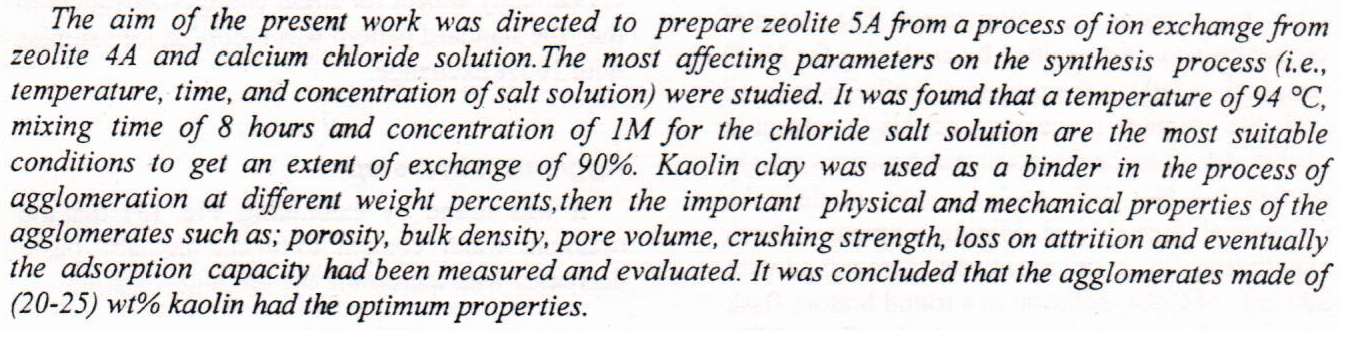
Preparation and Agglomeration of Zeolite 5A from Locally Available Raw Materials

The teacher is the most able to achieve the goals of education in education because he has the ability to affect the behavior of the disciples testified and its actions and appearance and other actions that convey pupils with it sometimes in a manner unconscious or unconscious , and the importance of the role of the teacher in the educational process , it is necessary to compromise the care and attention to the extent that commensurate with the important role that the rise in the preparation of youth and composition , and as a result is needed to continue efforts to improve the quality of teacher preparation so that it can be more effective and positive in the educational process .
First - Research Goals -<
Laser drilling is capable of producing small, precisely positioned holes with high degree of reproductively. In this paper , IR millisecond Nd:YAG single pulsed laser was used to determine the effect of laser parameters on the drilled hole of the glass - fiber reinforced epoxy composite FR-4 sample of 2 mm in thickness . The type of laser source was GSI lumonics JK760TR Series laser 1.064μm system in a CNC cabin. The JK760TR series has a 0.3-50ms pulse length and a maximum repetition rate 500Hz with an average power of 600W. The investigation of single pulse laser drilling in this paper was based on theoretical and experimental solutions. In single pulse technique, the investigation included focal plane position fpp, pulse shap
... Show More Sixteen new complexes with the general formula [M(L)2(H2O)2] were prepared resulting from the reaction of the two new Schiff base ligands, which are: - L1= (E)-5-((2-hydroxybenzylidene)amino)-2-phenyl-2,4-dihydro-3H-pyrazol-3-one) L2 = (E)-5-((2-hydroxy-3-methoxybenzylidene)amino)-2-phenylpyrazolidin-3-one) With divalent metal ions (manganese, cobalt, nickel, copper, zinc, cadmium, mercury) and (tetravalent platinum). Ligands was derived from the reaction of the amine (5-amino-2-phenyl-2,4-dihydro-3H-pyrazol-3-one) with Salicylaldehyde and ortho-vanillin, which is linked to the metal ions via the nitrogen atoms are the isomethene group and the oxygen is the hydroxide group of t
... Show More (54)
(54)
 (46)
(46)



The present research was conducted to reduce the sulfur content of Iraqi heavy naphtha by adsorption using different metals oxides over Y-Zeolite. The Y-Zeolite was synthesized by a sol-gel technique. The average size of zeolite was 92.39 nm, surface area 558 m2/g, and pore volume 0.231 cm3/g. The metals of nickel, zinc, and copper were dispersed by an impregnation method to prepare Ni/HY, Zn/HY, Cu/HY, and Ni + Zn /HY catalysts for desulfurization. The adsorptive desulfurization was carried out in a batch mode at different operating conditions such as mixing time (10,15,30,60, and 600 min) and catalyst dosage (0.2,0.4,0.6,0.8,1, and 1.2 g). The most of the sulfur compounds were removed at 10 min for all catalyst ty
... Show More
(3)
This study synthesized zeolite 4A, and hierarchical composite structure consisting of zeolite 4A- carbon were successfully prepared. Hydrothermal method was used to grow a layer of zeolite 4A over porous carbon surfaces to enhance mass transfer and increase surface area of zeolite. The products then were used to remove radioactive cesium137Cs from liquid wastewater. Iraqi dates leaves midribs (DM) were used as locally available agricultural waste to prepare low- cost porous carbon, using carbonization method in tubular furnace at 900C for two hours. Hierarchical porous structures including zeolite are prepared by mechanically activating the carbon surface via Ultrasonicating nanoparticles suspension of ground zeolite type 4A.F
... Show More
(7)
(6)
Ternary polymer blend of chitosan/poly vinyl alcohol/ poly vinyl pyrrolidone was prepared by solution castingmethod, nanocomposite was prepared by sonication method with nano Ag and Zn. All prepared compounds have been characterizedby FT-IR, SEM, DSC, as well as Biological activity. Antimicrobialactivity related to prepared blendsand Nanocomposites againstsix types of bacteria namely, Staphylococcus aureas, E. faecalis, S.typhi, P. aeruginosa, Bacillus subtilis, Escherichia coli andC. albicans fungal were examined and evaluated. The results reveal that the prepared polymer blends and nanocompositeshavegood antimicrobial activity against all kinds of microbials.
To learn how the manner of preparation influences film development, this study examined film expansion under a variety of deposition settings. To learn about the membrane’s properties and to ascertain the optimal pretreatment conditions, which are represented by ambient temperature and pressure, Laser pressure of 2.5[Formula: see text]m bar, the laser energy density of 500[Formula: see text]mJ, distortion ratio ([Formula: see text]) as a function of laser pulse count, all achieved with the double-frequency Nd: YAG laser operating in quality-factor mode at 1064[Formula: see text]nm. MgxZn[Formula: see text] films of thickness [Formula: see text][Formula: see text]nm were deposited on glass substrates at pulse
... Show More
(2)
(1)
The preparation and characterization of the Cu (II), Co(II), Ni(II), Zn(II), Cd(II), and Hg(II) metal complexes of heterocyclic azo ligand 2-[(4`-sulphamide phenyl) azo] -4,5-diphenyl imidazole (4-SuBAI) have been studied by elemental analysis, FT-IR and UV-Vis Spectroscopic, magnetic moment and molar conductance methods. The analytical data showed that all chelate complexes were prepared with (metal-ligand) ratio of (1:2). The general formula of these complexes was [ML2X2]. nH2O [were L=2-[(4`-sulphamide phenyl) azo]-4,5-diphenyl imidazole and X=Cl, and the octahedral geometry were suggested for these complexes .
Polycrystalline ingots of cadmium telluride have been synthesized using the direct
reaction technique, by fusing initial component consisting from pure elements in
stoichiometric ratio inside quartz ampoule is evacuated 10-6 torr cadmium telluride has
been grown under temperature at (1070) oC for (16) hr. was used in this study, the phases
observed in growing CdTe compound depend on the temperature used during the growth
process. Crystallography studies to CdTe compound was determined by X-ray diffraction
technique, which it has zinc blend structure and cubic unit cell, which lattice constants is
a=6.478
oA