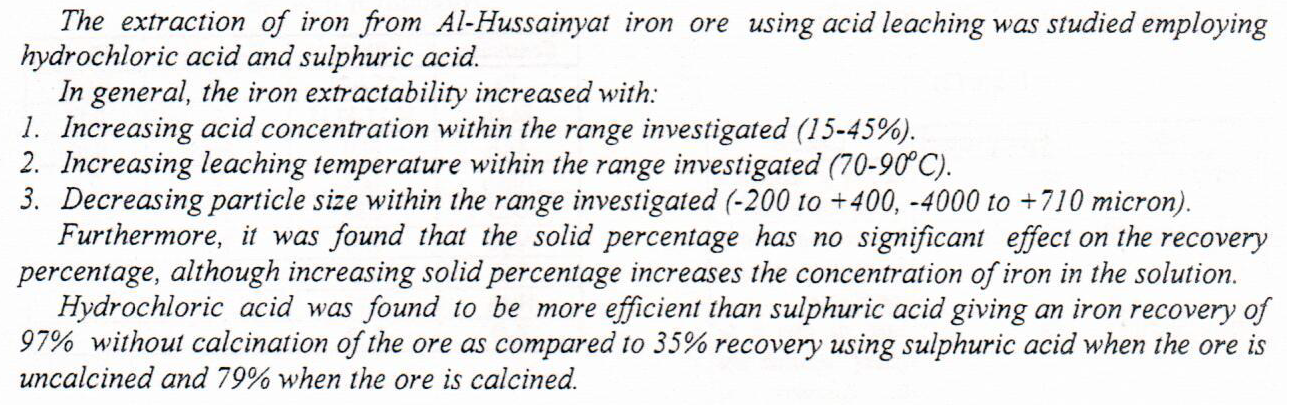
Extraction of Iron from Al-Hussainyat Iron Ore using Acid Leaching

 (5)
(5)

words of God the Quranic text , is genera words have many faces and connotations a ccording to references, cutures and Ages.That the Quranic text is fixed , But the connotations are moveable the scientists agreed about the miracle of the Qurantic text , But they differd of the Position of miracLe including the muatazala and Al- Ashaira who have adopted the idea of sytem and miracle of linguistic . Most of them were lingustics, grammerians and writers as: AL- Jahith, AL- Faraa Abivbeida , Ibn kutaba , AL -Rumani , AL -katabi , AL- Bakilaai , AL- Gargani and Others.
They also differed in what the words of Allaah mean . Is the Quranic text creature or updated ,it is the issue that exhausted the effort.of muslim scientists though its imbo
Schiff base derived from PVA and Erythroascorbic acid derivative (pentulosono-ɣ-lactone-2, 3-enedianisoate) was synthesized and characterized by Thin Layer Chromatography (TLC) and FTIR spectra, aldehyde was also characterized by (U.V-Vis), 1HNMR, 13CNMR and mass spectra. The inhibitory effect of prepared polymer on the activity of human serum Cholinesrerase has been studied in vitro. The polymer showed a remarkable activity at low concentration (4.5*10-3 – 4.5*10-8 M).
The aim of this work is the synthesis of new Schiff base derived from PVA and Erythro-ascorbic acid derivative (pentulosono-ɣ-lactone-2,3-enedianisoate) and its metal complexes of biological significance. All synthesized compounds were characterized by Thin layer chromatography (TLC) and FTIR spectra and aldehyde was also characterized by (U.V-Vis), 1HNMR, 13CNMR and mass spectra. The synthesized Schiff base & its metal complexes were screened for their in vitro antimicrobial activity against five pathogenic bacteria (Escherichia coli, Shigella dysentery,Klebsiellapneumonae,Staphylococcusaureus, Staphylococcus Albus) and two fungal (Aspergillus Niger,Yeast).The biological activity ofall complexes is higher than free Schiff base ligand andf
... Show MoreFeasibility of biosorbent of England bamboo plant origin was tested for removal of priority metal ions such as Cu and Zn from aqueous solutions in single metal state. Batch single metal state experiments were performed to determine the effect of dosage (0.5, 1 and 1.5 g), pH (3, 4, 4.5, 5 and 6), mixing speed (90, 111, 131, 156 and 170 rpm), temperature (20, 25, 30 and 35 °C) and metal ion concentration (10, 50, 70, 90 and 100 mg/L) on the ability of dried biomass to remove metal from solutions which were investigated. Dried powder of bamboo removed (for single metal state) about 74 % Cu and 69% Zn and maximum uptake of Cu and Zn was 7.39 mg/g and 6.96 mg/g respectively, from 100 mg/L of synthetic metal solution in 120 min. of contact t
... Show MoreIn this work, the nano particles of Na-A zeolite were synthesized by sol –gel method. The samples were characterized by X-ray diffraction (XRD), X-ray luorescence (XRF), Surface area and pore volume, Atomic Force Microscope (AFM) and Fourier Transform Infrared Spectroscopy (FTIR). Results show that the nano A zeolite is with average crystal size is 74.77 nm., Si/Al ratio 1.03, BET surface area was 581.211m2/g and the pore volume for NaA was found equal to 0.355cm3/g.
Coated sand (CS) filter media was investigated to remove phenol and 4-nitrophenol from aqueous solutions in batch experiments. Local sand was subjected to surface modification as impregnated with iron. The influence of process variables represented by solution pH value, contact time, initial concentration and adsorbent dosage on removal efficiency of phenol and 4-nitrophenol onto CS was studied. Batch studies were performed to evaluate the adsorption process, and it was found that the Langmuir isotherm effectively fits the experimental data for the adsorbates better than the Freundlich model with the CS highest adsorption capacity of 0.45 mg/g for 4-nitrophenol and 0.25 mg/g for phenol. The CS was found to adsorb 85% of 4-nitrophenol and
... Show MoreExtraction of copper (Cu) from aqueous solution utilizing Liquid Membrane technology (LM) is more effective than precipitation method that forms sludge and must be disposed of in landfills. In this work, we have formulated a liquid surfactant membrane (LSM) that uses kerosene oil as the main diluent of LSM to remove copper ions from the aqueous waste solution through di- (2-ethylhexyl) phosphoric acid - D2EHPA- as a carrier. This technique displays several advantages including one-stage extraction and stripping process, simple operation, low energy requirement, and. In this study, the LSM process was used to transport Cu (II) ions from the feed phase to the stripping phase, which was prepared, using H2SO4. For LSM p
... Show More (11)
(11)

In this work, we calculate and analyze the photon emission from quark and anti-quark interaction during annihilation process using simple model depending on phenomenology of quantum chromodynamic theory (QCD). The parameters, which include the running strength coupling, temperature of the system and the critical temperature, carry information regarding photon emission and have a significant impact on the photons yield. The emission of photon from strange interaction with anti-strange is large sensitive to decreases or increases there running strength coupling. The photons emission increases with decreases running strength coupling and vice versa. We introduce the influence of critical temperature on the photon emission rate in o
... Show More
(5)
The characteristics of sulfur nanoparticles were studied by using atomic force microscope (AFM) analysis. The atomic force microscope (AFM) measurements showed that the average size of sulfur nanoparticles synthesized using thiosulfate sodium solution through the extract of cucurbita pepo extra was 93.62 nm. Protecting galvanized steel from corrosion in salt media was achieved by using sulfur nanoparticles in different temperatures. The obtained data of thermodynamic in the presence of sulfur nanoparticles referred to high value as compares to counterpart in the absence of sulfur nanoparticles, the high inhibition efficiency (%IE) and corrosion resistance were at high temperature, the corrosion rate or weig
... Show More
(17)
(5)
